| [1] |
Lim W S, Avery A, Kon O M, et al. Anti-tuberculosis drug-induced liver injury[J]. BMJ, 2023, 383: e074866. DOI: 10.1136/bmj-2023-074866. |
| [2] |
Lewis J H, Korkmaz S Y, Rizk C A, et al. Diagnosis, prevention and risk-management of drug-induced liver injury due to medications used to treat Mycobacterium tuberculosis[J]. Expert Opin Drug Saf, 2024, 23( 9): 1093- 1107. DOI: 10.1080/14740338.2024.2399074. |
| [3] |
Chinese Medical Association Tuberculosis Branch. Guidelines for diagnosis and management of drug-induced liver injury caused by anti-tuberculosis drugs(2024 version)[J]. Chin J Tuberc Respir Dis, 2024, 47( 11): 1069- 1090. DOI: 10.3760/cma.j.cn112147-20240614-00338. |
| [4] |
Jiang F R, Yan H D, Liang L L, et al. Incidence and risk factors of anti-tuberculosis drug induced liver injury(DILI): Large cohort study involving 4652 Chinese adult tuberculosis patients[J]. Liver Int, 2021, 41( 7): 1565- 1575. DOI: 10.1111/liv.14896. |
| [5] |
Nyangwara V, Waja Z, Thelingwani R, et al. Incidence and associated risk factors of anti-tuberculosis drug induced liver injury among TB patients[J]. BMC Infect Dis, 2025, 25( 1): 1400. DOI: 10.1186/s12879-025-11796-4. |
| [6] |
Zhou Y Q, Wang M, Xu H M, et al. Incidence and risk factors of abnormal liver function and anti-tuberculosis drug-induced liver injury: A multicenter retrospective study involving 482 Chinese pediatric tuberculosis patients[J]. Ann Med, 2025, 57( 1): 2546701. DOI: 10.1080/07853890.2025.2546701. |
| [7] |
Kumar R, Kumar A, Kumar S. Acute liver failure from anti-tuberculosis drug-induced liver injury: An update[J]. World J Hepatol, 2025, 17( 5): 106618. DOI: 10.4254/wjh.v17.i5.106618. |
| [8] |
Tavkar V, Goyal A, Chopra V, et al. The role of NAT2 genetic variants in anti-tuberculosis drug-induced liver injury(AT-DILI): A meta-analysis[J]. Pharmacogenomics, 2025, 26( 17-18): 787- 803. DOI: 10.1080/14622416.2026.2624364. |
| [9] |
Huang X, Jiang J, He L, et al. NAT2 rs1495741 and anti-tuberculosis drug-induced liver injury in children: Genetic association and risk prediction[J]. Front Pharmacol, 2026, 17: 1810732. DOI: 10.3389/fphar.2026.1810732. |
| [10] |
Meitei H N, Pandey A, Haobam R. Polymorphisms in drug metabolism genes as a risk factor for first-line anti-tuberculosis drug-induced liver injury[J]. Mol Biol Rep, 2023, 50( 3): 2893- 2900. DOI: 10.1007/s11033-022-08158-7. |
| [11] |
Mahajan R, Tyagi A K. Pharmacogenomic insights into tuberculosis treatment shows the NAT2 genetic variants linked to hepatotoxicity risk: A systematic review and meta-analysis[J]. BMC Genom Data, 2024, 25( 1): 103. DOI: 10.1186/s12863-024-01286-y. |
| [12] |
Xu Y, Jiang Y F, Li Y. Pyrazinamide enhances lipid peroxidation and antioxidant levels to induce liver injury in rat models through PI 3k/Akt inhibition[J]. Toxicol Res, 2020, 9( 3): 149- 157. DOI: 10.1093/toxres/tfaa015. |
| [13] |
Hussain Z, Zhu J J, Ma X C. Metabolism and hepatotoxicity of pyrazinamide, an antituberculosis drug[J]. Drug Metab Dispos, 2021, 49( 8): 679- 682. DOI: 10.1124/dmd.121.000389. |
| [14] |
Wang Y C, Chen K H, Chen Y L, et al. Pyrazinamide related prolonged drug-induced liver injury: A case report[J]. Medicine, 2022, 101( 39): e30955. DOI: 10.1097/md.0000000000030955. |
| [15] |
Nyang’wa B T, Berry C, Kazounis E, et al. A 24-week, all-oral regimen for rifampin-resistant tuberculosis[J]. N Engl J Med, 2022, 387( 25): 2331- 2343. DOI: 10.1056/NEJMoa2117166. |
| [16] |
Dorman S E, Nahid P, Kurbatova E V, et al. Four-month rifapentine regimens with or without moxifloxacin for tuberculosis[J]. N Engl J Med, 2021, 384( 18): 1705- 1718. DOI: 10.1056/NEJMoa2033400. |
| [17] |
World Health Organization. WHO consolidated guidelines on tuberculosis. Module 4: Treatment-drug-susceptible tuberculosis treatment[R]. Geneva: World Health Organization, 2022.
|
| [18] |
Conradie F, Bagdasaryan T R, Borisov S, et al. Bedaquiline-pretomanid-linezolid regimens for drug-resistant tuberculosis[J]. N Engl J Med, 2022, 387( 9): 810- 823. DOI: 10.1056/NEJMoa2119430. |
| [19] |
Fontana R J, Liou I, Reuben A, et al. AASLD practice guidance on drug, herbal, and dietary supplement-induced liver injury[J]. Hepatology, 2023, 77( 3): 1036- 1065. DOI: 10.1002/hep.32689. |
| [20] |
Chalasani N P, Maddur H, Russo M W, et al. ACG clinical guideline: Diagnosis and management of idiosyncratic drug-induced liver injury[J]. Am J Gastroenterol, 2021, 116( 5): 878- 898. DOI: 10.14309/ajg.0000000000001259. |
| [21] |
Drug-induced Liver Disease Study Group, Chinese Society of Hepatology, Chinese Medical Association. Guidelines for the management of drug-induced liver injury[J]. J Clin Hepatol, 2015, 31( 11): 1752- 1769. DOI: 10.3969/j.issn.1001-5256.2015.11.002. |
| [22] |
Mao Y M, Ma S W, Liu C H, et al. Chinese guideline for the diagnosis and treatment of drug-induced liver injury: An update[J]. Hepatol Int, 2024, 18( 2): 384- 419. DOI: 10.1007/s12072-023-10633-7. |
| [23] |
Wang M G, Zhang M M, Liu Q X, et al. Plasma proteomics biomarkers for predicting anti-tuberculosis drug-induced liver injury: A comprehensive assessment[J]. Br J Clin Pharmacol, 2026, 92( 6): 1716- 1729. DOI: 10.1002/bcp.70446. |
| [24] |
Donovan J, Hung T T, Hiep N T T, et al. A randomised comparison of management strategies for drug-induced liver injury associated with tuberculous meningitis treatment[J]. J Infect, 2026, 93( 2): 106796. DOI: 10.1016/j.jinf.2026.106796. |


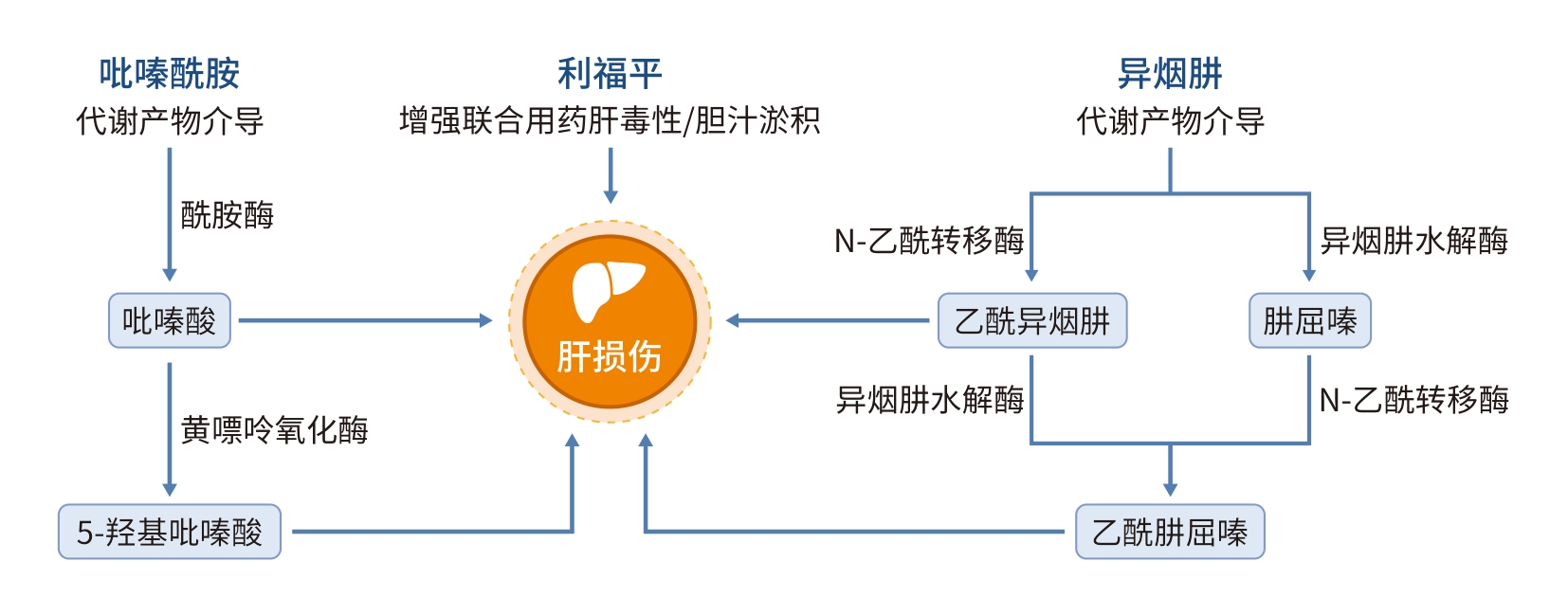







 DownLoad: