| [1] |
|
| [2] |
Goh X E, Goh M X, Chen V L, et al. Prevalence and clinical outcomes of recompensation in decompensated cirrhosis: A systematic review and meta-analysis[J]. Clin Gastroenterol Hepatol, 2026, 24( 4): 911- 922. DOI: 10.1016/j.cgh.2025.08.010. |
| [3] |
Wang S P, Guo G Y, Wang H, et al. Improved discrimination and predictive ability of novel prognostic scores for long-term mortality in hospitalized patients with cirrhosis[J]. J Clin Transl Hepatol, 2025, 13( 6): 484- 492. DOI: 10.14218/JCTH.2025.00004. |
| [4] |
Moreau R, Tonon M, Krag A, et al. EASL clinical practice guidelines on acute-on-chronic liver failure[J]. J Hepatol, 2023, 79( 2): 461- 491. DOI: 10.1016/j.jhep.2023.04.021. |
| [5] |
D’Amico G, Bernardi M, Angeli P. Towards a new definition of decompensated cirrhosis[J]. J Hepatol, 2022, 76( 1): 202- 207. DOI: 10.1016/j.jhep.2021.06.018. |
| [6] |
Zanetto A, Pelizzaro F, Campello E, et al. Severity of systemic inflammation is the main predictor of ACLF and bleeding in individuals with acutely decompensated cirrhosis[J]. J Hepatol, 2023, 78( 2): 301- 311. DOI: 10.1016/j.jhep.2022.09.005. |
| [7] |
Wong F, Reddy K R, Tandon P, et al. The prediction of in-hospital mortality in decompensated cirrhosis with acute-on-chronic liver failure[J]. Liver Transpl, 2022, 28( 4): 560- 570. DOI: 10.1002/lt.26311. |
| [8] |
Trebicka J, Fernandez J, Papp M, et al. The PREDICT study uncovers three clinical courses of acutely decompensated cirrhosis that have distinct pathophysiology[J]. J Hepatol, 2020, 73( 4): 842- 854. DOI: 10.1016/j.jhep.2020.06.013. |
| [9] |
Valainathan S R, Xie Q, Arroyo V, et al. Prognosis algorithms for acute decompensation of cirrhosis and ACLF[J]. Liver Int, 2025, 45( 3): e15927. DOI: 10.1111/liv.15927. |
| [10] |
Kim J W, Kim J H, Choe W H, et al. MELD-GRAIL-Na is a better predictor of mortality than MELD in Korean patients with cirrhosis[J]. Medicina(Kaunas), 2023, 59( 3): 592. DOI: 10.3390/medicina59030592. |
| [11] |
Piano S, Mahmud N, Caraceni P, et al. Mechanisms and treatment approaches for ACLF[J]. Liver Int, 2025, 45( 3): e15733. DOI: 10.1111/liv.15733. |
| [12] |
Li J, Liang X, Jiang J, et al. PBMC transcriptomics identifies immune-metabolism disorder during the development of HBV-ACLF[J]. Gut, 2022, 71( 1): 163- 175. DOI: 10.1136/gutjnl-2020-323395. |
| [13] |
Arroyo V, Angeli P, Moreau R, et al. The systemic inflammation hypothesis: Towards a new paradigm of acute decompensation and multiorgan failure in cirrhosis[J]. J Hepatol, 2021, 74( 3): 670- 685. DOI: 10.1016/j.jhep.2020.11.048. |
| [14] |
Costa D, Simbrunner B, Jachs M, et al. Systemic inflammation increases across distinct stages of advanced chronic liver disease and correlates with decompensation and mortality[J]. J Hepatol, 2021, 74( 4): 819- 828. DOI: 10.1016/j.jhep.2020.10.004. |
| [15] |
Jachs M, Hartl L, Schaufler D, et al. Amelioration of systemic inflammation in advanced chronic liver disease upon beta-blocker therapy translates into improved clinical outcomes[J]. Gut, 2021, 70( 9): 1758- 1767. DOI: 10.1136/gutjnl-2020-322712. |
| [16] |
Solé C, Solà E, Morales-Ruiz M, et al. Characterization of inflammatory response in acute-on-chronic liver failure and relationship with prognosis[J]. Sci Rep, 2016, 6: 32341. DOI: 10.1038/srep32341. |
| [17] |
Pompili E, Baldassarre M, Bedogni G, et al. Predictors of clinical trajectories of patients with acutely decompensated cirrhosis. An external validation of the PREDICT study[J]. Liver Int, 2024, 44( 1): 72- 82. DOI: 10.1111/liv.15734. |
| [18] |
Rizo-Téllez S A, Sekheri M, Filep J G. C-reactive protein: A target for therapy to reduce inflammation[J]. Front Immunol, 2023, 14: 1237729. DOI: 10.3389/fimmu.2023.1237729. |
| [19] |
Zhou H H, Tang Y L, Xu T H, et al. C-reactive protein: Structure, function, regulation, and role in clinical diseases[J]. Front Immunol, 2024, 15: 1425168. DOI: 10.3389/fimmu.2024.1425168. |
| [20] |
Balcar L, Semmler G, Pomej K, et al. Patterns of acute decompensation in hospitalized patients with cirrhosis and course of acute-on-chronic liver failure[J]. United European Gastroenterol J, 2021, 9( 4): 427- 437. DOI: 10.1002/ueg2.12089. |
| [21] |
Engelmann C, Clària J, Szabo G, et al. Pathophysiology of decompensated cirrhosis: Portal hypertension, circulatory dysfunction, inflammation, metabolism and mitochondrial dysfunction[J]. J Hepatol, 2021, 75( Suppl 1): S49- S66. DOI: 10.1016/j.jhep.2021.01.002. |
| [22] |
Taru V, Szabo G, Mehal W, et al. Inflammasomes in chronic liver disease: Hepatic injury, fibrosis progression and systemic inflammation[J]. J Hepatol, 2024, 81( 5): 895- 910. DOI: 10.1016/j.jhep.2024.06.016. |
| [23] |
Albillos A, Martin-Mateos R, Van der Merwe S, et al. Cirrhosis-associated immune dysfunction[J]. Nat Rev Gastroenterol Hepatol, 2022, 19( 2): 112- 134. DOI: 10.1038/s41575-021-00520-7. |
| [24] |
Moreau R, Jalan R, Gines P, et al. Acute-on-chronic liver failure is a distinct syndrome that develops in patients with acute decompensation of cirrhosis[J]. Gastroenterology, 2013, 144( 7): 1426- 1437.e9. DOI: 10.1053/j.gastro.2013.02.042. |
| [25] |
Barosa R, Roque Ramos L, Patita M, et al. CLIF-C ACLF score is a better mortality predictor than MELD, MELD-Na and CTP in patients with Acute on Chronic Liver Failure admitted to the ward[J]. Rev Esp Enferm Dig, 2017, 109: 399- 405. DOI: 10.17235/reed.2017.4701/2016. |
| [26] |
Hernaez R, Liu Y, Kramer J R, et al. Model for end-stage liver disease-sodium underestimates 90-day mortality risk in patients with acute-on-chronic liver failure[J]. J Hepatol, 2020, 73( 6): 1425- 1433. DOI: 10.1016/j.jhep.2020.06.005. |
| [27] |
Viveiros A, Finkenstedt A, Schaefer B, et al. Transferrin as a predictor of survival in cirrhosis[J]. Liver Transplant, 2018, 24( 3): 343- 351. DOI: 10.1002/lt.24981. |
| [28] |
Turco L, Garcia-Tsao G, Magnani I, et al. Cardiopulmonary hemodynamics and C-reactive protein as prognostic indicators in compensated and decompensated cirrhosis[J]. J Hepatol, 2018, 68( 5): 949- 958. DOI: 10.1016/j.jhep.2017.12.027. |
| [29] |
di Martino V, Coutris C, Cervoni J P, et al. Prognostic value of C-reactive protein levels in patients with cirrhosis[J]. Liver Transpl, 2015, 21( 6): 753- 760. DOI: 10.1002/lt.24088. |


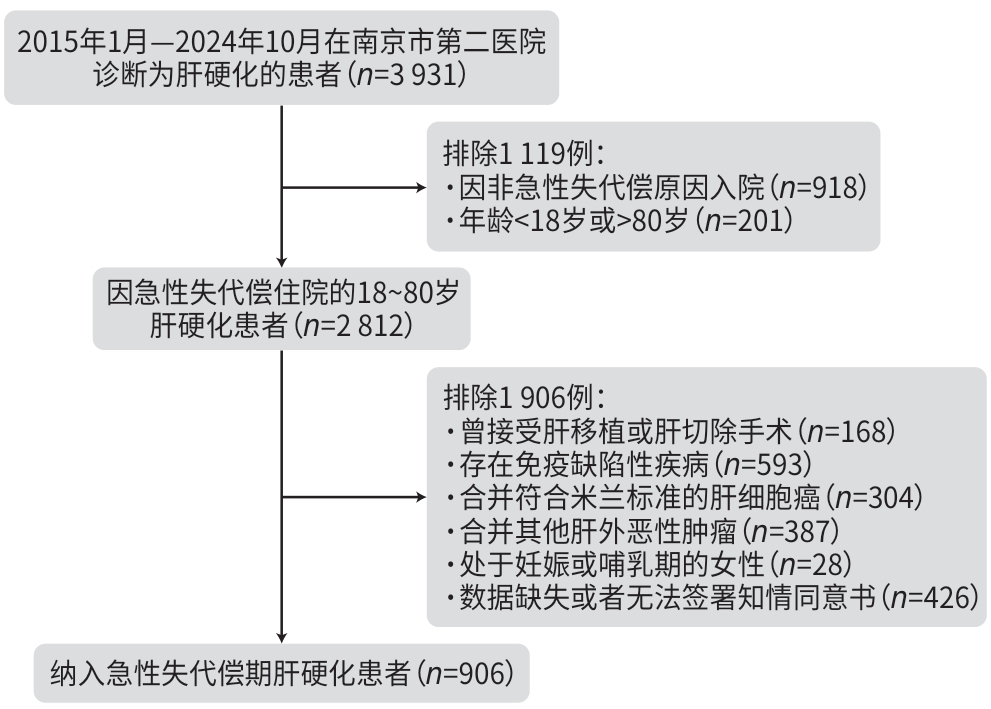







 DownLoad: