| [1] |
HARTL J, MIQUEL R, ZACHOU K, et al. Features and outcome of AIH patients without elevation of IgG[J]. JHEP Rep, 2020, 2( 3): 100094. DOI: 10.1016/j.jhepr.2020.100094. |
| [2] |
STOELINGA AEC, BIEWENGA M, DRENTH JPH, et al. Diagnostic criteria and long-term outcomes in AIH-PBC variant syndrome under combination therapy[J]. JHEP Rep, 2024, 6( 7): 101088. DOI: 10.1016/j.jhepr.2024.101088. |
| [3] |
LAPIERRE P, ALVAREZ F. Type 2 autoimmune hepatitis: Genetic susceptibility[J]. Front Immunol, 2022, 13: 1025343. DOI: 10.3389/fimmu.2022.1025343. |
| [4] |
WANG L, CAO ZM, ZHANG LL, et al. The role of gut microbiota in some liver diseases: From an immunological perspective[J]. Front Immunol, 2022, 13: 923599. DOI: 10.3389/fimmu.2022.923599. |
| [5] |
CHEN HR, HAN ZY, FAN YY, et al. CD4 + T-cell subsets in autoimmune hepatitis: A review[J]. Hepatol Commun, 2023, 7( 10): e0269. DOI: 10.1097/HC9.0000000000000269. |
| [6] |
SHEN MY, ZHOU LY, FAN XL, et al. Metabolic reprogramming of CD4 + T cells by mesenchymal stem cell-derived extracellular vesicles attenuates autoimmune hepatitis through mitochondrial protein transfer[J]. Int J Nanomedicine, 2024, 19: 9799- 9819. DOI: 10.2147/IJN.S472086. |
| [7] |
VUERICH M, WANG N, KALBASI A, et al. Dysfunctional immune regulation in autoimmune hepatitis: From pathogenesis to novel therapies[J]. Front Immunol, 2021, 12: 746436. DOI: 10.3389/fimmu.2021.746436. |
| [8] |
MUSCATE F, WOESTEMEIER A, GAGLIANI N. Functional heterogeneity of CD4 + T cells in liver inflammation[J]. Semin Immunopathol, 2021, 43( 4): 549- 561. DOI: 10.1007/s00281-021-00881-w. |
| [9] |
SIRBE C, SIMU G, SZABO I, et al. Pathogenesis of autoimmune hepatitis-cellular and molecular mechanisms[J]. Int J Mol Sci, 2021, 22( 24): 13578. DOI: 10.3390/ijms222413578. |
| [10] |
ZHANG KH, LI JC, SHI Z, et al. Ginsenosides regulates innate immunity to affect immune microenvironment of AIH through hippo-YAP/TAZ signaling pathway[J]. Front Immunol, 2022, 13: 851560. DOI: 10.3389/fimmu.2022.851560. |
| [11] |
|
| [12] |
ÄIJÖ T, THEOFILATOS D, CHENG M, et al. TET proteins regulate T cell and iNKT cell lineage specification in a TET2 catalytic dependent manner[J]. Front Immunol, 2022, 13: 940995. DOI: 10.3389/fimmu.2022.940995. |
| [13] |
GIOULBASANI M, ÄIJÖ T, LIU SY, et al. Concomitant loss of TET2 and TET3 results in T cell expansion and genomic instability in mice[J]. Commun Biol, 2024, 7( 1): 1606. DOI: 10.1038/s42003-024-07312-0. |
| [14] |
CONG BY, ZHANG Q, CAO XT. The function and regulation of TET2 in innate immunity and inflammation[J]. Protein Cell, 2021, 12( 3): 165- 173. DOI: 10.1007/s13238-020-00796-6. |
| [15] |
ZACHOU K, ARVANITI P, LYBEROPOULOU A, et al. Altered DNA methylation pattern characterizes the peripheral immune cells of patients with autoimmune hepatitis[J]. Liver Int, 2022, 42( 6): 1355- 1368. DOI: 10.1111/liv.15176. |
| [16] |
BAESSLER A, NOVIS CL, SHEN ZL, et al. Tet2 coordinates with Foxo1 and Runx1 to balance T follicular helper cell and T helper 1 cell differentiation[J]. Sci Adv, 2022, 8( 24): eabm4982. DOI: 10.1126/sciadv.abm4982. |
| [17] |
BAESSLER A, FUCHS B, PERKINS B, et al. Tet2 deletion in CD4 + T cells disrupts Th1 lineage commitment in memory cells and enhances T follicular helper cell recall responses to viral rechallenge[J]. Proc Natl Acad Sci USA, 2023, 120( 36): e2218324120. DOI: 10.1073/pnas.2218-324120. |
| [18] |
CHEN J, LIU W, ZHU WJ. FOXP3 + Treg cells are associated with pathological process of autoimmune hepatitis by activating methylation modification in autoimmune hepatitis patients[J]. Med Sci Monit, 2019, 25: 6204- 6212. DOI: 10.12659/MSM.915408. |
| [19] |
PRETI M, SCHLOTT L, LÜBBERING D, et al. Failure of thymic deletion and instability of autoreactive Tregs drive autoimmunity in immune-privileged liver[J]. JCI Insight, 2021, 6( 6): e141462. DOI: 10.1172/jci.insight.141462. |
| [20] |
OHKURA N, SAKAGUCHI S. Transcriptional and epigenetic basis of Treg cell development and function: Its genetic anomalies or variations in autoimmune diseases[J]. Cell Res, 2020, 30( 6): 465- 474. DOI: 10.1038/s41422-020-0324-7. |
| [21] |
BAI L, HAO XL, KEITH J, et al. DNA methylation in regulatory T cell differentiation and function: Challenges and opportunities[J]. Biomolecules, 2022, 12( 9): 1282. DOI: 10.3390/biom12091282. |
| [22] |
YUE XJ, LIO CJ, SAMANIEGO-CASTRUITA D, et al. Loss of TET2 and TET3 in regulatory T cells unleashes effector function[J]. Nat Commun, 2019, 10( 1): 2011. DOI: 10.1038/s41467-019-09541-y. |
| [23] |
PACINI G, PAOLINO S, ANDREOLI L, et al. Epigenetics, pregnancy and autoimmune rheumatic diseases[J]. Autoimmun Rev, 2020, 19( 12): 102685. DOI: 10.1016/j.autrev.2020.102685. |
| [24] |
WANG QX, SELMI C, ZHOU XM, et al. Epigenetic considerations and the clinical reevaluation of the overlap syndrome between primary biliary cirrhosis and autoimmune hepatitis[J]. J Autoimmun, 2013, 41: 140- 145. DOI: 10.1016/j.jaut.2012.10.004. |
| [25] |
MIGITA K, KOMORI A, KOZURU H, et al. Circulating microRNA profiles in patients with type-1 autoimmune hepatitis[J]. PLoS One, 2015, 10( 11): e 0136908.10.1371/journal.pone. 0136908.
|
| [26] |
PANDEY SP, BENDER MJ, MCPHERSON AC, et al. Tet2 deficiency drives liver microbiome dysbiosis triggering Tc1 cell autoimmune hepatitis[J]. Cell Host Microbe, 2022, 30( 7): 1003- 1019. DOI: 10.1016/j.chom.2022.05.006. |
| [27] |
ZHANG GL, WU SS, XIA GT. miR-326 sponges TET2 triggering imbalance of Th17/Treg differentiation to exacerbate pyroptosis of hepatocytes in concanavalin A-induced autoimmune hepatitis[J]. Ann Hepatol, 2024, 29( 2): 101183. DOI: 10.1016/j.aohep.2023.101183. |
| [28] |
TORP AUSTVOLL C, GALLO V, MONTAG D. Health impact of the Anthropocene: The complex relationship between gut microbiota, epigenetics, and human health, using obesity as an example[J]. Glob Health Epidemiol Genom, 2020, 5: e2. DOI: 10.1017/gheg.2020.2. |
| [29] |
SUN HJ, GUO YK, WANG HD, et al. Gut commensal Parabacteroides distasonis alleviates inflammatory arthritis[J]. Gut, 2023, 72( 9): 1664- 1677. DOI: 10.1136/gutjnl-2022-327756. |
| [30] |
LIU JZ, GUO M, YUAN XB, et al. Gut microbiota and their metabolites: The hidden driver of diabetic nephropathy? Unveiling gut microbe’s role in DN[J]. J Diabetes, 2025, 17( 4): e70068. DOI: 10.1111/1753-0407.70068. |
| [31] |
TZENG HT, LEE WC. Impact of transgenerational nutrition on nonalcoholic fatty liver disease development: Interplay between gut microbiota, epigenetics and immunity[J]. Nutrients, 2024, 16( 9): 1388. DOI: 10.3390/nu16091388. |
| [32] |
SZABO G, BALA S, PETRASEK J, et al. Gut-liver axis and sensing microbes[J]. Dig Dis, 2010, 28( 6): 737- 744. DOI: 10.1159/000324281. |
| [33] |
WANG H, WANG GD, BANERJEE N, et al. Aberrant gut microbiome contributes to intestinal oxidative stress, barrier dysfunction, inflammation and systemic autoimmune responses in MRL/lpr mice[J]. Front Immunol, 2021, 12: 651191. DOI: 10.3389/fimmu.2021.651191. |
| [34] |
CHEN Y, GAN YM, ZHONG HJ, et al. Gut microbe and hepatic macrophage polarization in non-alcoholic fatty liver disease[J]. Front Microbiol, 2023, 14: 1285473. DOI: 10.3389/fmicb.2023.1285473. |
| [35] |
ZHANG HX, LIU M, LIU X, et al. Bifidobacterium animalis ssp. lactis 420 mitigates autoimmune hepatitis through regulating intestinal barrier and liver immune cells[J]. Front Immunol, 2020, 11: 569104. DOI: 10.3389/fimmu.2020.569104. |
| [36] |
KANG YB, KUANG XY, YAN H, et al. A novel synbiotic alleviates autoimmune hepatitis by modulating the gut microbiota-liver axis and inhibiting the hepatic TLR4/NF-κB/NLRP3 signaling pathway[J]. mSystems, 2023, 8( 2): e01127-22. DOI: 10.1128/msystems.01127-22. |
| [37] |
|
| [38] |
LV JL, HAO PD, ZHOU Y, et al. Role of the intestinal flora-immunity axis in the pathogenesis of rheumatoid arthritis-mechanisms regulating short-chain fatty acids and Th17/Treg homeostasis[J]. Mol Biol Rep, 2025, 52( 1): 617. DOI: 10.1007/s11033-025-10714-w. |
| [39] |
LYON P, STRIPPOLI V, FANG B, et al. B vitamins and one-carbon metabolism: Implications in human health and disease[J]. Nutrients, 2020, 12( 9): 2867. DOI: 10.3390/nu12092867. |
| [40] |
ANSARI I, RADDATZ G, GUTEKUNST J, et al. The microbiota programs DNA methylation to control intestinal homeostasis and inflammation[J]. Nat Microbiol, 2020, 5( 4): 610- 619. DOI: 10.1038/s41564-019-0659-3. |
| [41] |
FERENC K, SOKAL-DEMBOWSKA A, HELMA K, et al. Modulation of the gut microbiota by nutrition and its relationship to epigenetics[J]. Int J Mol Sci, 2024, 25( 2): 1228. DOI: 10.3390/ijms25021228. |
| [42] |
AMES SR, LOTOSKI LC, AZAD MB. Comparing early life nutritional sources and human milk feeding practices: Personalized and dynamic nutrition supports infant gut microbiome development and immune system maturation[J]. Gut Microbes, 2023, 15( 1): 2190305. DOI: 10.1080/19490976.2023.2190305. |
| [43] |
ALIPOUR B, HOMAYOUNI-RAD A, VAGHEF-MEHRABANY E, et al. Effects of Lactobacillus casei supplementation on disease activity and inflammatory cytokines in rheumatoid arthritis patients: A randomized double-blind clinical trial[J]. Int J Rheum Dis, 2014, 17( 5): 519- 527. DOI: 10.1111/1756-185X.12333. |
| [44] |
MA ZY, AKHTAR M, PAN H, et al. Fecal microbiota transplantation improves chicken growth performance by balancing jejunal Th17/Treg cells[J]. Microbiome, 2023, 11( 1): 137. DOI: 10.1186/s40168-023-01569-z. |
| [45] |
CHEN L, RUAN GC, CHENG Y, et al. The role of Th17 cells in inflammatory bowel disease and the research progress[J]. Front Immunol, 2022, 13: 1055914. DOI: 10.3389/fimmu.2022.1055914. |
| [46] |
WU Q, GE Z, LV C, et al. Interacting roles of gut microbiota and T cells in the development of autoimmune hepatitis[J]. Front Immunol, 2025, 16: 1584001. DOI: 10.3389/fimmu.2025.1584001. |
| [47] |
MA HL, GAO WS, SUN XX, et al. STAT5 and TET2 cooperate to regulate FOXP3-TSDR demethylation in CD4 + T cells of patients with colorectal cancer[J]. J Immunol Res, 2018, 2018: 6985031. DOI: 10.1155/2018/6985031. |
| [48] |
GHORESCHI K, LAURENCE A, YANG XP, et al. T helper 17 cell heterogeneity and pathogenicity in autoimmune disease[J]. Trends Immunol, 2011, 32( 9): 395- 401. DOI: 10.1016/j.it.2011.06.007. |
| [49] |
HU X, ZOU YL, COPLAND DA, et al. Epigenetic drug screen identified IOX1 as an inhibitor of Th17-mediated inflammation through targeting TET2[J]. EBioMedicine, 2022, 86: 104333. DOI: 10.1016/j.ebiom.2022.104333. |


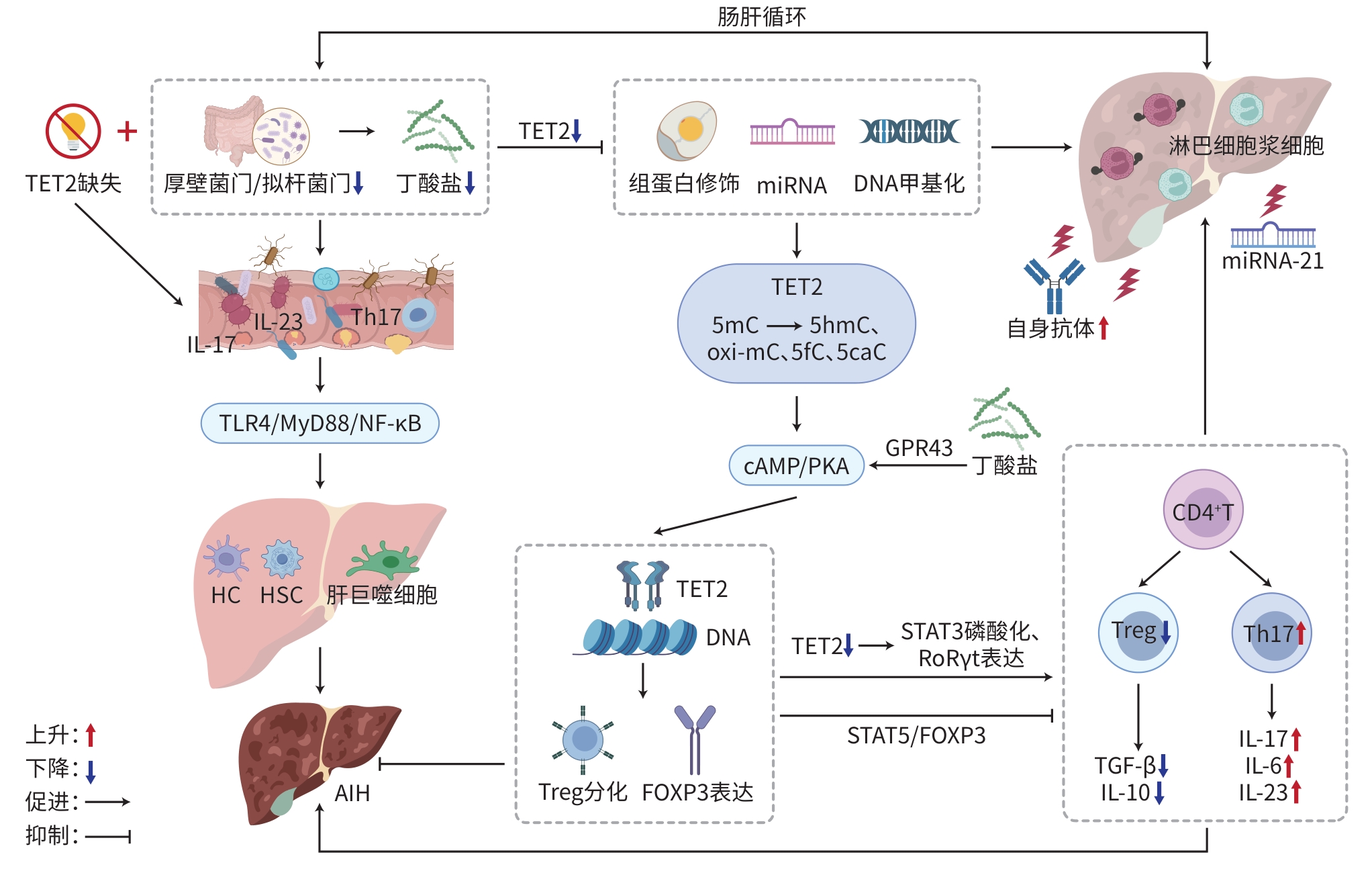







 DownLoad: