中文English
ISSN 1001-5256 (Print)
ISSN 2097-3497 (Online)
CN 22-1108/R
Volume 41 Issue 6
Jun.  2025
Turn off MathJax
Article Contents

Characteristics and lifestyles of patients with metabolic dysfunction-associated fatty liver disease based on the physical examination population

DOI: 10.12449/JCH250614
Research funding:

Beijing Municipal Administration of Hospitals Incubating Program (PX2023061);

Scientific Research Project of Beijing Youan Hospital (YNKTXF2021003)

More Information
  • Corresponding author: ZHANG Jing, zjyouan@ccmu.edu.cn (ORCID: 0000-0002-3082-8330)
  • Received Date: 2024-10-17
  • Accepted Date: 2024-12-02
  • Published Date: 2025-06-25
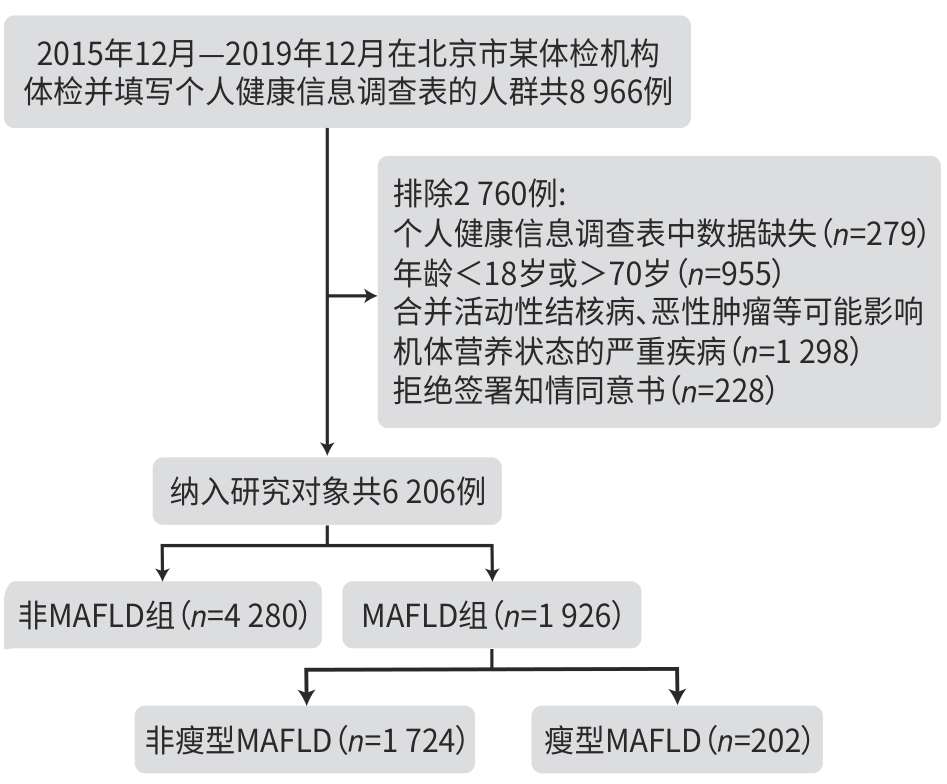
  •   Objective  To screen for the patients with metabolic dysfunction-associated fatty liver disease (MAFLD) among the physical examination population, to observe the characteristics of MAFLD patients, and to compare the differences in lifestyle between the MAFLD population and the non-MAFLD population.  Methods  A cross-sectional study was conducted among 6 206 individuals who underwent physical examination in a physical examination institution in Beijing from December 2015 to December 2019, and according to the new diagnostic criteria for MAFLD, the examination population was divided into MAFLD group and non-MAFLD group. Based on body mass index (BMI), the MAFLD group was further divided into lean MAFLD group (BMI<24 kg/m2) and non-lean MAFLD group (BMI ≥24 kg/m2). Related data were compared between groups, including demographic indicators, education level, work pressure, physical measurement indicators, and lifestyles such as sleep, diet, and exercise. The independent-samples t test was used for comparison of normally distributed continuous data between two groups, the Mann-Whitney U test was used for comparison of non-normally distributed continuous data between two groups, and the chi-square test was used for comparison of categorical data between groups.  Results  Of all individuals in this study, 1 926 (31.1%) had MAFLD and 4 280 (68.9%) did not have MAFLD. Compared with the non-MAFLD group, the MAFLD group had significantly higher age (Z=-14.459, P<0.001), proportion of male patients (χ2=72.004, P<0.001), work pressure (χ2=7.744, P=0.005), body weight (Z=-43.508, P<0.001), BMI (Z=-47.621, P<0.001), waist circumference (Z=-48.515, P<0.001), hip circumference (Z=-42.121, P<0.001), and waist-hip ratio (Z=-43.535, P<0.001), as well as a significantly lower education level (χ2=33.583, P<0.001). In terms of behavior, the MAFLD group had a significantly shorter sleep time (χ2=5.820, P=0.016) and a significantly faster eating speed (χ2=74.476, P<0.001). In terms of diet, the patients in the MAFLD group consumed more high-sodium, high-sugar, and high-calorie diets (χ2=42.667, P<0.001) and low-fiber diet (χ2=4.367, P=0.008). In terms of exercise, the MAFLD group had a significantly higher proportion of patients without exercise habits (χ2=10.278, P=0.001). Further analysis showed that there were 202 individuals (10.5%) in the lean MAFLD group and 1 724 (89.5%) in the non-lean MAFLD group. Compared with the non-lean MAFLD group, the lean MAFLD group had significantly higher age (Z=3.368, P=0.001) and education level (χ2=9.647, P=0.002) and significantly lower proportion of male patients (χ2=27.664, P<0.001), body weight (Z=-18.483, P<0.001), BMI (Z=-23.286, P<0.001), waist circumference (Z=-18.565, P<0.001), and hip circumference (Z=-18.097, P<0.001), and in terms of behavior, the non-lean MAFLD group had a significantly faster eating speed (χ2=4.549, P=0.033).  Conclusion  There is a relatively high prevalence rate of MAFLD among the physical examination population in Beijing, with a higher number of people with unhealthy lifestyles compared with the non-MAFLD population.


  • loading
  • [1]
    ESLAM M, SANYAL AJ, GEORGE J, et al. MAFLD: A consensus-driven proposed nomenclature for metabolic associated fatty liver disease[J]. Gastroenterology, 2020, 158( 7): 1999- 2014. e 1. DOI: 10.1053/j.gastro.2019.11.312.
    [2]
    Chinese Society of Hepatology, Chinese Medical Association. Guidelines for the prevention and treatment of metabolic dysfunction-associated(non-alcoholic) fatty liver disease(Version 2024)[J]. J Pract Hepatol, 2024, 27( 4): 494- 510. DOI: 10.3760/cma.j.cn501113-20240327-00163.

    中华医学会肝病学分会. 代谢相关(非酒精性)脂肪性肝病防治指南(2024年版)[J]. 实用肝脏病杂志, 2024, 27( 4): 494- 510. DOI: 10.3760/cma.j.cn501113-20240327-00163.
    [3]
    RINELLA ME, NEUSCHWANDER-TETRI BA, SIDDIQUI MS, et al. AASLD Practice Guidance on the clinical assessment and management of nonalcoholic fatty liver disease[J]. Hepatology, 2023, 77( 5): 1797- 1835. DOI: 10.1097/HEP.0000000000000323.
    [4]
    YOUNOSSI ZM, ZELBER-SAGI S, HENRY L, et al. Lifestyle interventions in nonalcoholic fatty liver disease[J]. Nat Rev Gastroenterol Hepatol, 2023, 20( 11): 708- 722. DOI: 10.1038/s41575-023-00800-4.
    [5]
    CHAI XN, ZHOU BQ, NING N, et al. Effects of lifestyle intervention on adults with metabolic associated fatty liver disease: A systematic review and meta-analysis[J]. Front Endocrinol(Lausanne), 2023, 14: 1081096. DOI: 10.3389/fendo.2023.1081096.
    [6]
    LU JF, YU YL, ZHAO Y, et al. The correlation between workers' working pressure and physical and mental health analyzed by the job demand-resource stress model[J]. Work, 2021, 69( 2): 573- 583. DOI: 10.3233/WOR-213500.
    [7]
    BALAKRISHNAN M, LIU K, SCHMITT S, et al. Behavioral weight-loss interventions for patients with NAFLD: A systematic scoping review[J]. Hepatol Commun, 2023, 7( 8): e0224. DOI: 10.1097/HC9.0000000000000224.
    [8]
    JI TT, LI XF, YU YY, et al. Progress of lifestyle interventions for metabolic dysfunction-associated fatty liver disease[J]. J Clin Hepatol, 2023, 39( 8): 1789- 1796. DOI: 10.3969/j.issn.1001-5256.2023.08.004.

    纪童童, 李鑫飞, 于岩岩, 等. 代谢相关脂肪性肝病生活方式干预治疗进展[J]. 临床肝胆病杂志, 2023, 39( 8): 1789- 1796. DOI: 10.3969/j.issn.1001-5256.2023.08.004.
    [9]
    TANG A, NG CH, PHANG PH, et al. Comparative burden of metabolic dysfunction in lean NAFLD vs non-lean NAFLD- A systematic review and meta-analysis[J]. Clin Gastroenterol Hepatol, 2023, 21( 7): 1750- 1760. e 12. DOI: 10.1016/j.cgh.2022.06.029.
    [10]
    ZOU ZY, WONG VW, FAN JG. Epidemiology of nonalcoholic fatty liver disease in non-obese populations: Meta-analytic assessment of its prevalence, genetic, metabolic, and histological profiles[J]. J Dig Dis, 2020, 21( 7): 372- 384. DOI: 10.1111/1751-2980.12871.
    [11]
    KIM NH, KIM JH, KIM YJ, et al. Clinical and metabolic factors associated with development and regression of nonalcoholic fatty liver disease in nonobese subjects[J]. Liver Int, 2014, 34( 4): 604- 611. DOI: 10.1111/liv.12454.
    [12]
    FU Y, YU B, YANG B, et al. Association between chronotype and metabolic-associated fatty liver disease in employed adults: A longitudinal study in Southwestern China[J]. Chronobiol Int, 2023, 40( 12): 1557- 1565. DOI: 10.1080/07420528.2023.2285316.
    [13]
    WENG ZY, OU WJ, HUANG JF, et al. Circadian misalignment rather than sleep duration is associated with MAFLD: A population-based propensity score-matched study[J]. Nat Sci Sleep, 2021, 13: 103- 111. DOI: 10.2147/NSS.S290465.
    [14]
    WANG T, JIANG YY, WANG XW, et al. Effect of different diet and exercise strategies on patients with nonalcoholic fatty liver disease[J]. J Clin Hepatol, 2020, 36( 2): 437- 441. DOI: 10.3969/j.issn.1001-5256.2020.02.045.

    汪涛, 蒋元烨, 王学伟, 等. 不同饮食及运动方案对非酒精性脂肪性肝病患者的影响[J]. 临床肝胆病杂志, 2020, 36( 2): 437- 441. DOI: 10.3969/j.issn.1001-5256.2020.02.045.
    [15]
    KWAK MS, KIM D. Non-alcoholic fatty liver disease and lifestyle modifications, focusing on physical activity[J]. Korean J Intern Med, 2018, 33( 1): 64- 74. DOI: 10.3904/kjim.2017.343.
  • 加载中

Catalog

    通讯作者: 陈斌, bchen63@163.com
    • 1. 

      沈阳化工大学材料科学与工程学院 沈阳 110142

    1. 本站搜索
    2. 百度学术搜索
    3. 万方数据库搜索
    4. CNKI搜索

    Figures(1)  / Tables(4)

    Article Metrics

    Article views (697) PDF downloads(50) Cited by()
    Proportional views
    Related

    /

    DownLoad:  Full-Size Img  PowerPoint
    Return
    Return