PDF下载 ( 849 KB)

液体活检在胰腺癌早期筛查诊断中的应用
DOI: 10.12449/JCH260636
-
摘要: 胰腺癌临床表现隐匿、恶性程度高,常规影像学检查与糖类抗原19-9检测对胰腺癌早期病变敏感度和特异度不足,早期诊断困难严重制约了胰腺癌患者的长期生存。液体活检以体液样本中循环肿瘤细胞、循环肿瘤DNA、循环肿瘤微小RNA、细胞外囊泡等标志物为检测靶标,具有无创、可连续监测等优势。本文系统综述液体活检在胰腺癌早期筛查诊断、复发预测和预后评估等方面的最新进展,以期为高危人群精准筛查与临床转化提供新思路和参考。Abstract: Pancreatic cancer is characterized by occult clinical manifestations and high malignancy, and conventional imaging examinations and carbohydrate antigen 19-9 lack sufficient sensitivity and specificity for detecting early-stage pancreatic cancer lesions. Difficulty in early diagnosis severely restricts the long-term survival of pancreatic cancer patients. Liquid biopsy targets the biomarkers in body fluid samples, including circulating tumor cells, circulating tumor DNA, circulating tumor microRNA, and extracellular vesicles, showing the advantages of noninvasiveness and continuous monitoring. This review systematically summarizes the latest advances in liquid biopsy for the early screening and diagnosis, recurrence prediction, and prognostic assessment of pancreatic cancer, aiming to provide new insights and references for precision screening of high-risk populations and the clinical translation of liquid biopsy.
-
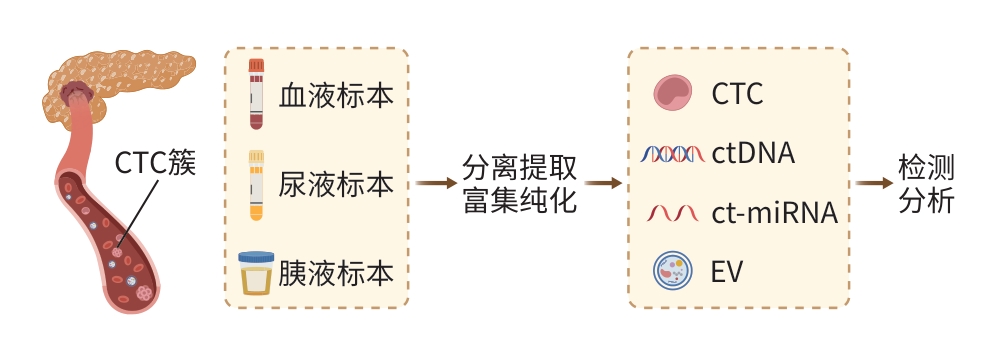
注: 在胰腺癌发生发展过程中,肿瘤细胞释放DNA、miRNA、外泌体等生物活性物质,肿瘤细胞(簇)亦可通过主动侵袭或被动脱落进入循环。液体活检通过采集血液等体液标本经过分离提取、富集纯化等步骤获取CTC、ctDNA、ct-miRNA、EV等标志物进行检测分析以实现早期筛查、诊断等目的。CTC,循环肿瘤细胞;ctDNA,循环肿瘤DNA;ct-miRNA,循环肿瘤微小RNA;EV,细胞外囊泡。
图 1 液体活检技术在胰腺癌早筛诊断中的应用
Figure 1. Application of liquid biopsy in early screening and diagnosis of pancreatic cancer
表 1 不同液体活检技术对胰腺癌早期筛查诊断的临床应用效能
Table 1. Clinical performance of different assay techniques for early screening and diagnosis of pancreatic cancer
检验技术 方法 研究对象 诊断策略 敏感度
(%)特异度
(%)AUC 参考文献 CTC 惯性微流控CTC富
集结合机器学习分
析技术良性胰腺疾病13例、胰腺癌26例
(Ⅰ/Ⅱ期13例、Ⅲ/Ⅳ期13例)联合门静脉CTC、外周血
CTC和CA19-980.80 92.30 0.944 [22] ctDNA cfDNA甲基化定量检
测分析对照组95例、慢性胰腺炎8例、胰
腺癌39例(Ⅰ期8例、ⅡA期9例、
ⅡB期20例、Ⅲ/Ⅳ期2例)cfDNA双基因(ADAMTS1、
BNC1)甲基化水平97.4 91.6 0.95 [23] 基于NGS技术对
ctDNA中抑癌基因甲
基化水平的检测
分析健康对照20例、胰腺良性疾病39
例、胰腺癌43例(Ⅰ期11例、Ⅱ期
18例、Ⅲ期10例、Ⅳ期4例)联合ctDNA四基因
(RASSF1A、EYA2、p16、
ppENK)甲基化水平和
CA19-9100 77.81 0.96 [24] ct-miRNA 基于机器学习对ct-
miRNA和外泌体
miRNA的测序分析
和定量检测非疾病对照124例(测序组57例,
分析组67例)、Ⅰ/Ⅱ期胰腺癌135
例(测序组44例、分析组91例)联合13-miRNA(5种循环
游离miRNA和8种循环
外泌体RNA)与CA19-993 — 0.99 [25] EV 基于外泌体lncRNA
全转录组测序和定
量检测对照组70例、胰腺癌78例(Ⅰ/Ⅱ
期59例、Ⅲ/Ⅳ期19例)4种外泌体lncRNA
(LINC01268、INC02802、
AC124854.1、L132657.1)
组合72 89 0.847 6 [26] MACS外泌体表面标
志物检测分析技术对照组51例、胰腺炎21例、胰腺
癌48例联合外泌体表面标志物
CD40、CD25和CA19-984.3 87.7 0.92 [27] 注:CTC,循环肿瘤细胞;ctDNA,循环肿瘤DNA;ct-miRNA,循环肿瘤微小RNA;EV,细胞外囊泡;cfDNA,细胞游离DNA;NGS,下一代DNA测序;MACS,磁性细胞分选技术;lncRNA,长链非编码RNA;CA19-9,糖类抗原19-9;AUC,曲线下面积。
 下载: 导出CSV
-
[1] FELISMINO TC, RODRIGUES D, BRITO A, et al. Evolving survival patterns in pancreatic adenocarcinoma: A 23-year retrospective observational analysis[J]. J Gastrointest Oncol, 2025, 16( 3): 1280- 1286. DOI: 10.21037/jgo-2024-942. [2] YI LX, FANG HL, LI JY, et al. Incidence and mortality of pancreatic cancer in the world and China in 2022[J]. Acad J Nav Med Univ, 2024, 45( 12): 1470- 1477. DOI: 10.16781/j.CN31-2187/R.20240630.易丽夏, 方涵露, 李婧怡, 等. 2022年全球和中国胰腺癌发病及死亡分析[J]. 海军军医大学学报, 2024, 45( 12): 1470- 1477. DOI: 10.16781/j.CN31-2187/R.20240630. [3] STOOP TF, JAVED AA, OBA A, et al. Pancreatic cancer[J]. Lancet, 2025, 405( 10485): 1182- 1202. DOI: 10.1016/S0140-6736(25)00261-2. [4] LIU WK, TANG BJ, WANG F, et al. Predicting early recurrence for resected pancreatic ductal adenocarcinoma: A multicenter retrospective study in China[J]. Am J Cancer Res, 2021, 11( 6): 3055- 3069. [5] BLACKFORD AL, CANTO MI, DBOUK M, et al. Pancreatic cancer surveillance and survival of high-risk individuals[J]. JAMA Oncol, 2024, 10( 8): 1087- 1096. DOI: 10.1001/jamaoncol.2024.1930. [6] ZHANG TP, YE LY, WANG YY. Development and practice of precise treatment of pancreatic cancer[J]. Chin J Dig Surg, 2025, 24( 5): 567- 573. DOI: 10.3760/cma.j.cn115610-20250411-00147.张太平, 叶力源, 王苑阳. 胰腺癌精准治疗的发展与实践[J]. 中华消化外科杂志, 2025, 24( 5): 567- 573. DOI: 10.3760/cma.j.cn115610-20250411-00147. [7] ZHENG BL, PENG J, MENG Y. Effect of KRAS gene mutation on clinical prognosis of resectable pancreatic cancer[J/OL]. Chin J Hepatic Surg(Electronic Edition), 2025, 14( 3): 456- 462. DOI: 10.3877/cma.j.issn.2095-3232.2025.03.019.郑秉礼, 彭洁, 孟塬. KRAS基因突变对可切除胰腺癌临床预后的影响[J/OL]. 中华肝脏外科手术学电子杂志, 2025, 14( 3): 456- 462. DOI: 10.3877/cma.j.issn.2095-3232.2025.03.019. [8] LILLY AC, ASTSATUROV I, GOLEMIS EA. Intrapancreatic fat, pancreatitis, and pancreatic cancer[J]. Cell Mol Life Sci, 2023, 80( 8): 206. DOI: 10.1007/s00018-023-04855-z. [9] PIAN LL, SONG MH, WANG TF, et al. Identification and analysis of pancreatic intraepithelial neoplasia: Opportunities and challenges[J]. Front Endocrinol, 2025, 15: 1401829. DOI: 10.3389/fendo.2024.1401829. [10] GARDNER TB, PARK WG, ALLEN PJ. Diagnosis and management of pancreatic cysts[J]. Gastroenterology, 2024, 167( 3): 454- 468. DOI: 10.1053/j.gastro.2024.02.041. [11] BOJANAPU S, KASI A. Pancreatic mucinous cystadenoma(archived)[M]. Treasure Island(FL): StatPearls Publishing, 2025. [12] YACHIDA S, JONES S, BOZIC I, et al. Distant metastasis occurs late during the genetic evolution of pancreatic cancer[J]. Nature, 2010, 467( 7319): 1114- 1117. DOI: 10.1038/nature09515. [13] YAMAO K, TSURUSAKI M, TAKASHIMA K, et al. Analysis of progression time in pancreatic cancer including carcinoma in situ based on magnetic resonance cholangiopancreatography findings[J]. Diagnostics, 2021, 11( 10): 1858. DOI: 10.3390/diagnostics11101858. [14] SAGAMI R, YAMAO K, NAKAHODO J, et al. Pre-operative imaging and pathological diagnosis of localized high-grade pancreatic intra-epithelial neoplasia without invasive carcinoma[J]. Cancers, 2021, 13( 5): 945. DOI: 10.3390/cancers13050945. [15] HELLER M, MANN DA, KATONA BW. Current approaches of pancreatic cancer surveillance in high-risk individuals[J]. J Gastrointest Cancer, 2025, 56( 1): 61. DOI: 10.1007/s12029-025-01184-1. [16] Pancreatic Disease Collaborative Group, Chinese Society of Digestive Endoscopy. Chinese consensus on the early screening and surveillance for pancreatic cancer in high-risk individuals(2021, Nanjing)[J]. J Clin Hepatol, 2022, 38( 5): 1016- 1022. DOI: 10.3969/j.issn.1001-5256.2022.05.008.中华医学会消化内镜学分会胰腺疾病协作组. 中国胰腺癌高危人群早期筛查和监测共识意见(2021, 南京)[J]. 临床肝胆病杂志, 2022, 38( 5): 1016- 1022. DOI: 10.3969/j.issn.1001-5256.2022.05.008. [17] ZHAO J, WANG JH, GU YL, et al. Diagnostic methods for pancreatic cancer and their clinical applications(Review)[J]. Oncol Lett, 2025, 30( 1): 370. DOI: 10.3892/ol.2025.15116. [18] PAWELEC N, DURKO Ł, MAŁECKA-WOJCIESKO E. Changes connected to early chronic pancreatitis and early pancreatic cancer in endoscopic ultrasonography(EUS): Clinical implications[J]. Cancers, 2025, 17( 11): 1891. DOI: 10.3390/cancers17111891. [19] OHTSUKA T, FERNANDEZ-DEL CASTILLO C, FURUKAWA T, et al. International evidence-based Kyoto guidelines for the management of intraductal papillary mucinous neoplasm of the pancreas[J]. Pancreatology, 2024, 24( 2): 255- 270. DOI: 10.1016/j.pan.2023.12.009. [20] JUNG P, KIM S, HYUN C, et al. Imaging-based surveillance in patients with initially detected pancreatic cystic lesions[J]. Eur J Radiol, 2025, 187: 112102. DOI: 10.1016/j.ejrad.2025.112102. [21] PIENKOWSKI T, WAWRZAK-PIENKOWSKA K, TANKIEWICZ-KWEDLO A, et al. Leveraging glycosylation for early detection and therapeutic target discovery in pancreatic cancer[J]. Cell Death Dis, 2025, 16( 1): 227. DOI: 10.1038/s41419-025-07517-z. [22] ZHU ZX, ZHANG YX, ZHANG WJ, et al. High-throughput enrichment of portal venous circulating tumor cells for highly sensitive diagnosis of CA19-9-negative pancreatic cancer patients using inertial microfluidics[J]. Biosens Bioelectron, 2024, 259: 116411. DOI: 10.1016/j.bios.2024.116411. [23] EISSA MAL, LERNER L, ABDELFATAH E, et al. Promoter methylation of ADAMTS1 and BNC1 as potential biomarkers for early detection of pancreatic cancer in blood[J]. Clin Epigenetics, 2019, 11( 1): 59. DOI: 10.1186/s13148-019-0650-0. [24] XIN WP, TU SJ, YI SQ, et al. Clinical significance of tumor suppressor genes methylation in circulating tumor DNA of patients with pancreatic cancer[J]. Gene, 2024, 897: 148078. DOI: 10.1016/j.gene.2023.148078. [25] NAKAMURA K, ZHU ZX, ROY S, et al. An exosome-based transcriptomic signature for noninvasive, early detection of patients with pancreatic ductal adenocarcinoma: A multicenter cohort study[J]. Gastroenterology, 2022, 163( 5): 1252- 1266.e2. DOI: 10.1053/j.gastro.2022.06.090. [26] HE XM, CHEN LT, DI Y, et al. Plasma-derived exosomal long noncoding RNAs of pancreatic cancer patients as novel blood-based biomarkers of disease[J]. BMC Cancer, 2024, 24( 1): 961. DOI: 10.1186/s12885-024-12755-z. [27] DAVID P, KOUHESTANI D, HANSEN FJ, et al. Exosomal CD40, CD25, and serum CA19-9 as combinatory novel liquid biopsy biomarker for the diagnosis and prognosis of patients with pancreatic ductal adenocarcinoma[J]. Int J Mol Sci, 2025, 26( 4): 1500. DOI: 10.3390/ijms26041500. [28] RING A, NGUYEN-STRÄULI BD, WICKI A, et al. Biology, vulnerabilities and clinical applications of circulating tumour cells[J]. Nat Rev Cancer, 2023, 23( 2): 95- 111. DOI: 10.1038/s41568-022-00536-4. [29] SUN YF, ZHOU J, FAN J, et al. Single-cell RNA sequencing reveals spatial heterogeneity and immune evasion of circulating tumor cells[J]. Cancer Biol Med, 2021, 18( 4): 934- 936. DOI: 10.20892/j.issn.2095-3941.2021.0466. [30] YASUI K, SAITO T, UEDA S, et al. Sequential changes in circulating tumor cells in the peripheral blood of pancreatic cancer patients with preoperative chemotherapy using a new immunocytology-based, light microscopic CTC detection platform[J]. Diagnostics, 2025, 15( 6): 752. DOI: 10.3390/diagnostics15060752. [31] WANG Y, YU XJ, HARTMANN D, et al. Circulating tumor cells in peripheral blood of pancreatic cancer patients and their prognostic role: A systematic review and meta-analysis[J]. HPB, 2020, 22( 5): 660- 669. DOI: 10.1016/j.hpb.2019.11.003. [32] ZHANG ZH, BAO YW, ZHAO YJ, et al. Circulating tumor cells as potential prognostic biomarkers for early-stage pancreatic cancer: A systematic review and meta-analysis[J]. World J Clin Oncol, 2023, 14( 11): 504- 517. DOI: 10.5306/wjco.v14.i11.504. [33] JAVED AA, DING D, HASANAIN A, et al. Persistent circulating tumor cells at 1 year after oncologic resection predict late recurrence in pancreatic cancer[J]. Ann Surg, 2023, 277( 6): 859- 865. DOI: 10.1097/SLA.0000000000005708. [34] GÖTZE J, MEIßNER K, PEREIRA-VEIGA T, et al. Identification and characterization of tumor and stromal derived liquid biopsy analytes in pancreatic ductal adenocarcinoma[J]. J Exp Clin Cancer Res, 2025, 44( 1): 14. DOI: 10.1186/s13046-024-03262-x. [35] CHENG H, LUO GP, JIN KZ, et al. Kras mutation correlating with circulating regulatory T cells predicts the prognosis of advanced pancreatic cancer patients[J]. Cancer Med, 2020, 9( 6): 2153- 2159. DOI: 10.1002/cam4.2895. [36] MA LW, GUO HL, ZHAO YX, et al. Liquid biopsy in cancer current: Status, challenges and future prospects[J]. Signal Transduct Target Ther, 2024, 9( 1): 336. DOI: 10.1038/s41392-024-02021-w. [37] HAO MD, YANG YZ, WANG MD, et al. Application strategy of circulating tumor DNA in entire process of precision medicine for hepatocellular carcinoma[J]. Chin J Dig Surg, 2025, 24( 1): 86- 92. DOI: 10.3760/cma.j.cn115610-20241224-00578.赫明达, 杨钰泽, 王明达, 等. 循环肿瘤DNA在肝细胞癌精准医疗全程中的应用策略[J]. 中华消化外科杂志, 2025, 24( 1): 86- 92. DOI: 10.3760/cma.j.cn115610-20241224-00578. [38] THEPAREE T, AKROUSH M, SABATINI LM, et al. Cell free DNA in patients with pancreatic adenocarcinoma: Clinicopathologic correlations[J]. Sci Rep, 2024, 14: 15744. DOI: 10.1038/s41598-024-65562-8. [39] SELLAHEWA R, MOGHADDAM SM, LUNDY J, et al. Circulating tumor DNA is an accurate diagnostic tool and strong prognostic marker in pancreatic cancer[J]. Pancreas, 2023, 52( 3): e188- e195. DOI: 10.1097/MPA.0000000000002239. [40] ALQAHTANI A, ALLOGHBI A, COFFIN P, et al. Prognostic utility of preoperative and postoperative KRAS-mutated circulating tumor DNA(ctDNA) in resected pancreatic ductal adenocarcinoma: A systematic review and meta-analysis[J]. Surg Oncol, 2023, 51: 102007. DOI: 10.1016/j.suronc.2023.102007. [41] YI JM, GUZZETTA AA, BAILEY VJ, et al. Novel methylation biomarker panel for the early detection of pancreatic cancer[J]. Clin Cancer Res, 2013, 19( 23): 6544- 6555. DOI: 10.1158/1078-0432.CCR-12-3224. [42] KATHURIA-PRAKASH N, DAVE P, GARCIA L, et al. microRNAs in genitourinary malignancies: An exciting frontier of cancer diagnostics and therapeutics[J]. Int J Mol Sci, 2024, 25( 17): 9499. DOI: 10.3390/ijms25179499. [43] BESTARI MB, JOEWONO IR, SYAM AF. A quest for survival: A review of the early biomarkers of pancreatic cancer and the most effective approaches at present[J]. Biomolecules, 2024, 14( 3): 364. DOI: 10.3390/biom14030364. [44] TREEKITKARNMONGKOL W, DAI JL, LIU SY, et al. Blood-based microRNA biomarker signature of early-stage pancreatic ductal adenocarcinoma with lead-time trajectory in prediagnostic samples[J]. Gastro Hep Adv, 2024, 3( 8): 1098- 1115. DOI: 10.1016/j.gastha.2024.08.002. [45] BUCHHOLZ M, LAUSSER L, SCHENK M, et al. Combined analysis of a serum mRNA/miRNA marker signature and CA 19-9 for timely and accurate diagnosis of recurrence after resection of pancreatic ductal adenocarcinoma: A prospective multicenter cohort study[J]. United European Gastroenterol J, 2025, 13( 3): 353- 363. DOI: 10.1002/ueg2.12676. [46] KALLURI R, LEBLEU VS. The biology, function, and biomedical applications of exosomes[J]. Science, 2020, 367( 6478): eaau6977. DOI: 10.1126/science.aau6977. [47] TONG XY, TAN K, BAI LL, et al. Application of exosomes in diagnosis and treatment of hepatocellular carcinoma[J/OL]. Chin J Hepatic Surg(Electronic Edition), 2024, 13( 3): 384- 388. DOI: 10.3877/cma.j.issn.2095-3232.2024.03.021.仝心语, 谭凯, 白亮亮, 等. 外泌体在肝细胞癌诊疗中的应用[J/OL]. 中华肝脏外科手术学电子杂志, 2024, 13( 3): 384- 388. DOI: 10.3877/cma.j.issn.2095-3232.2024.03.021. [48] WANG FB, WANG CB, CHEN SH, et al. Identification of blood-derived exosomal tumor RNA signatures as noninvasive diagnostic biomarkers for multi-cancer: A multi-phase, multi-center study[J]. Mol Cancer, 2025, 24( 1): 60. DOI: 10.1186/s12943-025-02271-4. [49] YANG G, QIU JD, XU JW, et al. Using a microRNA panel of circulating exosomes for diagnosis of pancreatic cancer: Multicentre case-control study[J]. Br J Surg, 2023, 110( 8): 908- 912. DOI: 10.1093/bjs/znac375. [50] ENGELS MML, BERGER CK, MAHONEY DW, et al. Multimodal pancreatic cancer detection using methylated DNA biomarkers in pancreatic juice and plasma CA 19-9: A prospective multicenter study[J]. Clin Gastroenterol Hepatol, 2025, 23( 5): 766- 775. DOI: 10.1016/j.cgh.2024.07.048. [51] BABA S, KAWASAKI T, HIRANO S, et al. A noninvasive urinary microRNA-based assay for the detection of pancreatic cancer from early to late stages: A case control study[J]. EClinicalMedicine, 2024, 78: 102936. DOI: 10.1016/j.eclinm.2024.102936. [52] ITO T, IWASAWA T, SAKURABA S, et al. Plasma and urine circulating tumor DNA methylation profiles for non-invasive pancreatic ductal adenocarcinoma detection: Significant findings in plasma only[J]. Int J Mol Sci, 2025, 26( 11): 4972. DOI: 10.3390/ijms26114972. [53] YEO D, BASTIAN A, STRAUSS H, et al. Exploring the clinical utility of pancreatic cancer circulating tumor cells[J]. Int J Mol Sci, 2022, 23( 3): 1671. DOI: 10.3390/ijms23031671. [54] VELPULA T, BUDDOLLA V. Enhancing detection and monitoring of circulating tumor cells: Integrative approaches in liquid biopsy advances[J]. J Liq Biopsy, 2025, 8: 100297. DOI: 10.1016/j.jlb.2025.100297. -

 本文二维码
本文二维码
计量
- 文章访问数: 716
- HTML全文浏览量: 346
- PDF下载量: 96
- 被引次数: 0