PDF下载 ( 855 KB)

Yes相关蛋白参与肝细胞癌发生发展的作用机制
DOI: 10.12449/JCH260630
Mechanism of action of Yes-associated protein in the development and progression of hepatocellular carcinoma
-
摘要: 肝细胞癌(HCC)全球高发且病死率高。尽管目前手术、靶向药及免疫治疗不断发展,但因肿瘤异质性强、易转移且耐药率高等特点,患者5年生存率仍未显著提升。因此,寻找新的治疗靶点成为当务之急。Yes相关蛋白(YAP)的异常激活是HCC细胞增殖、转移及免疫逃逸的核心枢纽。本文系统综述了YAP在HCC中活化的多重调控机制,包括Hippo通路失活、G蛋白偶联受体信号激活及细胞外基质机械应力改变等对其入核功能的促进作用;归纳了YAP与Wnt通路等非经典通路的协同串扰关系,以及其通过上调程序性死亡配体1重塑免疫微环境、助力肿瘤免疫逃逸的具体作用;评述了YAP-TEA结构域转录因子抑制剂及蛋白降解靶向嵌合体等新技术的发展,并指出YAP多重调控机制的交叉作用是导致肿瘤异质性和治疗耐药的重要原因,未来靶向YAP调控网络的新型抑制剂开发、联合治疗策略及分子标志物检测体系构建,或成为推动HCC精准治疗的重要方向。Abstract: Hepatocellular carcinoma (HCC) is highly prevalent worldwide with a high mortality rate. Despite the continuous advances in current treatment methods such as surgery, targeted drugs, and immunotherapy, there is still a lack of significant improvement in the 5-year survival rate of patients due to strong tumor heterogeneity, high metastatic potential, and a high drug resistance rate. Therefore, it is urgently needed to identify new therapeutic targets. The aberrant activation of Yes-associated protein (YAP) is a pivotal hub for cell proliferation, metastasis, and immune evasion of HCC. This article systematically reviews the multiple regulatory mechanisms underlying YAP activation in HCC, including the promotion of YAP nuclear translocation by Hippo pathway inactivation, G protein-coupled receptor signal activation, and changes in mechanical stress of extracellular matrix. Meanwhile, it summarizes the synergistic crosstalk between YAP and non-classical pathways such as the Wnt pathway, as well as its specific role in remodeling the immune microenvironment and facilitating tumor immune escape by upregulating programmed death ligand 1. In addition, it reviews the development of new technologies such as YAP-TEAD inhibitors and proteolysis-targeting chimera and points out that interactions between the multiple regulatory mechanisms of YAP is a key contributor to tumor heterogeneity and therapeutic resistance. Future research should focus on developing novel inhibitors targeting the YAP regulatory network, designing combined therapy strategies, and establishing molecular biomarker detection systems, which may become pivotal directions for promoting precise treatment of HCC.
-
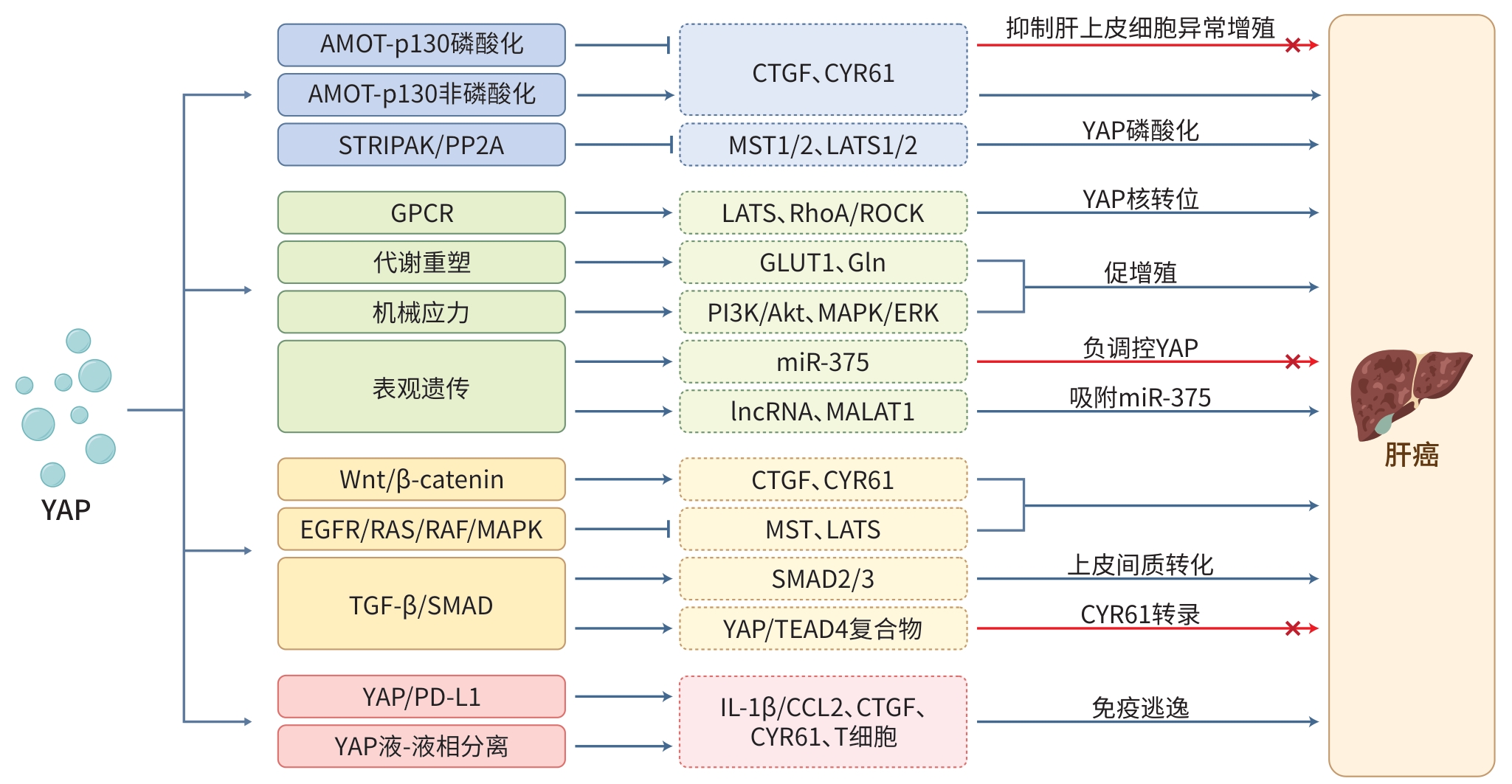
注: YAP,Yes相关蛋白;AMOT,Motin家族成员血管动蛋白;STRIPAK,纹状蛋白相互作用磷酸酶-激酶复合物;PP2A,蛋白磷酸酶2A;GPCR,G蛋白偶联受体;β-catenin,β-联蛋白;EGFR,表皮生长因子受体;RAS,大鼠肉瘤病毒癌基因;RAF,丝氨酸/苏氨酸蛋白激酶;MAPK,丝裂原活化蛋白激酶;TGF-β,转化生长因子β;SMAD,SMAD蛋白家族;PD-L1,程序性细胞死亡配体1;CTGF,结缔组织生长因子;CYR61,富含半胱氨酸的血管生成诱导因子61;MST,哺乳动物不育系20样激酶;LATS,大肿瘤抑制激酶;RhoA,RAS同源基因家族成员A;ROCK,Rho相关卷曲螺旋形成蛋白激酶;GLUT1,葡萄糖转运蛋白1;Gln,谷氨酰胺;PI3K,磷脂肌醇3-激酶;Akt,蛋白激酶B;ERK,胞外信号调节激酶;miR-375,微小RNA-375;LncRNA,长链非编码RNA;MALAT1,肺腺癌转移相关转录本1;TEAD,TEA结构域转录因子;IL-1β,白细胞介素1β;CCL2,趋化因子配体2。
图 1 YAP活化的主要来源、串扰通路及其作用
Figure 1. Main sources, crosstalk pathways and biological functions of YAP activation
表 1 YAP在HCC中具体调控机制及作用
Table 1. The specific regulatory mechanisms and roles of YAP in HCC
调控层面 关键因素 关键分子 YAP参与核心机制 作用 Hippo通路 上游调控因子与
核心激酶模块AMOT-p130 磷酸化:YAP磷酸化并滞留于细胞质中,减少CTGF、
CYR61等下游靶基因的激活[11-12]↓ 非磷酸化:增强YAP与TEAD结合能力,增加下游靶基
因的激活[13]↑ STRIPAK 通过PP2A介导MST1/2去磷酸化,抑制下游LATS1/2
的激活,导致YAP/TAZ磷酸化[16-17]↑ AMPK — — 非Hippo通路 GPCR信号级联 Gα12/13、Gαq/11 通过LPA受体介导的细胞骨架重排抑制LATS,激活
YAP[19]— NPFFR2 激活RhoA/ROCK信号通路,促使YAP核转位[20] ↑ 代谢重塑 GLUT1 YAP间接激活JNK/p38 MAPK通路,上调GLUT1,增强
有氧糖酵解[23]↑ YAP直接激活并上调GLUT1,增强有氧糖酵解 [25] Gln — — 机械应力 ECM YAP直接响应ECM机械应力,上调各种靶基因的
表达[31]↑ ECM激活PI3K/Akt、MAPK/ERK等促癌通路,激活
YAP/TAZ[31]表观遗传 miR-375 靶向YAP mRNA的3'UTR,负向调控YAP的表达[33] ↓ 抑制YAP下游靶点CTGF mRNA的水平,干扰YAP信
号输出[33]LncRNA MALAT1 吸附抑癌miR-375,解除miR-375对YAP1的转录抑制,
促使YAP1表达上调[35]↑ 交叉调控 Wnt/β-catenin CTGF、CYR61 协同激活下游靶基因CTGF、CYR61等的表达[37] ↑ TBX3、CTNNB1 通过TBX3-PLD1-YAP/TAZ轴抑制CTNNB1基因突变
型HCC进展[40]↓ EGFR/RAS/RAF/
MAPKRAF、ERK/JNK RAF抑制MST激酶的激活;ERK/JNK磷酸化Ajuba,抑
制LATS激酶活性,阻止YAP/TAZ失活[43-44]↑ EGFR、AREG YAP/TAZ与TEAD结合,上调EGFR配体AREG等,抑
制Hippo-YAP通路[43-44]索拉非尼耐药 TGF-β/SMAD SMAD、CYR61 早期,SMAD与YAP/TEAD4形成复合物,协同刺激
CYR61基因转录[45]↓ SMAD2/3 晚期,SMAD2/3磷酸化上调YAP/TAZ表达,诱导
SNAIL、SLUG、N-cadherin等的表达[46-47]↑ 微环境调控 YAP/PD-L1 PD-L1、T细胞 YAP直接结合PD-L1的启动子区域,激活IL-1β/CCL2
通路,招募M2型巨噬细胞和Th2细胞,最终导致CD8+T
细胞功能耗竭[48-49]免疫逃逸 YAP液-液相分离 协同增强PD-L1的转录效率,驱动CTGF、CYR61等下
游靶基因的高表达[50-51]免疫治疗耐药 注:“—”表示不明确;“↑”表示促癌;“↓”表示抑癌。YAP,Yes相关蛋白;GPCR,G蛋白偶联受体;Wnt/β-catenin,Wnt/β-联蛋白信号通路;EGFR,表皮生长因子受体;RAS,大鼠肉瘤病毒癌基因;RAF,丝氨酸/苏氨酸蛋白激酶;MAPK,丝裂原活化的蛋白质激酶;TGF-β,转化生长因子β;SMAD,SMAD蛋白家族;PD-L1,程序性细胞死亡配体1;AMOT,Motin家族成员血管动蛋白;STRIPAK,纹状蛋白相互作用磷酸酶-激酶复合物;AMPK,AMP活化的蛋白质激酶;Gα12/13,G蛋白α12/13亚基;Gαq/11,G蛋白αq/11亚基;NPFFR2,神经肽FF受体2;GLUT1,葡萄糖转运蛋白1;Gln,谷氨酰胺;ECM,细胞外基质;miR-375,微RNA-375;lncRNA,长链非编码RNA;MALAT1,肺腺癌转移相关转录本1;CTGF,结缔组织生长因子;CYR61,富含半胱氨酸的血管生成诱导因子61;SMAD2/3,Smad2/3蛋白;TBX3,T-box转录因子3;CTNNB1,连环蛋白β1;ERK,胞外信号调节激酶;JNK,c-Jun氨基末端激酶;AREG,双调蛋白;TEAD,TEA结构域转录因子;PP2A,蛋白磷酸酶2A;MST1/2,哺乳动物不育系20样激酶1/2;LATS1/2,大肿瘤抑制激酶1/2;TAZ,具有PDZ结合基序的转录共激活因子;LPA,溶血磷脂酸;RhoA,RAS同源基因家族成员A;ROCK,Rho相关卷曲螺旋形成蛋白激酶;PI3K,磷脂肌醇3-激酶;Akt,蛋白激酶B;UTR,非翻译区; PLD1,磷脂酶D1;HCC,肝细胞癌;Ajuba,Ajuba LIM蛋白;SNAIL,Snail锌指转录因子;SLUG,Slug锌指转录因子;N-cadherin,N-钙黏蛋白;IL-1β,白细胞介素1β;CCL2,趋化因子配体2。
 下载: 导出CSV
-
[1] ZHOU J, HUANG XY. The latest advances in the treatment of hepatocellular carcinoma[J]. J Clin Hepatol, 2025, 41( 8): 1481- 1486. DOI: 10.12449/JCH250801.周俭, 黄晓勇. 肝细胞癌治疗新进展[J]. 临床肝胆病杂志, 2025, 41( 8): 1481- 1486. DOI: 10.12449/JCH250801. [2] RUMGAY H, ARNOLD M, FERLAY J, et al. Global burden of primary liver cancer in 2020 and predictions to 2040[J]. J Hepatol, 2022, 77( 6): 1598- 1606. DOI: 10.1016/j.jhep.2022.08.021. [3] HUANG Y, HUANG SX, LIU XF. Advances and prospects of systemic therapy for hepatocellular carcinoma[J]. J Clin Hepatol, 2025, 41( 8): 1491- 1496. DOI: 10.12449/JCH250803.黄勇, 黄声稀, 刘秀峰. 肝细胞癌系统治疗进展与展望[J]. 临床肝胆病杂志, 2025, 41( 8): 1491- 1496. DOI: 10.12449/JCH250803. [4] MAO WH, MAI J, PENG H, et al. YAP in pancreatic cancer: Oncogenic role and therapeutic strategy[J]. Theranostics, 2021, 11( 4): 1753- 1762. DOI: 10.7150/thno.53438. [5] ZHANG LQ, ZHANG F, LIANG HM, et al. Hippo/YAP signaling pathway in colorectal cancer: Regulatory mechanisms and potential drug exploration[J]. Front Oncol, 2025, 15: 1545952. DOI: 10.3389/fonc.2025.1545952. [6] NG J, CAI L, GIRARD L, et al. Molecular and pathologic characterization of YAP1-expressing small cell lung cancer cell lines leads to reclassification as SMARCA4-deficient malignancies[J]. Clin Cancer Res, 2024, 30( 9): 1846- 1858. DOI: 10.1158/1078-0432.CCR-23-2360. [7] ZHAO F, LI ZL, PIAO LH, et al. Effect of Yes-associated proteins on biological behaviors of human cervical cancer SiHa cells[J]. J Jilin Univ(Med Ed), 2025, 51( 1): 68- 75. DOI: 10.13481/j.1671-587X.20250109.赵芳, 李珍玲, 朴丽花, 等. Yes相关蛋白对人宫颈癌SiHa细胞生物学行为的影响[J]. 吉林大学学报(医学版), 2025, 51( 1): 68- 75. DOI: 10.13481/j.1671-587X.20250109. [8] DRISKILL JH, PAN DJ. The Hippo pathway in liver homeostasis and pathophysiology[J]. Annu Rev Pathol Mech Dis, 2021, 16: 299- 322. DOI: 10.1146/annurev-pathol-030420-105050. [9] SHI HW, ZOU Y, ZHONG WW, et al. Complex roles of Hippo-YAP/TAZ signaling in hepatocellular carcinoma[J]. J Cancer Res Clin Oncol, 2023, 149( 16): 15311- 15322. DOI: 10.1007/s00432-023-05272-2. [10] ZHANG YY, ZHANG YM, KAMEISHI S, et al. The Amot/integrin protein complex transmits mechanical forces required for vascular expansion[J]. Cell Rep, 2021, 36( 8): 109616. DOI: 10.1016/j.celrep.2021.109616. [11] AMIRIFAR P, KISSIL J. The role of Motin family proteins in tumorigenesis: An update[J]. Oncogene, 2023, 42( 16): 1265- 1271. DOI: 10.1038/s41388-023-02677-8. [12] CHAN SW, LIM CJ, GUO FS, et al. Actin-binding and cell proliferation activities of angiomotin family members are regulated by Hippo pathway-mediated phosphorylation[J]. J Biol Chem, 2013, 288( 52): 37296- 37307. DOI: 10.1074/jbc.M113.527598. [13] MOLEIRINHO S, HOXHA S, MANDATI V, et al. Regulation of localization and function of the transcriptional co-activator YAP by angiomotin[J]. eLife, 2017, 6: e23966. DOI: 10.7554/eLife.23966. [14] HSU CC, PENG DN, CAI Z, et al. AMPK signaling and its targeting in cancer progression and treatment[J]. Semin Cancer Biol, 2022, 85: 52- 68. DOI: 10.1016/j.semcancer.2021.04.006. [15] CHANG WH, LAI AG. An integrative pan-cancer investigation reveals common genetic and transcriptional alterations of AMPK pathway genes as important predictors of clinical outcomes across major cancer types[J]. BMC Cancer, 2020, 20( 1): 773. DOI: 10.1186/s12885-020-07286-2. [16] LI AX, MARTIN TA, LANE J, et al. Cellular impacts of striatins and the STRIPAK complex and their roles in the development and metastasis in clinical cancers(review)[J]. Cancers, 2023, 16( 1): 76. DOI: 10.3390/cancers16010076. [17] JEONG BC, BAE SJ, NI LS, et al. Cryo-EM structure of the Hippo signaling integrator human STRIPAK[J]. Nat Struct Mol Biol, 2021, 28( 3): 290- 299. DOI: 10.1038/s41594-021-00564-y. [18] ADDIS P, BALI U, BARON F, et al. Key aspects of modern GPCR drug discovery[J]. SLAS Discov, 2024, 29( 1): 1- 22. DOI: 10.1016/j.slasd.2023.08.007. [19] WEI YZ, HUI VLZ, CHEN YL, et al. YAP/TAZ: Molecular pathway and disease therapy[J]. MedComm, 2023, 4( 4): e340. DOI: 10.1002/mco2.340. [20] SHIN Y, JUNG W, KIM MY, et al. NPFFR2 contributes to the malignancy of hepatocellular carcinoma development by activating RhoA/YAP signaling[J]. Cancers, 2022, 14( 23): 5850. DOI: 10.3390/cancers14235850. [21] CHELAKKOT C, CHELAKKOT VS, SHIN Y, et al. Modulating glycolysis to improve cancer therapy[J]. Int J Mol Sci, 2023, 24( 3): 2606. DOI: 10.3390/ijms24032606. [22] KOOSHAN Z, CÁRDENAS-PIEDRA L, CLEMENTS J, et al. Glycolysis, the sweet appetite of the tumor microenvironment[J]. Cancer Lett, 2024, 600: 217156. DOI: 10.1016/j.canlet.2024.217156. [23] FENG J, LI JJ, WU LW, et al. Emerging roles and the regulation of aerobic glycolysis in hepatocellular carcinoma[J]. J Exp Clin Cancer Res, 2020, 39( 1): 126. DOI: 10.1186/s13046-020-01629-4. [24] LIU QP, LUO Q, DENG B, et al. Stiffer matrix accelerates migration of hepatocellular carcinoma cells through enhanced aerobic glycolysis via the MAPK-YAP signaling[J]. Cancers, 2020, 12( 2): 490. DOI: 10.3390/cancers12020490. [25] WANG LH, ZHU Z, LIANG Q, et al. A novel small molecule glycolysis inhibitor WZ35 exerts anti-cancer effect via metabolic reprogramming[J]. J Transl Med, 2022, 20( 1): 530. DOI: 10.1186/s12967-022-03758-0. [26] ZOU WX, HAN ZT, WANG ZH, et al. Targeting glutamine metabolism as a potential target for cancer treatment[J]. J Exp Clin Cancer Res, 2025, 44( 1): 180. DOI: 10.1186/s13046-025-03430-7. [27] KANDASAMY P, ZLOBEC I, NYDEGGER DT, et al. Oncogenic KRAS mutations enhance amino acid uptake by colorectal cancer cells via the Hippo signaling effector YAP1[J]. Mol Oncol, 2021, 15( 10): 2782- 2800. DOI: 10.1002/1878-0261.12999. [28] EDWARDS DN, NGWA VM, WANG S, et al. The receptor tyrosine kinase EphA2 promotes glutamine metabolism in tumors by activating the transcriptional coactivators YAP and TAZ[J]. Sci Signal, 2017, 10( 508): eaan4667. DOI: 10.1126/scisignal.aan4667. [29] ROY AM, IYER R, CHAKRABORTY S. The extracellular matrix in hepatocellular carcinoma: Mechanisms and therapeutic vulnerability[J]. Cell Rep Med, 2023, 4( 9): 101170. DOI: 10.1016/j.xcrm.2023.101170. [30] MA D, LUO Q, SONG GB. Matrix stiffening facilitates stemness of liver cancer stem cells by YAP activation and BMF inhibition[J]. Biomater Adv, 2024, 163: 213936. DOI: 10.1016/j.bioadv.2024.213936. [31] PASSI M, ZAHLER S. Mechano-signaling aspects of hepatocellular carcinoma[J]. J Cancer, 2021, 12( 21): 6411- 6421. DOI: 10.7150/jca.60102. [32] LIU AM, POON RTP, LUK JM. microRNA-375 targets Hippo-signaling effector YAP in liver cancer and inhibits tumor properties[J]. Biochem Biophys Res Commun, 2010, 394( 3): 623- 627. DOI: 10.1016/j.bbrc.2010.03.036. [33] YU KR, LI H, JIANG ZY, et al. miR-375/Yes-associated protein axis regulates IL-6 and TGF-β expression, which is involved in the cisplatin-induced resistance of liver cancer cells[J]. Oncol Rep, 2021, 46( 2): 162. DOI: 10.3892/or.2021.8112. [34] ZHU PP, WANG YY, WU JY, et al. LncBRM initiates YAP1 signalling activation to drive self-renewal of liver cancer stem cells[J]. Nat Commun, 2016, 7: 13608. DOI: 10.1038/ncomms13608. [35] ZHAO LY, LOU GH, LI AC, et al. lncRNA MALAT1 modulates cancer stem cell properties of liver cancer cells by regulating YAP1 expression via miR-375 sponging[J]. Mol Med Rep, 2020, 22( 2): 1449- 1457. DOI: 10.3892/mmr.2020.11196. [36] GOYAL B, YADAV SRM, AWASTHEE N, et al. Diagnostic, prognostic, and therapeutic significance of long non-coding RNA MALAT1 in cancer[J]. Biochim Biophys Acta Rev Cancer, 2021, 1875( 2): 188502. DOI: 10.1016/j.bbcan.2021.188502. [37] XU F, ZHANG J, MA D. Crosstalk of Hippo/YAP and Wnt/β-catenin pathways[J]. Hereditas, 2014, 36( 2): 95- 102. DOI: 10.3724/SP.J.1005.2014.0095.许飞, 张进, 马端. Hippo/YAP和Wnt/β-catenin通路的对话[J]. 遗传, 2014, 36( 2): 95- 102. DOI: 10.3724/SP.J.1005.2014.0095. [38] ASTONE M, TESORIERO C, SCHIAVONE M, et al. Wnt/β-catenin signaling regulates Yap/Taz activity during embryonic development in zebrafish[J]. Int J Mol Sci, 2024, 25( 18): 10005. DOI: 10.3390/ijms251810005. [39] AZZOLIN L, ZANCONATO F, BRESOLIN S, et al. Role of TAZ as mediator of Wnt signaling[J]. Cell, 2012, 151( 7): 1443- 1456. DOI: 10.1016/j.cell.2012.11.027. [40] LIANG BY, ZHOU Y, QIAN MN, et al. TBX3 functions as a tumor suppressor downstream of activated CTNNB1 mutants during hepatocarcinogenesis[J]. J Hepatol, 2021, 75( 1): 120- 131. DOI: 10.1016/j.jhep.2021.01.044. [41] BHAT M, PASINI E, PASTRELLO C, et al. Integrative analysis of layers of data in hepatocellular carcinoma reveals pathway dependencies[J]. World J Hepatol, 2021, 13( 1): 94- 108. DOI: 10.4254/wjh.v13.i1.94. [42] BAHAR ME, KIM HJ, KIM DR. Targeting the RAS/RAF/MAPK pathway for cancer therapy: From mechanism to clinical studies[J]. Signal Transduct Target Ther, 2023, 8( 1): 455. DOI: 10.1038/s41392-023-01705-z. [43] ZINATIZADEH MR, MIRI SR, ZARANDI PK, et al. The Hippo tumor suppressor pathway(YAP/TAZ/TEAD/MST/LATS) and EGFR-RAS-RAF-MEK in cancer metastasis[J]. Genes Dis, 2019, 8( 1): 48- 60. DOI: 10.1016/j.gendis.2019.11.003. [44] VALIŠ K, NOVÁK P. Targeting ERK-Hippo interplay in cancer therapy[J]. Int J Mol Sci, 2020, 21( 9): 3236. DOI: 10.3390/ijms21093236. [45] ZHANG C, WEI WJ, TU S, et al. Upregulation of CYR61 by TGF-β and YAP signaling exerts a counter-suppression of hepatocellular carcinoma[J]. J Biol Chem, 2024, 300( 4): 107208. DOI: 10.1016/j.jbc.2024.107208. [46] SHENG JQ, LUO YM, LV EJ, et al. LINC01980 induced by TGF-beta promotes hepatocellular carcinoma metastasis via miR-376b-5p/E2F5 axis[J]. Cell Signal, 2023, 112: 110923. DOI: 10.1016/j.cellsig.2023.110923. [47] GHABOURA N. Unraveling the Hippo pathway: YAP/TAZ as central players in cancer metastasis and drug resistance[J]. EXCLI J, 2025, 24: 612- 637. DOI: 10.17179/excli2025-8351. [48] LI SH, JI JM, ZHANG ZQ, et al. Cisplatin promotes the expression level of PD-L1 in the microenvironment of hepatocellular carcinoma through YAP1[J]. Mol Cell Biochem, 2020, 475( 1-2): 79- 91. DOI: 10.1007/s11010-020-03861-0. [49] MAITY S, GRIDNEV A, MISRA JR. Assays used for discovering small molecule inhibitors of YAP activity in cancers[J]. Cancers, 2022, 14( 4): 1029. DOI: 10.3390/cancers14041029. [50] PENG ZX. The role of YAP phase separation in tumor resistance to immunotherapy[D]. Wuhan: Huazhong University of Science and Technology, 2021. DOI: 10.27157/d.cnki.ghzku.2021.000225.彭政鑫. YAP相分离在肿瘤免疫治疗耐药中的功能及机制研究[D]. 武汉: 华中科技大学, 2021. DOI: 10.27157/d.cnki.ghzku.2021.000225. [51] SHAO YQ, ZHANG YT, ZHU WX, et al. Biomolecular condensates in Hippo pathway regulation[J]. J Zhejiang Univ Sci B, 2025, 26( 10): 949- 960. DOI: 10.1631/jzus.B2500092. [52] LIU-CHITTENDEN Y, HUANG B, SHIM JS, et al. Genetic and pharmacological disruption of the TEAD-YAP complex suppresses the oncogenic activity of YAP[J]. Genes Dev, 2012, 26( 12): 1300- 1305. DOI: 10.1101/gad.192856.112. [53] IFTIKHAR R, ZAHOOR AF, IRFAN M, et al. Synthetic molecules targeting yes associated protein activity as chemotherapeutics against cancer[J]. Chem Biol Drug Des, 2021, 98( 6): 1025- 1037. DOI: 10.1111/cbdd.13960. [54] ZHOU C, SUN CB, ZHOU W, et al. Development of novel indole-based covalent inhibitors of TEAD as potential antiliver cancer agents[J]. J Med Chem, 2024, 67( 18): 16270- 16295. DOI: 10.1021/acs.jmedchem.4c00925. [55] LI X, SONG YC. Proteolysis-targeting Chimera(PROTAC) for targeted protein degradation and cancer therapy[J]. J Hematol Oncol, 2020, 13( 1): 50. DOI: 10.1186/s13045-020-00885-3. [56] LU YH, YAN ZQ, SUN JQ, et al. Selective degradation of TEADs by a PROTAC molecule exhibited robust anticancer efficacy in vitro and in vivo[J]. J Med Chem, 2025, 68( 5): 5616- 5640. DOI: 10.1021/acs.jmedchem.4c02884. [57] MAESTRO S, WEBER ND, ZABALETA N, et al. Novel vectors and approaches for gene therapy in liver diseases[J]. JHEP Rep, 2021, 3( 4): 100300. DOI: 10.1016/j.jhepr.2021.100300. -

 本文二维码
本文二维码
计量
- 文章访问数: 401
- HTML全文浏览量: 313
- PDF下载量: 93
- 被引次数: 0