PDF下载 ( 961 KB)

噬菌体在代谢相关脂肪性肝病中的调控机制及治疗应用前景
DOI: 10.12449/JCH260324
利益冲突声明:本文不存在任何利益冲突。
作者贡献声明:罗泳珊负责收集及分析资料,撰写论文;陈慧婷负责拟定写作思路,指导撰写文章并最后定稿。
Regulatory mechanism of bacteriophages in metabolic dysfunction-associated fatty liver disease and their application prospects in treatment
-
摘要: 代谢相关脂肪性肝病(MAFLD)是目前全球患病率最高的慢性肝病之一,迄今尚缺乏有效治疗方法。噬菌体作为肠道微生物群的重要组成部分,近年研究发现其可通过重塑菌群结构、调节肠屏障功能以及肠-肝轴信号传递,在MAFLD的病理进程中发挥关键作用。研究表明,MAFLD患者肠道噬菌体多样性下降,特定噬菌体的丰度与疾病严重程度密切相关。其潜在机制涉及噬菌体对肠道屏障功能的调节、对致病菌的靶向清除与有益菌的促定植作用,以及对免疫反应和炎症因子释放的调控。动物模型及临床前期试验显示,靶向干预噬菌体策略有望缓解肝脏炎症、改善脂肪变性及代谢紊乱。然而,噬菌体耐药性、宿主-噬菌体相互作用的复杂性及临床转化的安全性问题,仍是当前面临的挑战。本综述系统阐述了噬菌体在MAFLD中的调控机制及治疗应用前景,以期为该领域的后续研究及噬菌体疗法的开发提供理论参考。Abstract: Metabolic dysfunction-associated fatty liver disease (MAFLD) is one of the most prevalent chronic liver diseases worldwide, and currently there is still a lack of effective therapies. Bacteriophages are an important component of gut microbiota, and recent studies have shown that bacteriophages play a pivotal role in the pathological progression of MAFLD by reshaping microbiota structure, modulating intestinal barrier function, and regulating gut-liver axis signaling. Studies have also shown that there is a reduction in the diversity of bacteriophages in MAFLD patients, and the abundance of specific bacteriophages is closely associated with disease severity. The underlying mechanisms of bacteriophages involve the regulation of intestinal barrier, targeted clearance of pathogenic bacteria, promotion of the colonization of probiotic bacteria, and modulation of immune responses and the release of inflammatory cytokines. Animal models and preclinical trials have shown that targeted bacteriophage intervention strategies are expected to alleviate liver inflammation, improve steatosis, and ameliorate metabolic disorders. However, there are still challenges such as drug resistance of bacteriophage, the complexity of host-bacteriophage interactions, and safety issues in clinical translation. This article systematically elaborates on the regulatory mechanisms of bacteriophages in MAFLD and their application prospects in treatment, in order to provide a theoretical reference for future research and the development of bacteriophage-based therapies in this field.
-
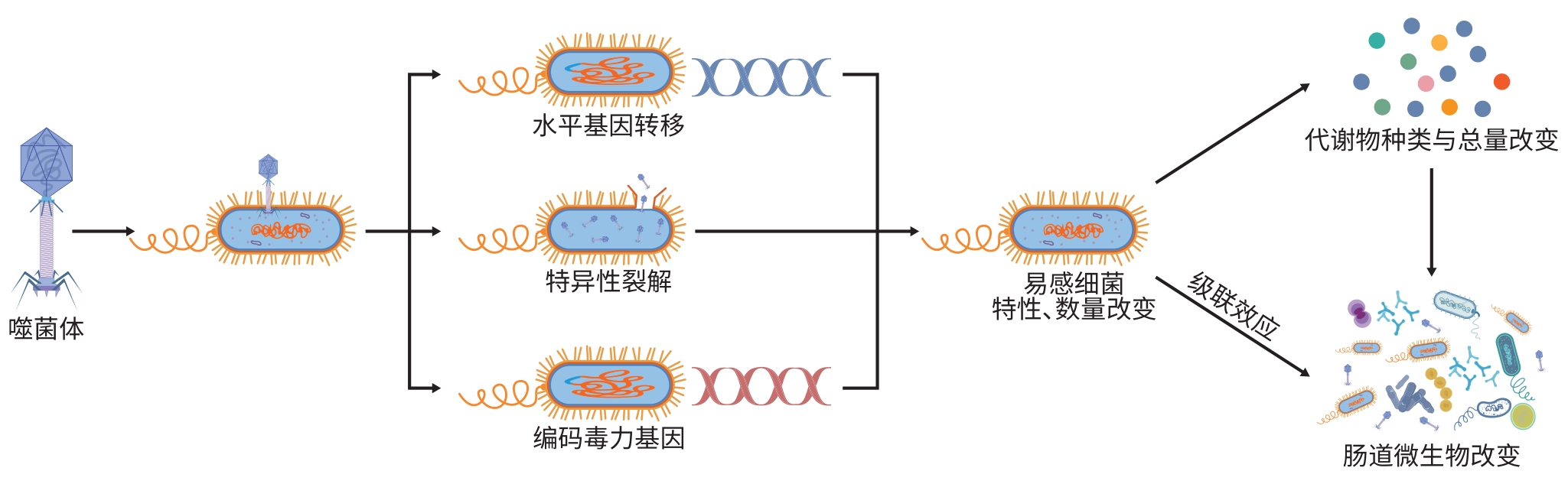
注: 噬菌体可通过特异性裂解、水平基因转移和编码毒力基因等方式,直接调控易感细菌的数量并改变肠道菌群结构;细菌特性与数量的变化又进一步影响代谢物的种类与总量,并通过级联效应作用于肠道共生细菌群落中的非目标细菌种类。
图 1 噬菌体影响肠道菌群
Figure 1. Bacteriophages influence the gut microbiota
-
[1] JIANG MQ, BUTT AS, CUA IH, et al. MAFLD vs. MASLD: A year in review[J]. Expert Rev Endocrinol Metab, 2025, 20( 4): 267- 278. DOI: 10.1080/17446651.2025.2492767. [2] LOU TW, YANG RX, FAN JG. The global burden of fatty liver disease: The major impact of China[J]. Hepatobiliary Surg Nutr, 2024, 13( 1): 119- 123. DOI: 10.21037/hbsn-23-556. [3] ZHOU JH, ZHOU F, WANG WX, et al. Epidemiological features of NAFLD from 1999 to 2018 in China[J]. Hepatology, 2020, 71( 5): 1851- 1864. DOI: 10.1002/hep.31150. [4] RINELLA ME, LAZARUS JV, RATZIU V, et al. A multisociety Delphi consensus statement on new fatty liver disease nomenclature[J]. J Hepatol, 2023, 79( 6): 1542- 1556. DOI: 10.1016/j.jhep.2023.06.003. [5] DEC M, WERNICKI A, URBAN-CHMIEL R. Efficacy of experimental phage therapies in livestock[J]. Anim Health Res Rev, 2020, 21( 1): 69- 83. DOI: 10.1017/S1466252319000161. [6] HAN SW, DING KF. Intestinal phages interact with bacteria and are involved in human diseases[J]. Gut Microbes, 2022, 14( 1): 2113717. DOI: 10.1080/19490976.2022.2113717. [7] CAMARA-WILPERT S, MAYO-MUÑOZ D, RUSSEL J, et al. Bacteriophages suppress CRISPR-Cas immunity using RNA-based anti-CRISPRs[J]. Nature, 2023, 623( 7987): 601- 607. DOI: 10.1038/s41586-023-06612-5. [8] KWAN SY, SABOTTA CM, CRUZ LR, et al. Gut phageome in Mexican Americans: A population at high risk for metabolic dysfunction-associated steatotic liver disease and diabetes[J]. mSystems, 2024, 9( 9): e00434-24. DOI: 10.1128/msystems.00434-24. [9] MASCARDI MF, MAZZINI FN, SUÁREZ B, et al. Integrated analysis of the transcriptome and its interaction with the metabolome in metabolic associated fatty liver disease: Gut microbiome signatures, correlation networks, and effect of PNPLA3 genotype[J]. Proteomics, 2023, 23( 18): e2200414. DOI: 10.1002/pmic.202200414. [10] LANG S, DEMIR M, MARTIN A, et al. Intestinal virome signature associated with severity of nonalcoholic fatty liver disease[J]. Gastroenterology, 2020, 159( 5): 1839- 1852. DOI: 10.1053/j.gastro.2020.07.005. [11] HSU CL, LANG S, DEMIR M, et al. Any alcohol use in NAFLD patients is associated with significant changes to the intestinal virome[J]. Hepatology, 2023, 77( 6): 2073- 2083. DOI: 10.1097/HEP.0000000000000238. [12] TARANTINO G, CITRO V, CATALDI M. Findings from studies are congruent with obesity having a viral origin, but what about obesity-related NAFLD[J]. Viruses, 2021, 13( 7): 1285. DOI: 10.3390/v13071285. [13] DENG YP, JIANG SW, DUAN HY, et al. Bacteriophages and their potential for treatment of metabolic diseases[J]. J Diabetes, 2024, 16( 11): e70024. DOI: 10.1111/1753-0407.70024. [14] BANNAZADEH BAGHI H, NAGHILI B, SHANEHBANDI D, et al. Evaluation of a human gut-associated phage and gut dominant microbial phyla in the metabolic syndrome[J]. Clin Nutr ESPEN, 2022, 50: 133- 137. DOI: 10.1016/j.clnesp.2022.06.009. [15] de JONGE PA, WORTELBOER K, SCHEITHAUER TPM, et al. Gut virome profiling identifies a widespread bacteriophage family associated with metabolic syndrome[J]. Nat Commun, 2022, 13( 1): 3594. DOI: 10.1038/s41467-022-31390-5. [16] BIKEL S, LÓPEZ-LEAL G, CORNEJO-GRANADOS F, et al. Gut dsDNA virome shows diversity and richness alterations associated with childhood obesity and metabolic syndrome[J]. iScience, 2021, 24( 8): 102900. DOI: 10.1016/j.isci.2021.102900. [17] HU XL, YU C, HE YT, et al. Integrative metagenomic analysis reveals distinct gut microbial signatures related to obesity[J]. BMC Microbiol, 2024, 24( 1): 119. DOI: 10.1186/s12866-024-03278-5. [18] MA YF, YOU XY, MAI GQ, et al. A human gut phage catalog correlates the gut phageome with type 2 diabetes[J]. Microbiome, 2018, 6( 1): 24. DOI: 10.1186/s40168-018-0410-y. [19] CHEN Q, MA XJ, LI C, et al. Enteric phageome alterations in patients with type 2 diabetes[J]. Front Cell Infect Microbiol, 2020, 10: 575084. DOI: 10.3389/fcimb.2020.575084. [20] YANG KL, NIU JK, ZUO T, et al. Alterations in the gut virome in obesity and type 2 diabetes mellitus[J]. Gastroenterology, 2021, 161( 4): 1257- 1269. e 13. DOI: 10.1053/j.gastro.2021.06.056. [21] FAN G, CAO F, KUANG TT, et al. Alterations in the gut virome are associated with type 2 diabetes and diabetic nephropathy[J]. Gut Microbes, 2023, 15( 1): 2226925. DOI: 10.1080/19490976.2023.2226925. [22] BENEDÉ-UBIETO R, CUBERO FJ, NEVZOROVA YA. Breaking the barriers: The role of gut homeostasis in Metabolic-Associated Steatotic Liver Disease(MASLD)[J]. Gut Microbes, 2024, 16( 1): 2331460. DOI: 10.1080/19490976.2024.2331460. [23] BARR JJ, AURO R, FURLAN M, et al. Bacteriophage adhering to mucus provide a non-host-derived immunity[J]. Proc Natl Acad Sci USA, 2013, 110( 26): 10771- 10776. DOI: 10.1073/pnas.1305923110. [24] CHEN LY, HOU XH, CHU HK. The novel role of phage particles in chronic liver diseases[J]. Microorganisms, 2023, 11( 5): 1181. DOI: 10.3390/microorganisms11051181. [25] NGUYEN S, BAKER K, PADMAN BS, et al. Bacteriophage transcytosis provides a mechanism to cross epithelial cell layers[J]. mBio, 2017, 8( 6): e01874-17. DOI: 10.1128/mBio.01874-17. [26] MENDES BG, DUAN Y, SCHNABL B. Immune response of an oral Enterococcus faecalis phage cocktail in a mouse model of ethanol-induced liver disease[J]. Viruses, 2022, 14( 3): 490. DOI: 10.3390/v14030490. [27] BLANCO-PICAZO P, GÓMEZ-GÓMEZ C, AGUILÓ-CASTILLO S, et al. Chicken liver is a potential reservoir of bacteriophages and phage-derived particles containing antibiotic resistance genes[J]. Microb Biotechnol, 2022, 15( 9): 2464- 2475. DOI: 10.1111/1751-7915.14056. [28] GAN L, FENG YL, DU B, et al. Bacteriophage targeting microbiota alleviates non-alcoholic fatty liver disease induced by high alcohol-producing Klebsiella pneumoniae[J]. Nat Commun, 2023, 14( 1): 3215. DOI: 10.1038/s41467-023-39028-w. [29] XIN FZ, ZHAO ZH, LIU XL, et al. Escherichia fergusonii promotes nonobese nonalcoholic fatty liver disease by interfering with host hepatic lipid metabolism through its own msRNA 23487[J]. Cell Mol Gastroenterol Hepatol, 2022, 13( 3): 827- 841. DOI: 10.1016/j.jcmgh.2021.12.003. [30] HSU BB, GIBSON TE, YELISEYEV V, et al. Dynamic modulation of the gut microbiota and metabolome by bacteriophages in a mouse model[J]. Cell Host Microbe, 2019, 25( 6): 803- 814.e5. DOI: 10.1016/j.chom.2019.05.001. [31] CAMPBELL DE, LY LK, RIDLON JM, et al. Infection with Bacteroides phage BV01 alters the host transcriptome and bile acid metabolism in a common human gut microbe[J]. Cell Rep, 2020, 32( 11): 108142. DOI: 10.1016/j.celrep.2020.108142. [32] PUXTY RJ, MILLARD AD. Functional ecology of bacteriophages in the environment[J]. Curr Opin Microbiol, 2023, 71: 102245. DOI: 10.1016/j.mib.2022.102245. [33] KRUT O, BEKEREDJIAN-DING I. Contribution of the immune response to phage therapy[J]. J Immunol, 2018, 200( 9): 3037- 3044. DOI: 10.4049/jimmunol.1701745. [34] POPESCU M, van BELLEGHEM JD, KHOSRAVI A, et al. Bacteriophages and the immune system[J]. Annu Rev Virol, 2021, 8( 1): 415- 435. DOI: 10.1146/annurev-virology-091919-074551. [35] GÓRSKI A, MIĘDZYBRODZKI R, BORYSOWSKI J, et al. Phage as a modulator of immune responses: Practical implications for phage therapy[J]. Adv Virus Res, 2012, 83: 41- 71. DOI: 10.1016/B978-0-12-394438-2.00002-5. [36] SAFARI Z, SADEGHIZADEH M, ASGARITARGHI G, et al. M13 phage coated surface elicits an anti-inflammatory response in BALB/c and C57BL/6 peritoneal macrophages[J]. Int Immunopharmacol, 2022, 107: 108654. DOI: 10.1016/j.intimp.2022.108654. [37] ALDAHLAWI AM, ALSUBHI GA, ALRAHIMI JS, et al. Immunomodulatory effects of Escherichia coli phage GADS24 on human dendritic cells[J]. Biomedicines, 2025, 13( 7): 1519. DOI: 10.3390/biomedicines13071519. [38] ALBILLOS A, de GOTTARDI A, RESCIGNO M. The gut-liver axis in liver disease: Pathophysiological basis for therapy[J]. J Hepatol, 2020, 72( 3): 558- 577. DOI: 10.1016/j.jhep.2019.10.003. [39] de SOUZA EB, PINTO AR, FONGARO G. Bacteriophages as potential clinical immune modulators[J]. Microorganisms, 2023, 11( 9): 2222. DOI: 10.3390/microorganisms11092222. [40] ZHOU D, PAN Q, SHEN F, et al. Total fecal microbiota transplantation alleviates high-fat diet-induced steatohepatitis in mice via beneficial regulation of gut microbiota[J]. Sci Rep, 2017, 7( 1): 1529. DOI: 10.1038/s41598-017-01751-y. [41] RASMUSSEN TS, MENTZEL CMJ, KOT W, et al. Faecal virome transplantation decreases symptoms of type 2 diabetes and obesity in a murine model[J]. Gut, 2020, 69( 12): 2122- 2130. DOI: 10.1136/gutjnl-2019-320005. [42] LIN DM, KOSKELLA B, RITZ NL, et al. Transplanting fecal virus-like particles reduces high-fat diet-induced small intestinal bacterial overgrowth in mice[J]. Front Cell Infect Microbiol, 2019, 9: 348. DOI: 10.3389/fcimb.2019.00348. [43] YUAN J, CHEN C, CUI JH, et al. Fatty liver disease caused by high-alcohol-producing Klebsiella pneumoniae[J]. Cell Metab, 2019, 30( 6): 1172. DOI: 10.1016/j.cmet.2019.11.006. [44] ZHANG Z, ZHU T, LI Y, et al. Butyrate regulates intestinal DNA virome and lipopolysaccharide levels to prevent high-fat diet-related liver damage in rats[J]. J Agric Food Chem, 2025, 73( 14): 8277- 8289. DOI: 10.1021/acs.jafc.4c07966. [45] DUAN Y, LLORENTE C, LANG S, et al. Bacteriophage targeting of gut bacterium attenuates alcoholic liver disease[J]. Nature, 2019, 575( 7783): 505- 511. DOI: 10.1038/s41586-019-1742-x. [46] ICHIKAWA M, NAKAMOTO N, KREDO-RUSSO S, et al. Bacteriophage therapy against pathological Klebsiella pneumoniae ameliorates the course of primary sclerosing cholangitis[J]. Nat Commun, 2023, 14( 1): 3261. DOI: 10.1038/s41467-023-39029-9. [47] van NIEUWENHUYSE B, van der LINDEN D, CHATZIS O, et al. Bacteriophage-antibiotic combination therapy against extensively drug-resistant Pseudomonas aeruginosa infection to allow liver transplantation in a toddler[J]. Nat Commun, 2022, 13( 1): 5725. DOI: 10.1038/s41467-022-33294-w. [48] YE JM, MENG Q, JIN KZ, et al. Phage cocktail alleviated type 2 diabetes by reshaping gut microbiota and decreasing proinflammatory cytokines[J]. Appl Microbiol Biotechnol, 2024, 108( 1): 9. DOI: 10.1007/s00253-023-12912-7. [49] RODRÍGUEZ-ARELLANO SN, GONZÁLEZ-GÓMEZ JP, GOMEZ-GIL B, et al. A two-phage cocktail modulates gut microbiota composition and metabolic profiles in an ex vivo colon model[J]. Int J Mol Sci, 2025, 26( 6): 2805. DOI: 10.3390/ijms26062805. [50] HESSE S, MALACHOWA N, PORTER AR, et al. Bacteriophage treatment rescues mice infected with multidrug-resistant Klebsiella pneumoniae ST258[J]. mBio, 2021, 12( 1): e00034-21. DOI: 10.1128/mBio.00034-21. [51] CUI LZ, WATANABE S, MIYANAGA K, et al. A comprehensive review on phage therapy and phage-based drug development[J]. Antibiotics, 2024, 13( 9): 870. DOI: 10.3390/antibiotics13090870. [52] PIRNAY JP, DJEBARA S, STEURS G, et al. Personalized bacteriophage therapy outcomes for 100 consecutive cases: A multicentre, multinational, retrospective observational study[J]. Nat Microbiol, 2024, 9( 6): 1434- 1453. DOI: 10.1038/s41564-024-01705-x. [53] ZMORA N, ZILBERMAN-SCHAPIRA G, SUEZ J, et al. Personalized gut mucosal colonization resistance to empiric probiotics is associated with unique host and microbiome features[J]. Cell, 2018, 174( 6): 1388- 1405. e 21. DOI: 10.1016/j.cell.2018.08.041. [54] SHALON D, CULVER RN, GREMBI JA, et al. Profiling the human intestinal environment under physiological conditions[J]. Nature, 2023, 617( 7961): 581- 591. DOI: 10.1038/s41586-023-05989-7. -

 下载:
下载:
 本文二维码
本文二维码
图(2)
计量
- 文章访问数: 487
- HTML全文浏览量: 130
- PDF下载量: 109
- 被引次数: 0