PDF下载 ( 843 KB)

生长分化因子15在肝细胞癌发生发展中的作用机制及靶向治疗策略
DOI: 10.12449/JCH261032
利益冲突声明:本文不存在任何利益冲突。
作者贡献声明:周丹负责文章撰写;高晓琴、王珊负责文献整理;张立婷、李敏负责文章审阅。
Mechanism of action of growth differentiation factor 15 in hepatocellular carcinoma and related targeted therapeutic strategies
-
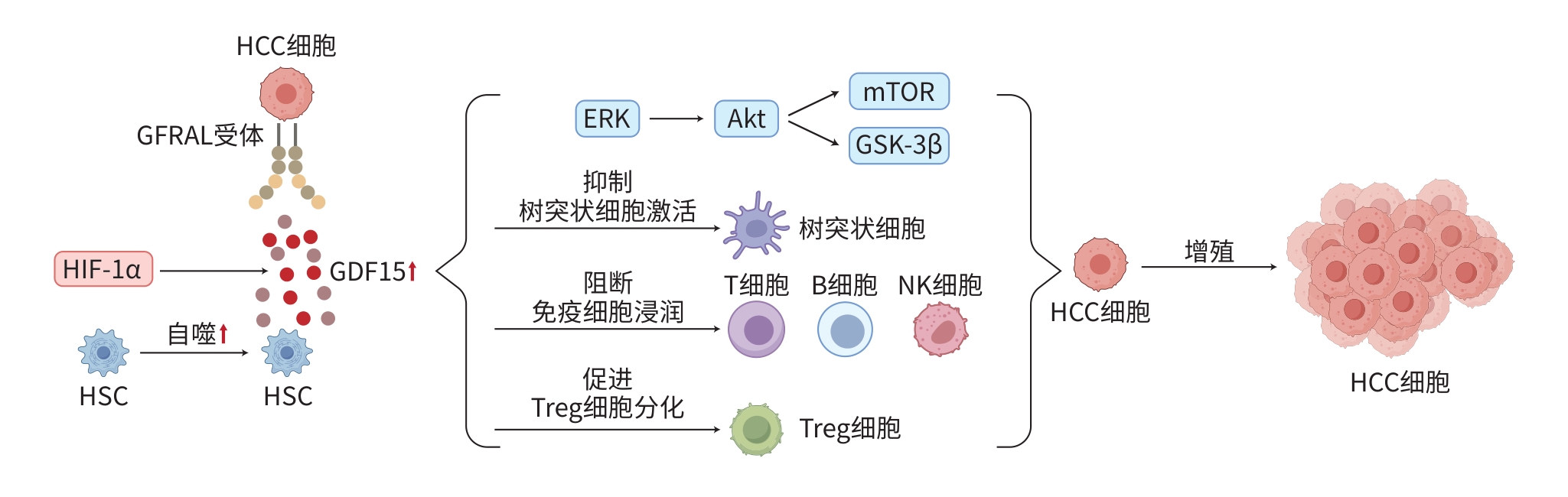
摘要: 肝细胞癌(HCC)是全球第五大恶性肿瘤,也是第三大癌症相关死因。尽管近年来HCC的诊断和治疗取得了一定进展,但其预后仍不理想。生长分化因子15(GDF15)是转化生长因子β超家族成员,在HCC的相关研究中引起了广泛关注,可参与肿瘤发生、发展和转移的全过程。现有研究证实,GDF15可通过多种机制促进HCC的发生发展。本文系统综述GDF15的生物学功能,参与HCC发生发展的相关机制,作为预后生物标志物的临床价值,以及作为治疗靶点的应用潜力,旨在为HCC的基础和临床研究提供新方向。Abstract: Hepatocellular carcinoma (HCC) ranks fifth among the most common malignant tumors globally and is the third leading cause of cancer-related deaths. Despite recent advances in the diagnosis and treatment of HCC, its prognosis remains unsatisfactory. As a member of the transforming growth factor-β superfamily, growth differentiation factor 15 (GDF15) has attracted great attention in the research on HCC and participates in the development, progression, and metastasis of tumors. Existing studies have confirmed that GDF15 can promote the development and progression of HCC through multiple mechanisms. This article systematically reviews the biological functions of GDF15, its mechanisms in the development and progression of HCC, its clinical value as a prognostic biomarker, and its potential as a therapeutic target, in order to provide new directions for basic and clinical research on HCC.
-
[1] Hwang S Y, Danpanichkul P, Agopian V, et al. Hepatocellular carcinoma: Updates on epidemiology, surveillance, diagnosis and treatment[J]. Clin Mol Hepatol, 2025, 31( Suppl): S228- S254. DOI: 10.3350/cmh.2024.0824. [2] Wang J, Qiu K J, Zhou S S, et al. Risk factors for hepatocellular carcinoma: An umbrella review of systematic review and meta-analysis[J]. Ann Med, 2025, 57( 1): 2455539. DOI: 10.1080/07853890.2025.2455539. [3] Shen K Y, Zhu Y, Xie S Z, et al. Immunosuppressive tumor microenvironment and immunotherapy of hepatocellular carcinoma: Current status and prospectives[J]. J Hematol Oncol, 2024, 17( 1): 25. DOI: 10.1186/s13045-024-01549-2. [4] Wang X X, Lu J. Immunotherapy for hepatocellular carcinoma[J]. Chin Med J, 2024, 137( 15): 1765- 1776. DOI: 10.1097/CM9.0000000000003060. [5] Bootcov M R, Bauskin A R, Valenzuela S M, et al. MIC-1, a novel macrophage inhibitory cytokine, is a divergent member of the TGF-beta superfamily[J]. Proc Natl Acad Sci U S A, 1997, 94( 21): 11514- 11519. DOI: 10.1073/pnas.94.21.11514. [6] Du Y N, Zhao J W. GDF15: Immunomodulatory role in hepatocellular carcinoma pathogenesis and therapeutic implications[J]. J Hepatocell Carcinoma, 2024, 11: 1171- 1183. DOI: 10.2147/JHC.S471239. [7] Li Y, Zhang J, Chen S R, et al. Growth differentiation factor 15: Emerging role in liver diseases[J]. Cytokine, 2024, 182: 156727. DOI: 10.1016/j.cyto.2024.156727. [8] Hüllwegen M, Kleinert M, von Haehling S, et al. GDF15: From biomarker to target in cancer cachexia[J]. Trends Cancer, 2025, 11( 11): 1093- 1105. DOI: 10.1016/j.trecan.2025.06.007. [9] Wischhusen J, Melero I, Fridman W H. Growth/differentiation factor-15(GDF-15): From biomarker to novel targetable immune checkpoint[J]. Front Immunol, 2020, 11: 951. DOI: 10.3389/fimmu.2020.00951. [10] Feng X Q, Huai Q, Zhang F M, et al. Single-cell and spatial analyses of the GDF family in tumors, with a focus on the prognostic and biological role of GDF15 in hepatocellular carcinoma[J]. Cell Biosci, 2025, 15( 1): 92. DOI: 10.1186/s13578-025-01431-9. [11] Silva-Bermudez L S, Klüter H, Kzhyshkowska J G. Macrophages as a source and target of GDF-15[J]. Int J Mol Sci, 2024, 25( 13): 7313. DOI: 10.3390/ijms25137313. [12] Sigvardsen C M, Richter M M, Engelbeen S, et al. GDF15 is still a mystery hormone[J]. Trends Endocrinol Metab, 2025, 36( 6): 591- 601. DOI: 10.1016/j.tem.2024.09.002. [13] Siddiqui J A, Pothuraju R, Khan P, et al. Pathophysiological role of growth differentiation factor 15(GDF15) in obesity, cancer, and cachexia[J]. Cytokine Growth Factor Rev, 2022, 64: 71- 83. DOI: 10.1016/j.cytogfr.2021.11.002. [14] Lee H Y, Nga H T, Tian J W, et al. Mitochondrial metabolic signatures in hepatocellular carcinoma[J]. Cells, 2021, 10( 8): 1901. DOI: 10.3390/cells10081901. [15] Myojin Y, Hikita H, Sugiyama M, et al. Hepatic stellate cells in hepatocellular carcinoma promote tumor growth via growth differentiation factor 15 production[J]. Gastroenterology, 2021, 160( 5): 1741- 1754.e16. DOI: 10.1053/j.gastro.2020.12.015. [16] Wang L D, Zhuang B, Jiang Y W, et al. Hypoxia-induced HIF1A impairs sorafenib sensitivity in hepatocellular carcinoma through NSUN2-mediated stabilization of GDF15[J]. Cell Signal, 2025, 135: 112076. DOI: 10.1016/j.cellsig.2025.112076. [17] Xu Q, Xu H X, Li J P, et al. Growth differentiation factor 15 induces growth and metastasis of human liver cancer stem-like cells via AKT/GSK-3β/β-catenin signaling[J]. Oncotarget, 2017, 8( 10): 16972- 16987. DOI: 10.18632/oncotarget.15216. [18] Li C, Wang J Y, Kong J L, et al. GDF15 promotes EMT and metastasis in colorectal cancer[J]. Oncotarget, 2016, 7( 1): 860- 872. DOI: 10.18632/oncotarget.6205. [19] Ma M Z Zhang X H, Li B, et al. Growth differentiation factor 15(GDF15) contributes to invasion and anti-anoikis of hepatocellular cancer through TGF-β/Smad-associated signaling[J]. Int J Clin Exp Med, 2018, 11( 12): 12964- 12973. [20] Du G T, Dou C M, Sun P, et al. Regulatory T cells and immune escape in HCC: Understanding the tumor microenvironment and advancing CAR-T cell therapy[J]. Front Immunol, 2024, 15: 1431211. DOI: 10.3389/fimmu.2024.1431211. [21] Sas Z, Cendrowicz E, Weinhäuser I, et al. Tumor microenvironment of hepatocellular carcinoma: Challenges and opportunities for new treatment options[J]. Int J Mol Sci, 2022, 23( 7): 3778. DOI: 10.3390/ijms23073778. [22] Shi G G, Zhang W Q, Xie F, et al. GFRAL-Fc disarms GDF15 to reprogram tumor immunity and amplify PD-1 efficacy in hepatocellular carcinoma[J]. Cell Commun Signal, 2025, 23( 1): 440. DOI: 10.1186/s12964-025-02427-1. [23] Wang Z W, He L, Li W N, et al. GDF15 induces immunosuppression via CD48 on regulatory T cells in hepatocellular carcinoma[J]. J Immunother Cancer, 2021, 9( 9): e002787. DOI: 10.1136/jitc-2021-002787. [24] Xing R, Gan J Y, Mei J, et al. Serum GDF15 level as predictive biomarker of clinical outcome in patients with unresectable hepatocellular carcinoma treated with hepatic arterial infusion chemotherapy[J]. Front Immunol, 2025, 16: 1619387. DOI: 10.3389/fimmu.2025.1619387. [25] Joachim J H, Mehta K J. Hepcidin in hepatocellular carcinoma[J]. Br J Cancer, 2022, 127( 2): 185- 192. DOI: 10.1038/s41416-022-01753-2. [26] Chen S L, Huang C, Liao G R, et al. Distinct single-cell immune ecosystems distinguish true and de novo HBV-related hepatocellular carcinoma recurrences[J]. Gut, 2023, 72( 6): 1196- 1210. DOI: 10.1136/gutjnl-2022-328428. [27] Chen J J, Tang D L, Xu C, et al. Evaluation of serum GDF15, AFP, and PIVKA-II as diagnostic markers for HBV-associated hepatocellular carcinoma[J]. Lab Med, 2021, 52( 4): 381- 389. DOI: 10.1093/labmed/lmaa089. [28] Zhang S Z, Gao C H, Zhou Q, et al. Identification and validation of circulating biomarkers for detection of liver cancer with antibody array[J]. Neoplasma, 2023, 70( 1): 36- 45. DOI: 10.4149/neo_2022_220606N600. [29] Si Y H, Liu X Y, Cheng M, et al. Growth differentiation factor 15 is induced by hepatitis C virus infection and regulates hepatocellular carcinoma-related genes[J]. PLoS One, 2011, 6( 5): e19967. DOI: 10.1371/journal.pone.0019967. [30] Sometani E, Hikita H, Murai K, et al. High serum growth differentiation factor 15 is a risk factor for the occurrence of hepatocellular carcinoma in chronic hepatitis B patients treated with nucleos(t)ide analogs[J]. Hepatol Res, 2025, 55( 1): 22- 33. DOI: 10.1111/hepr.14111. [31] Myojin Y, Hikita H, Tahata Y, et al. Serum growth differentiation factor 15 predicts hepatocellular carcinoma occurrence after hepatitis C virus elimination[J]. Aliment Pharmacol Ther, 2022, 55( 4): 422- 433. DOI: 10.1111/apt.16691. [32] Suriben R, Chen M, Higbee J, et al. Antibody-mediated inhibition of GDF15-GFRAL activity reverses cancer cachexia in mice[J]. Nat Med, 2020, 26( 8): 1264- 1270. DOI: 10.1038/s41591-020-0945-x. [33] Melero I, de Miguel Luken M, de Velasco G, et al. Neutralizing GDF-15 can overcome anti-PD-1 and anti-PD-L1 resistance in solid tumours[J]. Nature, 2025, 637( 8048): 1218- 1227. DOI: 10.1038/s41586-024-08305-z. [34] He L, Li Z Z, Su D J, et al. Tumor microenvironment-responsive nanocapsule delivery CRISPR/Cas9 to reprogram the immunosuppressive microenvironment in hepatoma carcinoma[J]. Adv Sci(Weinh), 2024, 11( 26): e2403858. DOI: 10.1002/advs.202403858. -

 下载:
 本文二维码
图(1)
计量
- 文章访问数: 16
- HTML全文浏览量: 10
- PDF下载量: 1
- 被引次数: 0