PDF下载 ( 785 KB)

高密度脂蛋白胆固醇水平对肝细胞癌患者1年预后的预测价值
DOI: 10.12449/JCH261022
Value of high-density lipoprotein cholesterol in predicting the one-year prognosis of patients with hepatocellular carcinoma
-
摘要:
目的 探讨高密度脂蛋白胆固醇(HDL-C)对肝细胞癌(HCC)患者死亡风险的预测价值。 方法 回顾性纳入2016年1月—2019年7月于首都医科大学附属北京地坛医院就诊的414例HCC患者为研究对象,随访1年,根据生存结局将其分为生存组(n=275)与死亡组(n=139)。收集患者的临床资料和实验室指标。计量资料两组间比较采用成组t检验或Mann-Whitney U检验。计数资料两组间比较采用χ2检验。采用Cox回归模型分析预后因素,利用受试者操作特征曲线评估各指标的预测效能,通过最大选择秩统计量确定最佳截断值,并采用Kaplan-Meier法及Long-rank检验进行生存分析。 结果 多因素Cox回归分析显示,腹水[风险比(HR)=1.652,95%置信区间(CI):1.148~2.376]、天冬氨酸氨基转移酶(HR=1.011,95%CI:1.008~1.014)、甲胎蛋白(HR=4.108,95%CI:2.306~6.319)、终末期肝病模型评分(HR=1.161,95%CI:1.085~1.243)是HCC患者1年死亡的独立危险因素(P值均<0.05),HDL-C为保护因素(HR=0.386,95%CI:0.132~0.672,P=0.022)。HDL-C的受试者操作特征曲线下面积为0.801,预测价值最优。HDL-C的最佳截断值为0.61 mmol/L,高风险组(<0.61 mmol/L)的1年病死率为68.1%,显著高于低风险组的20.5%(χ2=124.6,P<0.001)。 结论 HDL-C是HCC患者预后的可靠预测指标,其水平<0.61 mmol/L提示患者1年死亡风险显著升高。 Abstract:Objective To investigate the value of high-density lipoprotein cholesterol (HDL-C) in predicting the risk of mortality in patients with hepatocellular carcinoma (HCC). Methods A total of 414 patients with HCC who attended Beijing Ditan Hospital from January 2016 to July 2019 were retrospectively enrolled, and after follow-up for one year, the patients were divided into a survival group with 275 patients and a death group with 139 patients according to their survival outcomes. The clinical data and laboratory indicators of the patients were collected. The independent-samples t test or the Mann-Whitney U test was used for comparison of continuous data between groups, and the chi-square test was used for comparison of categorical data between groups. The Cox regression analysis was used to identify prognostic factors; the receiver operating characteristic (ROC) curve was used to assess the predictive performance of each indicator; the maximally selected rank statistic was used to determine the optimal cut-off value; the Kaplan-Meier method and Log-rank test were used for survival analysis. Results The multivariable Cox regression analysis showed that ascites (hazard ratio [HR]=1.652, 95% confidence interval [CI]: 1.148 — 2.376, P<0.05), aspartate aminotransferase (HR=1.011, 95%CI: 1.008 — 1.014, P<0.05), alpha-fetoprotein (HR=4.108, 95%CI: 2.306 — 6.319, P<0.05), and Model for End-Stage Liver Disease score (HR=1.161, 95%CI: 1.085 — 1.243, P<0.05) were independent risk factors for one-year mortality in HCC patients, while HDL-C was an independent protective factor (HR=0.386, 95%CI: 0.132 — 0.672, P=0.022). HDL-C achieved an area under the ROC curve of 0.801, suggesting that it had the highest predictive value. The optimal cut-off value of HDL-C was 0.61 mmol/L, and the high-risk group (HDL-C<0.61 mmol/L) had a significantly higher one-year mortality rate than the low-risk group (68.1% vs 20.5%, χ2=124.6, P<0.001). Conclusion HDL-C is a reliable predictive factor for the prognosis of patients with HCC, and HDL-C with a level of <0.61 mmol/L indicates a significant increase in the risk of one-year mortality. -
Key words:
- Carcinoma, Hepatocellular /
- Cholesterol, HDL /
- Prognosis /
- Root Cause Analysis
-
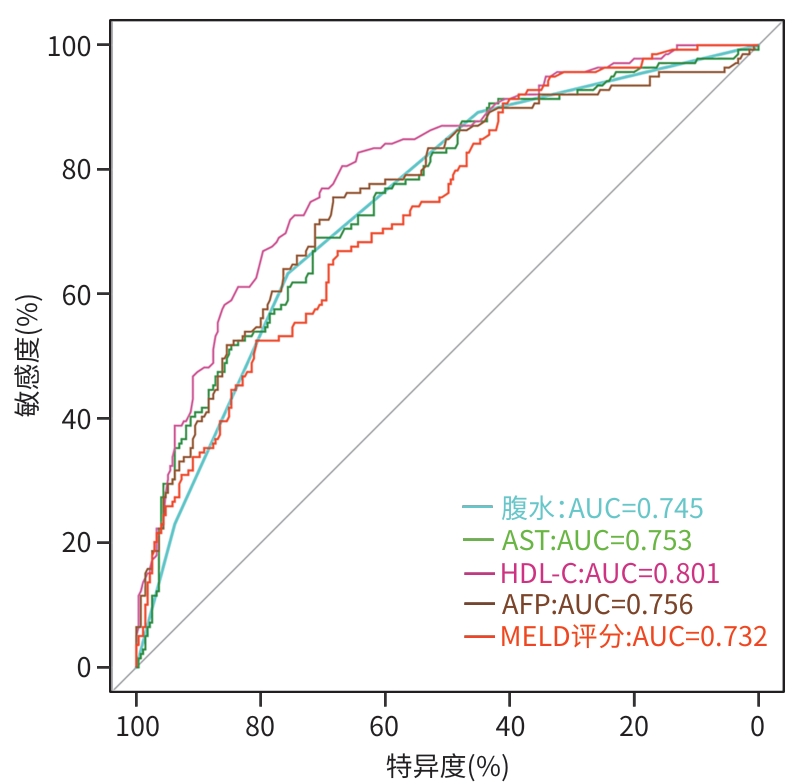
注: AST,天冬氨酸氨基转移酶;HDL-C,高密度脂蛋白胆固醇;AFP,甲胎蛋白;MELD评分,终末期肝病模型评分;HCC,肝细胞癌;ROC曲线,受试者操作特征曲线;AUC,曲线下面积。
图 1 各风险因素预测HCC患者1年预后的ROC曲线
Figure 1. ROC curves of various risk factors for predicting 1‑year prognosis in HCC patients
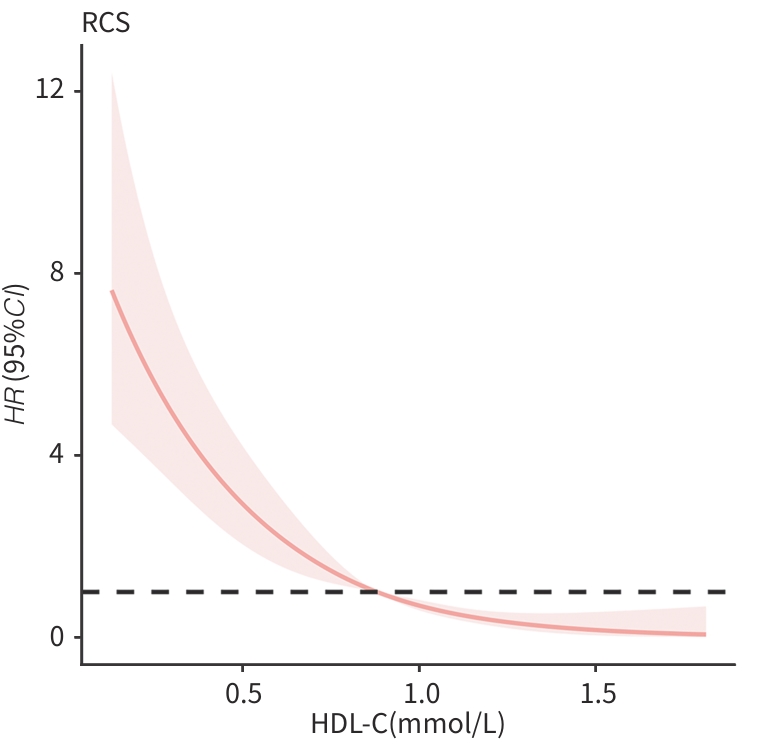
注: HDL-C,高密度脂蛋白胆固醇;HCC,肝细胞癌;HR,风险比;95%CI,95%置信区间;RCS,限制性立方样条。
图 2 HDL-C水平与HCC患者1年预后的关系
Figure 2. Relationship between HDL‑C levels and 1‑year prognosis in HCC patients
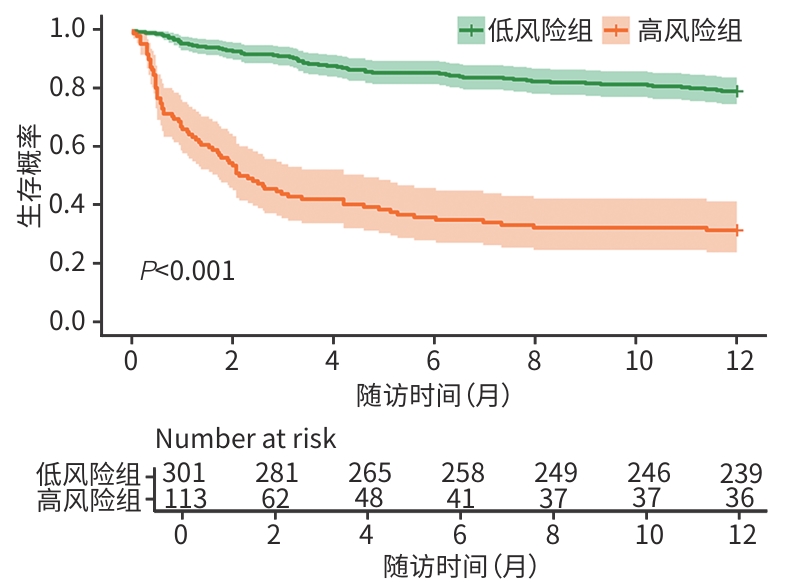
图 3 不同HDL-C水平HCC患者的生存曲线
Figure 3. Survival curves for HCC patients with different HDL-C levels
表 1 生存组与死亡组患者的基线特征
Table 1. Baseline characteristics of patients in the survival group and the non‑survival group
指标 生存组(n=275) 死亡组(n=139) 统计值 P值 年龄(岁) 57.84±10.78 58.68±11.73 t=-0.723 0.470 性别[例(%)] χ2=0.003 0.958 男 219(79.6) 111(79.9) 女 56(20.4) 28(20.1) 腹水[例(%)] 151(54.9) 124(89.2) χ2=48.705 <0.001 ALT(U/L) 30.20(19.15,51.05) 46.40(24.80,82.45) Z=1.418 0.157 AST(U/L) 38.90(25.85,63.60) 89.40(48.75,190.70) Z=6.785 <0.001 TBil(µmol/L) 21.70(13.70,35.55) 40.50(21.60,81.95) Z=4.539 <0.001 Alb(g/L) 34.20(28.65,39.95) 31.20(27.30,34.70) Z=-3.760 <0.001 GGT(U/L) 49.00(24.40,91.16) 146.70(70.37,340.10) Z=-7.091 <0.001 WBC(×109/L) 4.13(2.88,5.46) 5.99(4.31,9.12) Z=-6.723 <0.001 NEUT(×109/L) 2.28(1.64,3.46) 4.54(2.99,6.56) Z=-8.028 <0.001 LYM(×109/L) 0.99(0.64,1.45) 0.89(0.68,1.22) Z=2.123 0.034 TC(mmol/L) 3.44(2.86,4.06) 3.28(2.77,4.15) Z=0.368 0.713 TG(mmol/L) 0.78(0.58,1.07) 0.84(0.63,1.10) Z=0.116 0.908 HDL-C(mmol/L) 0.98(0.76,1.22) 0.57(0.32,0.81) Z=-11.211 <0.001 LDL-C(mmol/L) 1.81(1.37,2.23) 2.01(1.51,2.75) Z=3.336 0.001 PTA(%) 72.25(59.00,88.00) 70.00(57.10,79.85) Z=-3.056 0.002 PLT(×109/L) 76.40(52.00,123.00) 120.00(76.40,172.60) Z=5.693 <0.001 Cr(µmol/L) 68.00(56.00,77.00) 71.70(57.90,86.35) Z=2.714 0.007 MELD评分(分) 9.59(7.57,12.48) 13.32(9.77,18.04) Z=8.254 <0.001 AFP[例(%)] χ2=8.049 <0.001 ≥400 ng/mL 68(24.7) 71(51.1) <400 ng/mL 207(75.3) 68(48.9) 肿瘤多发[例(%)] χ2=9.852 0.001 是 38(13.8) 101(72.6) 否 237(86.2) 38(27.4) 肿瘤大小[例(%)] χ2=5.122 <0.001 ≥5 cm 197(71.6) 52(37.4) <5 cm 78(28.4) 87(62.6) 门静脉癌栓[例(%)] χ2=48.591 <0.001 有 16(5.8) 81(58.3) 无 259(94.2) 58(41.7) BCLC分期[例(%)] χ2=46.308 <0.001 0~A期 103(37.4) 5(3.6) B期 108(39.3) 18(13.0) C期 20(7.3) 61(43.9) D期 44(16.0) 55(39.5) 治疗方式[例(%)] χ2=52.242 <0.001 手术切除 26(9.4) 2(1.4) 微创 217(79.0) 38(27.4) 保守治疗 32(11.6) 99(71.2) 注:ALT,丙氨酸氨基转移酶;AST,天冬氨酸氨基转移酶;TBil,总胆红素;Alb,白蛋白;GGT,γ-谷氨酰转移酶;WBC,白细胞;NEUT,中性粒细胞计数;LYM,淋巴细胞计数;TC,总胆固醇;TG,甘油三酯;HDL-C,高密度脂蛋白胆固醇;LDL-C,低密度脂蛋白胆固醇;PTA,凝血酶原活动度;PLT,血小板;Cr,肌酐;MELD评分,终末期肝病模型评分;AFP,甲胎蛋白;BCLC,巴塞罗那肝癌临床分期。
 下载: 导出CSV
表 2 HCC患者1年预后影响因素的Cox回归分析
Table 2. Cox regression analysis of factors influencing 1‑year prognosis in HCC patients
指标 单因素分析 多因素分析 HR(95%CI) P值 HR(95%CI) P值 年龄(岁) 1.007(0.992~1.022) 0.385 性别(男vs女) 0.985(0.651~1.491) 0.943 腹水(是vs否) 2.128(1.802~2.514) <0.001 1.652(1.148~2.376) 0.007 ALT(U/L) 1.001(1.000~1.003) 0.070 AST(U/L) 1.003(1.003~1.004) <0.001 1.011(1.008~1.014) 0.001 TBil(μmol/L) 1.003(1.002~1.005) <0.001 Alb(g/L) 0.952(0.930~0.976) <0.001 GGT(U/L) 1.001(1.001~1.002) <0.001 WBC(×109/L) 1.206(1.162~1.250) <0.001 NLR 1.261(1.211~1.312) <0.001 TC(mmol/L) 1.031(0.889~1.197) 0.684 TG(mmol/L) 1.021(0.797~1.306) 0.872 HDL-C(mmol/L) 0.063(0.038~0.104) <0.001 0.386(0.132~0.672) 0.022 LDL-C(mmol/L) 1.339(1.147~1.562) <0.001 PTA(%) 0.985(0.976~0.994) 0.001 PLT(×109/L) 1.005(1.004~1.007) <0.001 Cr(µmol/L) 1.002(1.001~1.003) 0.001 MELD评分(分) 1.135(1.107~1.165) <0.001 1.161(1.085~1.243) 0.001 AFP(≥400 ng/mL vs <400 ng/mL) 5.377(3.840~7.532) <0.001 4.108(2.306~6.319) <0.001 肿瘤多发(是vs否) 3.320(2.285~4.826) <0.001 肿瘤大小(<5 cm vs ≥5 cm) 0.319(0.266~0.450) <0.001 门静脉癌栓(无 vs 有) 0.281(0.206~0.384) <0.001 BCLC分期(C~D期 vs 0~B期) 2.320(1.964~2.741) <0.001 治疗方式 手术切除 1.000 微创 2.172(1.820~3.922) 0.031 保守治疗 5.101(3.341~7.064) 0.001 注:ALT,丙氨酸氨基转移酶;AST,天冬氨酸氨基转移酶;TBil,总胆红素;Alb,白蛋白;GGT,γ-谷氨酰转移酶;WBC,白细胞;NLR,中性粒细胞与淋巴细胞比值;TC,总胆固醇;TG,甘油三酯;HDL-C,高密度脂蛋白胆固醇;LDL-C,低密度脂蛋白胆固醇;PTA,凝血酶原活动度;PLT,血小板;Cr,肌酐;MELD评分,终末期肝病模型评分;AFP,甲胎蛋白;BCLC,巴塞罗那肝癌临床分期;HCC,肝细胞癌;HR,风险比;95%CI,95%置信区间。
下载: 导出CSV
-
[1] Sung H, Ferlay J, Siegel R L, et al. Global cancer statistics 2020: GLOBOCAN estimates of incidence and mortality worldwide for 36 cancers in 185 countries[J]. CA Cancer J Clin, 2021, 71( 3): 209- 249. DOI: 10.3322/caac.21660. [2] Rumgay H, Arnold M, Ferlay J, et al. Global burden of primary liver cancer in 2020 and predictions to 2040[J]. J Hepatol, 2022, 77( 6): 1598- 1606. DOI: 10.1016/j.jhep.2022.08.021. [3] McGlynn K A, Petrick J L, El-Serag H B. Epidemiology of hepatocellular carcinoma[J]. Hepatology, 2021, 73( S1): 4- 13. DOI: 10.1002/hep.31288. [4] Cao Bailu, Ai Min, Huang Ping, et al. Research advances in local treatment combined with systemic therapy for advanced hepatocellular carcinoma[J]. J Clin Hepatol, 2023, 39( 8): 1972- 1976. DOI: 10.3969/j.issn.1001-5256.2023.08.031.曹白露, 艾敏, 黄平, 等. 中晚期肝细胞癌的局部治疗联合系统治疗研究进展[J]. 临床肝胆病杂志, 2023, 39( 8): 1972- 1976. DOI: 10.3969/j.issn.1001-5256.2023.08.031. [5] Santos-Gallego C G, Badimon J J, Rosenson R S. Beginning to understand high-density lipoproteins[J]. Endocrinol Metab Clin North Am, 2014, 43( 4): 913- 947. DOI: 10.1016/j.ecl.2014.08.001. [6] Pedersen K M, Çolak Y, Bojesen S E, et al. Low high-density lipoprotein and increased risk of several cancers: 2 population-based cohort studies including 116, 728 individuals[J]. J Hematol Oncol, 2020, 13( 1): 129. DOI: 10.1186/s13045-020-00963-6. [7] Crudele L, de Matteis C, Piccinin E, et al. Low HDL-cholesterol levels predict hepatocellular carcinoma development in individuals with liver fibrosis[J]. JHEP Rep, 2023, 5( 1): 100627. DOI: 10.1016/j.jhepr.2022.100627. [8] Cho Y, Cho E J, Yoo J J, et al. Association between lipid profiles and the incidence of hepatocellular carcinoma: A nationwide population-based study[J]. Cancers, 2021, 13( 7): 1599. DOI: 10.3390/cancers13071599. [9] Omata M, Cheng A L, Kokudo N, et al. Asia-Pacific clinical practice guidelines on the management of hepatocellular carcinoma: A 2017 update[J]. Hepatol Int, 2017, 11( 4): 317- 370. DOI: 10.1007/s12072-017-9799-9. [10] Zhu G Q, Tang Z, Huang R, et al. CD36+ cancer-associated fibroblasts provide immunosuppressive microenvironment for hepatocellular carcinoma via secretion of macrophage migration inhibitory factor[J]. Cell Discov, 2023, 9( 1): 25. DOI: 10.1038/s41421-023-00529-z. [11] Rohatgi A, Westerterp M, von Eckardstein A, et al. HDL in the 21st century: A multifunctional roadmap for future HDL research[J]. Circulation, 2021, 143( 23): 2293- 2309. DOI: 10.1161/CIRCULATIONAHA.120.044221. [12] Georgila K, Vyrla D, Drakos E. Apolipoprotein A-I(ApoA-I), immunity, inflammation and cancer[J]. Cancers, 2019, 11( 8): 1097. DOI: 10.3390/cancers11081097. [13] Nderitu P, Bosco C, Garmo H, et al. The association between individual metabolic syndrome components, primary liver cancer and cirrhosis: A study in the Swedish AMORIS cohort[J]. Int J Cancer, 2017, 141( 6): 1148- 1160. DOI: 10.1002/ijc.30818. [14] Ben-Aicha S, Badimon L, Vilahur G. Advances in HDL: Much more than lipid transporters[J]. Int J Mol Sci, 2020, 21( 3): 732. DOI: 10.3390/ijms21030732. [15] Dessì S, Batetta B, Pulisci D, et al. Cholesterol content in tumor tissues is inversely associated with high-density lipoprotein cholesterol in serum in patients with gastrointestinal cancer[J]. Cancer, 1994, 73( 2): 253- 258. DOI: 3.0.co;2-f">10.1002/1097-0142(19940115)73:2<253::aid-cncr2820730204>3.0.co;2-f. [16] Hebel T, Eisinger K, Neumeier M, et al. Lipid abnormalities in alpha/beta2-syntrophin null mice are independent from ABCA1[J]. Biochim Biophys Acta, 2015, 1851( 5): 527- 536. DOI: 10.1016/j.bbalip.2015.01.012. [17] He W Z, Wang M, Zhang X C, et al. Estrogen induces LCAT to maintain cholesterol homeostasis and suppress hepatocellular carcinoma development[J]. Cancer Res, 2024, 84( 15): 2417- 2431. DOI: 10.1158/0008-5472.CAN-23-3966. [18] Llovet J M, Kelley R K, Villanueva A, et al. Author correction: Hepatocellular carcinoma[J]. Nat Rev Dis Primers, 2024, 10: 10. DOI: 10.1038/s41572-024-00500-6. [19] Fessler M B, Parks J S. Intracellular lipid flux and membrane microdomains as organizing principles in inflammatory cell signaling[J]. J Immunol, 2011, 187( 4): 1529- 1535. DOI: 10.4049/jimmunol.1100253. [20] Jiang S S, Weng D S, Jiang L, et al. The clinical significance of preoperative serum cholesterol and high-density lipoprotein-cholesterol levels in hepatocellular carcinoma[J]. J Cancer, 2016, 7( 6): 626- 632. DOI: 10.7150/jca.13837. [21] Miao T G, Lou X Z, Dong S M, et al. Monocyte-to-high-density lipoprotein-cholesterol ratio predicts prognosis of hepatocellular carcinoma in patients with metabolic-associated fatty liver disease[J]. J Hepatocell Carcinoma, 2024, 11: 145- 157. DOI: 10.2147/JHC.S439397. [22] Shi K, Hou J, Zhang Q, et al. Neutrophil-to-high-density-lipoprotein-cholesterol ratio and mortality among patients with hepatocellular carcinoma[J]. Front Nutr, 2023, 10: 1127913. DOI: 10.3389/fnut.2023.1127913. -

 本文二维码
计量
- 文章访问数: 17
- HTML全文浏览量: 8
- PDF下载量: 1
- 被引次数: 0