PDF下载 ( 763 KB)

肝纤维化类器官模型的类型与应用
DOI: 10.12449/JCH260930
利益冲突声明:本文不存在任何利益冲突。
作者贡献声明:蒋孟洳负责查阅论文资料,设计论文框架,撰写论文;王泽然、戈宏焱负责指导撰写文章并最后定稿。
-
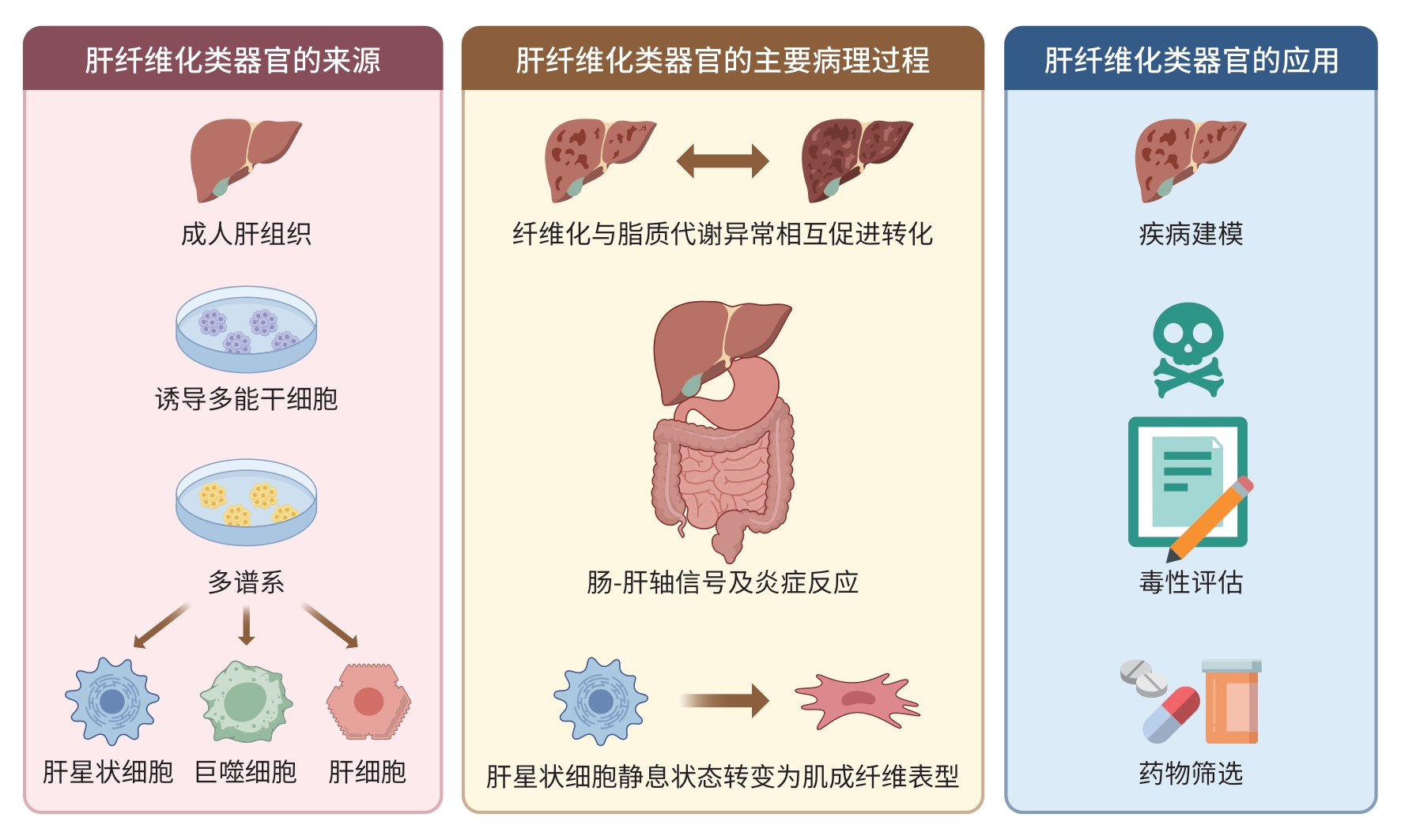
摘要: 肝纤维化是慢性肝病进展过程中的重要病理阶段,其发展涉及肝星状细胞异常活化、细胞外基质沉积等多种机制的相互作用。由于传统动物模型和二维细胞培养体系难以真实模拟人类肝纤维化过程中复杂的多细胞相互作用及代谢微环境,三维肝类器官技术逐渐被应用于肝纤维化模型的构建,并为机制研究和治疗评估提供了新的研究手段。本文围绕肝纤维化类器官相关模型的构建,重点阐述类器官模型中肝星状细胞异常激活、慢性炎症反应、肠-肝轴信号及脂质代谢异常相关机制与肝纤维化进展之间的关系,并总结其在抗肝纤维化药物筛选与靶向治疗评价中的研究现状。最后,简要讨论当前肝纤维化类器官模型存在的局限性及未来研究方向,为肝纤维化的基础研究和临床应用提供理论参考。Abstract: Liver fibrosis is a critical pathological stage in the progression of chronic liver diseases, involving the interaction between multiple mechanisms such as abnormal activation of hepatic stellate cells and extracellular matrix deposition. Since traditional animal models and two-dimensional cell culture systems cannot faithfully recapitulate the complex multicellular interactions and metabolic microenvironment of human liver fibrosis, three-dimensional liver organoid technologies have gradually been used in the construction of liver fibrosis models, providing novel research methods for mechanistic studies and therapeutic evaluation. Focusing on the construction of liver fibrosis-related organoid models, this article elaborates on the association of abnormal activation of hepatic stellate cells, chronic inflammatory response, gut-liver axis signaling, and lipid metabolic dysregulation with the progression of liver fibrosis and summarizes the current research advances in the application of organoid models for anti-fibrotic drug screening and targeted therapeutic assessment. Finally, this article briefly discusses the limitations of existing organoid models for liver fibrosis and future research directions, in order to provide a theoretical reference for both basic research and clinical application in liver fibrosis.
-
Key words:
- Liver Fibrosis /
- Organoid /
- Hepatic Stellate Cells /
- Drug Evaluation, Preclinical
-
[1] Chen L E, Ye X S, Yang L X, et al. Linking fatty liver diseases to hepatocellular carcinoma by hepatic stellate cells[J]. J Natl Cancer Cent, 2024, 4( 1): 25- 35. DOI: 10.1016/j.jncc.2024.01.002. [2] Devarbhavi H, Asrani S K, Arab J P, et al. Global burden of liver disease: 2023 update[J]. J Hepatol, 2023, 79( 2): 516- 537. DOI: 10.1016/j.jhep.2023.03.017. [3] Akkız H, Gieseler R K, Canbay A. Liver fibrosis: From basic science towards clinical progress, focusing on the central role of hepatic stellate cells[J]. Int J Mol Sci, 2024, 25( 14): 7873. DOI: 10.3390/ijms25147873. [4] Hu Y, Geng Q, Wang L, et al. Research progress and application of liver organoids for disease modeling and regenerative therapy[J]. J Mol Med(Berl), 2024, 102( 7): 859- 874. DOI: 10.1007/s00109-024-02455-3. [5] Liu S, Cheng C L, Zhu L Y, et al. Liver organoids: Updates on generation strategies and biomedical applications[J]. Stem Cell Res Ther, 2024, 15( 1): 244. DOI: 10.1186/s13287-024-03865-3. [6] Liedtke C, Nevzorova Y A, Luedde T, et al. Liver fibrosis-from mechanisms of injury to modulation of disease[J]. Front Med, 2021, 8: 814496. DOI: 10.3389/fmed.2021.814496. [7] Takebe T, Sekine K, Enomura M, et al. Vascularized and functional human liver from an iPSC-derived organ bud transplant[J]. Nature, 2013, 499( 7459): 481- 484. DOI: 10.1038/nature12271. [8] Mochida T, Miyoshi M, Kakinuma S, et al. Crosstalk via ICAM-1 enhances supportive phenotype of stellate cells and drives hepatocyte proliferation in iPSC-derived hepatic organoids[J]. Stem Cell Reports, 2025, 20( 10): 102642. DOI: 10.1016/j.stemcr.2025.102642. [9] Elbadawy M, Yamanaka M, Goto Y, et al. Efficacy of primary liver organoid culture from different stages of non-alcoholic steatohepatitis(NASH) mouse model[J]. Biomaterials, 2020, 237: 119823. DOI: 10.1016/j.biomaterials.2020.119823. [10] Guan Y, Fang Z Q, Hu A, et al. Live-cell imaging of human liver fibrosis using hepatic micro-organoids[J]. JCI Insight, 2024, 10( 2): e187099. DOI: 10.1172/jci.insight.187099. [11] Dowbaj A M, Sljukic A, Niksic A, et al. Mouse liver assembloids model periportal architecture and biliary fibrosis[J]. Nature, 2025, 644( 8076): 473- 482. DOI: 10.1038/s41586-025-09183-9. [12] Dewidar B, Meyer C, Dooley S, et al. TGF-β in hepatic stellate cell activation and liver fibrogenesis-updated 2019[J]. Cells, 2019, 8( 11): 1419. DOI: 10.3390/cells8111419. [13] Sugimoto A, Saito Y, Wang G X, et al. Hepatic stellate cells control liver zonation, size and functions via R-spondin 3[J]. Nature, 2025, 640( 8059): 752- 761. DOI: 10.1038/s41586-025-08677-w. [14] Navik U, Singh S K, Khurana A, et al. Revolutionizing liver fibrosis research: The promise of 3D organoid models in understanding and treating chronic liver disease[J]. Expert Rev Gastroenterol Hepatol, 2025, 19( 2): 105- 110. DOI: 10.1080/17474124.2025.2455581. [15] Shek D, Chen D S, Read S A, et al. Examining the gut-liver axis in liver cancer using organoid models[J]. Cancer Lett, 2021, 510: 48- 58. DOI: 10.1016/j.canlet.2021.04.008. [16] Shao W D, Xu H, Zeng K H, et al. Advances in liver organoids: Replicating hepatic complexity for toxicity assessment and disease modeling[J]. Stem Cell Res Ther, 2025, 16( 1): 27. DOI: 10.1186/s13287-025-04139-2. [17] Bi G Y, Zhang X, Li W H, et al. Modeling alcohol-associated liver disease in humans using adipose stromal or stem cell-derived organoids[J]. Cell Rep Methods, 2024, 4( 5): 100778. DOI: 10.1016/j.crmeth.2024.100778. [18] Li X M, Fu G X, Zhang L, et al. Assay establishment and validation of a high-throughput organoid-based drug screening platform[J]. Stem Cell Res Ther, 2022, 13( 1): 219. DOI: 10.1186/s13287-022-02902-3. [19] Luce E, Messina A, Duclos-Vallée J C. Hepatic organoids as a platform for liver disease modeling and the development of novel therapies[J]. Clin Res Hepatol Gastroenterol, 2025, 49( 7): 102647. DOI: 10.1016/j.clinre.2025.102647. [20] Lee J E, Lee Y J, Yoon J K. Advanced 3D in vitro liver fibrosis models: Spheroids, organoids, and liver-on-chips[J]. Biomimetics(Basel), 2025, 10( 10): 639. DOI: 10.3390/biomimetics10100639. [21] Leite S B, Roosens T, El Taghdouini A, et al. Novel human hepatic organoid model enables testing of drug-induced liver fibrosis in vitro[J]. Biomaterials, 2016, 78: 1- 10. DOI: 10.1016/j.biomaterials.2015.11.026. [22] Zhao J Q, Huang D Q, Wang J L, et al. Microperfused biomimetic liver-on-a-chip for high-throughput hepatotoxicity screening[J]. Small, 2025, 21( 48): e05653. DOI: 10.1002/smll.202505653. [23] Fang H Y, Xu H Y, Yu J, et al. Human hepatobiliary organoids: Recent advances in drug toxicity verification and drug screening[J]. Biomolecules, 2024, 14( 7): 794. DOI: 10.3390/biom14070794. [24] Nuciforo S, Heim M H. Organoids to model liver disease[J]. JHEP Rep, 2021, 3( 1): 100198. DOI: 10.1016/j.jhepr.2020.100198. [25] Gong D, Mo J Y, Zhai M, et al. Advances, challenges and future applications of liver organoids in experimental regenerative medicine[J]. Front Med, 2024, 11: 1521851. DOI: 10.3389/fmed.2024.1521851. [26] Caiazza C, Parisi S, Caiazzo M. Liver organoids: Updates on disease modeling and biomedical applications[J]. Biology, 2021, 10( 9): 835. DOI: 10.3390/biology10090835. [27] Mugaanyi J, Huang J, Fang J Z, et al. Developments and applications of liver-on-a-chip technology-current status and future prospects[J]. Biomedicines, 2025, 13( 6): 1272. DOI: 10.3390/biomedicines13061272. [28] Yoon Y, Gong S C, Kim M Y, et al. Generation of fibrotic liver organoids using hepatocytes, primary liver sinusoidal endothelial cells, hepatic stellate cells, and macrophages[J]. Cells, 2023, 12( 21): 2514. DOI: 10.3390/cells12212514. [29] Xu J M, Sang X P, He Y F, et al. Lycii radicis cortex alleviates fibrosis in hiPSC-derived multilineage hepatic organoids via the cAMP-PKA pathway[J]. Front Pharmacol, 2025, 16: 1730255. DOI: 10.3389/fphar.2025.1730255. [30] Akbari S, Arslan N, Senturk S, et al. Next-generation liver medicine using organoid models[J]. Front Cell Dev Biol, 2019, 7: 345. DOI: 10.3389/fcell.2019.00345. [31] Karabicici M, Akbari S, Caliskan C, et al. Modeling hepatic fibrosis in TP53 knockout iPSC-derived human liver organoids[J]. Mol Oncol, 2026, 20( 3): 668- 687. DOI: 10.1002/1878-0261.70119. [32] Han D W, Xu K H, Jin Z L, et al. Customized liver organoids as an advanced in vitro modeling and drug discovery platform for non-alcoholic fatty liver diseases[J]. Int J Biol Sci, 2023, 19( 11): 3595- 3613. DOI: 10.7150/ijbs.85145. [33] Hu W L, Wang Y S, Han J L, et al. Microfluidic organ-on-a-chip models for the gut-liver axis: From structural mimicry to functional insights[J]. Biomater Sci, 2025, 13( 7): 1624- 1656. DOI: 10.1039/d4bm01273a. [34] Lederer A K, Görrissen N, Nguyen T T, et al. Exploring the effects of gut microbiota on cholangiocarcinoma progression by patient-derived organoids[J]. J Transl Med, 2025, 23( 1): 34. DOI: 10.1186/s12967-024-06012-x. [35] He Jiarui, Li Yongnan, Li Jian, et al. Application of organoids in liver diseases research[J]. Chin J Dig Surg, 2025, 24( 5): 657- 664. DOI: 10.3760/cma.j.cn115610-20250121-00031.何佳睿, 李勇男, 李鉴, 等. 类器官在肝脏疾病研究中的应用[J]. 中华消化外科杂志, 2025, 24( 5): 657- 664. DOI: 10.3760/cma.j.cn115610-20250121-00031. -

 下载:
 本文二维码
图(1)
计量
- 文章访问数: 12
- HTML全文浏览量: 5
- PDF下载量: 0
- 被引次数: 0