PDF下载 ( 1431 KB)

声动力疗法在肝细胞癌中的应用
DOI: 10.12449/JCH260528
利益冲突声明:本文不存在任何利益冲突。
作者贡献声明:张雪柠负责课题设计,资料分析,撰写论文;左梓峰、闫慧敏和张杨参与收集数据,修改论文;盖永浩负责拟定写作思路,指导撰写文章并最后定稿。
-
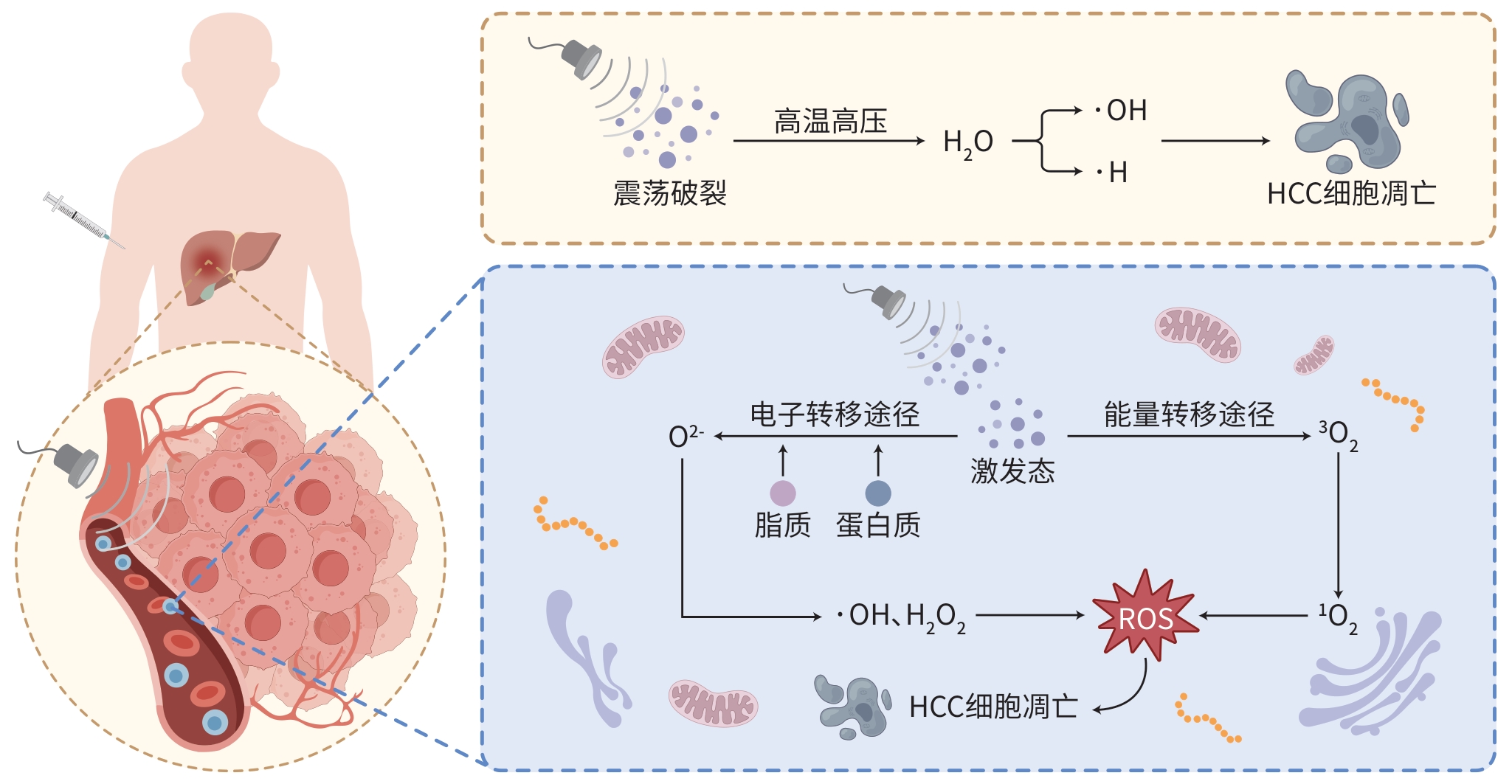
摘要: 声动力疗法(SDT)是利用低频超声激活富集于肿瘤部位的声敏剂,通过空化效应原位产生活性氧(ROS),从而实现对肿瘤的精准、高效治疗。借助其强穿透性、治疗范围可控等优势,SDT备受青睐并被广泛应用于多种肿瘤的治疗研究中。在肝细胞癌(HCC)的治疗中,传统疗法虽已取得显著成效,但存在一定的局限性。基于此,以纳米医学为基础的SDT,通过纳米药物靶向性能实现特异性杀伤HCC,并能与光动力疗法、化疗及免疫疗法产生协同效应,从而为开发新型HCC治疗模式提供了契机。本文系统综述SDT的作用机制及其在HCC治疗中的研究与应用进展,分析当前研究的不足,并提出对未来的展望,以期为HCC的相关研究提供理论基础与科学指导。Abstract: Sonodynamic therapy (SDT) applies low-frequency ultrasound to activate sonosensitizers that have accumulated in tumor location, which induces cavitation effects and leads to the in-situ generation of reactive oxygen species (ROS), thereby achieving precise and efficient tumor treatment. Owing to its advantages such as deep tissue penetration and controllable treatment range, SDT has attracted significant attention and has been widely used in the research on the treatment of various tumors. While conventional treatment modalities have achieved significant efficacy in the treatment of hepatocellular carcinoma (HCC), there are still certain limitations. In this context, nanomedicine-based SDT leverages the targeting capabilities of nano-agents to realize specific killing of HCC cells, and furthermore, it can synergize with photodynamic therapy, chemotherapy, and immunotherapy to provide new opportunities for developing novel treatment modalities for HCC. This article reviews the mechanism of action of SDT and the advances in the research and application of SDT in the treatment of HCC, analyzes the shortcomings of existing studies, and proposes the directions for future development, in order to provide a theoretical foundation and scientific guidance for related research on HCC.
-
Key words:
- Carcinoma, Hepatocellular /
- Sonodynamic Therapy /
- Reactive Oxygen Species
-
[1] LEE DD, CROOME KP, SHALEV JA, et al. Early allograft dysfunction after liver transplantation: An intermediate outcome measure for targeted improvements[J]. Ann Hepatol, 2016, 15( 1): 53- 60. DOI: 10.5604/16652681.1184212. [2] HUANG YX, OUYANG WH, LAI ZJ, et al. Nanotechnology-enabled sonodynamic therapy against malignant tumors[J]. Nanoscale Adv, 2024, 6( 8): 1974- 1991. DOI: 10.1039/d3na00738c. [3] SON S, KIM JH, WANG XW, et al. Multifunctional sonosensitizers in sonodynamic cancer therapy[J]. Chem Soc Rev, 2020, 49( 11): 3244- 3261. DOI: 10.1039/c9cs00648f. [4] KOOIMAN K, ROOVERS S, LANGEVELD SAG, et al. Ultrasound-responsive cavitation nuclei for therapy and drug delivery[J]. Ultrasound Med Biol, 2020, 46( 6): 1296- 1325. DOI: 10.1016/j.ultrasmedbio.2020.01.002. [5] ALPHANDÉRY E. Ultrasound and nanomaterial: An efficient pair to fight cancer[J]. J Nanobiotechnology, 2022, 20( 1): 139. DOI: 10.1186/s12951-022-01243-w. [6] YANG YR, HUANG J, LIU M, et al. Emerging sonodynamic therapy-based nanomedicines for cancer immunotherapy[J]. Adv Sci, 2023, 10( 2): 2204365. DOI: 10.1002/advs.202204365. [7] YU P, ZHANG X, LIU N, et al. Pyroptosis: Mechanisms and diseases[J]. Signal Transduct Target Ther, 2021, 6( 1): 128. DOI: 10.1038/s41392-021-00507-5. [8] ZHANG NS, DAI ZF. Utilizing sonodynamic therapy-induced pyroptosis for liver cancer therapy[J]. J Sichuan Univ Med Sci, 2024, 55( 5): 1329- 1335. DOI: 10.12182/20240960210.张妮丝, 戴志飞. 利用声动力作用诱导细胞焦亡的肝癌治疗方式[J]. 四川大学学报(医学版), 2024, 55( 5): 1329- 1335. DOI: 10.12182/20240960210. [9] LIN XH, LIU SY, ZHANG X, et al. An ultrasound activated vesicle of Janus Au-MnO nanoparticles for promoted tumor penetration and sono-chemodynamic therapy of orthotopic liver cancer[J]. Angew Chem Int Ed, 2020, 59( 4): 1682- 1688. DOI: 10.1002/anie.201912768. [10] LI YJ, CHEN W, KANG Y, et al. Nanosensitizer-mediated augmentation of sonodynamic therapy efficacy and antitumor immunity[J]. Nat Commun, 2023, 14( 1): 6973. DOI: 10.1038/s41467-023-42509-7. [11] CHANG CC, DINH TK, LEE YA, et al. Nanoparticle delivery of Mno2 and antiangiogenic therapy to overcome hypoxia-driven tumor escape and suppress hepatocellular carcinoma[J]. ACS Appl Mater Interfaces, 2020, 12( 40): 44407- 44419. DOI: 10.1021/acsami.0c08473. [12] LIAO M, CHEN F, CHEN L, et al. Synergistic enzyme-mimetic catalysis-based non-thermal sonocavitation and sonodynamic therapy for efficient hypoxia relief and cancer ablation[J]. Small, 2023, 19( 42): e2302744. DOI: 10.1002/smll.202302744. [13] SONG QF, WANG AN, ZHANG YQ, et al. A transformable and self-oxygenated smart probe for enhanced tumor sonodynamic therapy[J]. Acta Biomater, 2024, 184: 409- 418. DOI: 10.1016/j.actbio.2024.06.019. [14] NIU BY, LIAO KX, ZHOU YX, et al. Application of glutathione depletion in cancer therapy: Enhanced ROS-based therapy, ferroptosis, and chemotherapy[J]. Biomaterials, 2021, 277: 121110. DOI: 10.1016/j.biomaterials.2021.121110. [15] XU QB, ZHAN GT, ZHANG ZL, et al. Manganese porphyrin-based metal-organic framework for synergistic sonodynamic therapy and ferroptosis in hypoxic tumors[J]. Theranostics, 2021, 11( 4): 1937- 1952. DOI: 10.7150/thno.45511. [16] XU MM, ZHOU LQ, ZHENG L, et al. Sonodynamic therapy-derived multimodal synergistic cancer therapy[J]. Cancer Lett, 2021, 497: 229- 242. DOI: 10.1016/j.canlet.2020.10.037. [17] FAN SS, ZHANG Y, TAN HS, et al. Manganese/iron-based nanoprobes for photodynamic/chemotherapy combination therapy of tumor guided by multimodal imaging[J]. Nanoscale, 2021, 13( 10): 5383- 5399. DOI: 10.1039/d0nr08831e. [18] XING LJ, YANG XT, BAI JH, et al. Use of UMFNPs/Ce6@MBs in multimodal imaging-guided sono-photodynamic combination therapy for hepatocellular carcinoma[J]. Biomater Sci, 2024, 13( 1): 179- 192. DOI: 10.1039/d4bm00613e. [19] ZHU JX, WANG YF, YANG PP, et al. GPC3-targeted and curcumin-loaded phospholipid microbubbles for sono-photodynamic therapy in liver cancer cells[J]. Colloids Surf B Biointerfaces, 2021, 197: 111358. DOI: 10.1016/j.colsurfb.2020.111358. [20] ZHU JX, ZHU WT, HU JH, et al. Curcumin-loaded poly(L-lactide-co-glycolide) microbubble-mediated sono-photodynamic therapy in liver cancer cells[J]. Ultrasound Med Biol, 2020, 46( 8): 2030- 2043. DOI: 10.1016/j.ultrasmedbio.2020.03.030. [21] WANG CJ, WANG HZ, LI W. A novel conjunction of folate-targeted carbon nanotubes containing protohemin and oridonin-liposome loaded microbubbles for cancer chemo-sonodynamic therapy[J]. J Drug Target, 2019, 27( 10): 1076- 1083. DOI: 10.1080/1061186X.2019.1591422. [22] SHEN S, WU L, LIU JJ, et al. Core-shell structured Fe3O4@TiO2-doxorubicin nanoparticles for targeted chemo-sonodynamic therapy of cancer[J]. Int J Pharm, 2015, 486( 1-2): 380- 388. DOI: 10.1016/j.ijpharm.2015.03.070. [23] GAO XJ, BAO K, ZHANG YQ, et al. The synergistic effects of multidrug-loaded nanocarriers improve tumor microenvironment responsive chemo-sonodynamic therapy of hepatocellular carcinoma[J]. Adv Funct Materials, 2023, 33( 29): 2215014. DOI: 10.1002/adfm.202215014. [24] ZHANG WY, HAN B, GAO CY, et al. Integrated platform of oxygen self-enriched nanovesicles: SP94 peptide-directed chemo/sonodynamic therapy for liver cancer[J]. Eur J Pharm Biopharm, 2022, 179: 206- 220. DOI: 10.1016/j.ejpb.2022.09.012. [25] DONNE R, LUJAMBIO A. The liver cancer immune microenvironment: Therapeutic implications for hepatocellular carcinoma[J]. Hepatology, 2023, 77( 5): 1773- 1796. DOI: 10.1002/hep.32740. [26] XU HC, WANG FL, XIE LH. Current status and perspectives in clinical treatment of intermediate and advanced primary hepatocellular carcinoma[J]. J Changchun Univ Chin Med, 2024, 40( 1): 103- 107. DOI: 10.13463/j.cnki.cczyy.2024.01.024.许华晨, 王凤玲, 谢林虎. 中晚期原发性肝细胞癌的临床治疗现状与展望[J]. 长春中医药大学学报, 2024, 40( 1): 103- 107. DOI: 10.13463/j.cnki.cczyy.2024.01.024. [27] LLOVET JM, CASTET F, HEIKENWALDER M, et al. Immunotherapies for hepatocellular carcinoma[J]. Nat Rev Clin Oncol, 2022, 19( 3): 151- 172. DOI: 10.1038/s41571-021-00573-2. [28] XU JC, PEI ZF, WANG YJ, et al. Bioactive microspheres to enhance sonodynamic-embolization-metalloimmune therapy for orthotopic liver cancer[J]. Biomaterials, 2025, 317: 123063. DOI: 10.1016/j.biomaterials.2024.123063. -

 下载:
下载:
 本文二维码
本文二维码
图(1)
计量
- 文章访问数: 514
- HTML全文浏览量: 119
- PDF下载量: 109
- 被引次数: 0