PDF下载 ( 723 KB)

基于目标导向的原发性肝癌中医药防治疗效评价体系的构建
DOI: 10.12449/JCH260504
利益冲突声明:本文不存在任何利益冲突。
作者贡献声明:张宁负责撰写论文;陆荫英负责拟定写作思路、提出核心观点并指导论文撰写。
Construction of a goal-oriented efficacy evaluation system for traditional Chinese medicine in the prevention and treatment of primary liver cancer
-
摘要: 中医药在原发性肝癌全周期管理中发挥着重要作用,以肿瘤客观缓解为主要评价指标、以随机对照试验和系统评价/荟萃分析为核心的循证医学评价体系不能充分呈现中医药的特点与优势。本文在现有中医防治原发性肝癌疗效评价现状的基础上,提出构建以分期论治的阶段目标为导向、融合终点性指标与过程性指标的多维评价体系。前者包括总生存期、无复发生存期等现代医学终点指标;后者涵盖中医证候改善、患者报告结局、不良反应缓解率及主方案停药率等短期疗效内容。强调中医药方案的总结应遵循“理论内涵-验案积累-观察性评价-干预性评价”的递进顺序。同时,建议将人工智能方法融入该评价体系,以推动疗效评价的智能化与精准化。
-
关键词:
- 肝肿瘤 /
- 中医药疗法 /
- 实体肿瘤疗效评价标准
Abstract: Traditional Chinese medicine (TCM) plays an important role in the full-cycle management of primary liver cancer; however, the current evidence-based evaluation system with the main assessment index of objective tumor remission is mainly centered on randomized controlled trials and systematic reviews/meta-analyses and cannot fully reflect the characteristics and advantages of TCM. Based on the current status of TCM efficacy evaluation in the prevention and treatment of liver cancer, this article proposes the construction of a multi-dimensional evaluation system that is oriented by stage-specific treatment goals and integrates outcome indicators with process indicators. Outcome indicators include modern medical endpoints such as overall survival and recurrence-free survival, and process indicators include short-term outcomes such as the improvement in TCM syndrome, patient-reported outcomes, the remission rate of adverse events, and the discontinuation rate of the core regimen. It is emphasized that the development of standardized TCM regimens should follow the order of theoretical connotation, accumulation of proven cases, observational evaluation, and interventional evaluation. Furthermore, it is recommended to incorporate artificial intelligence approaches into this evaluation system, so as to promote the intelligent and precise assessment of TCM efficacy. -
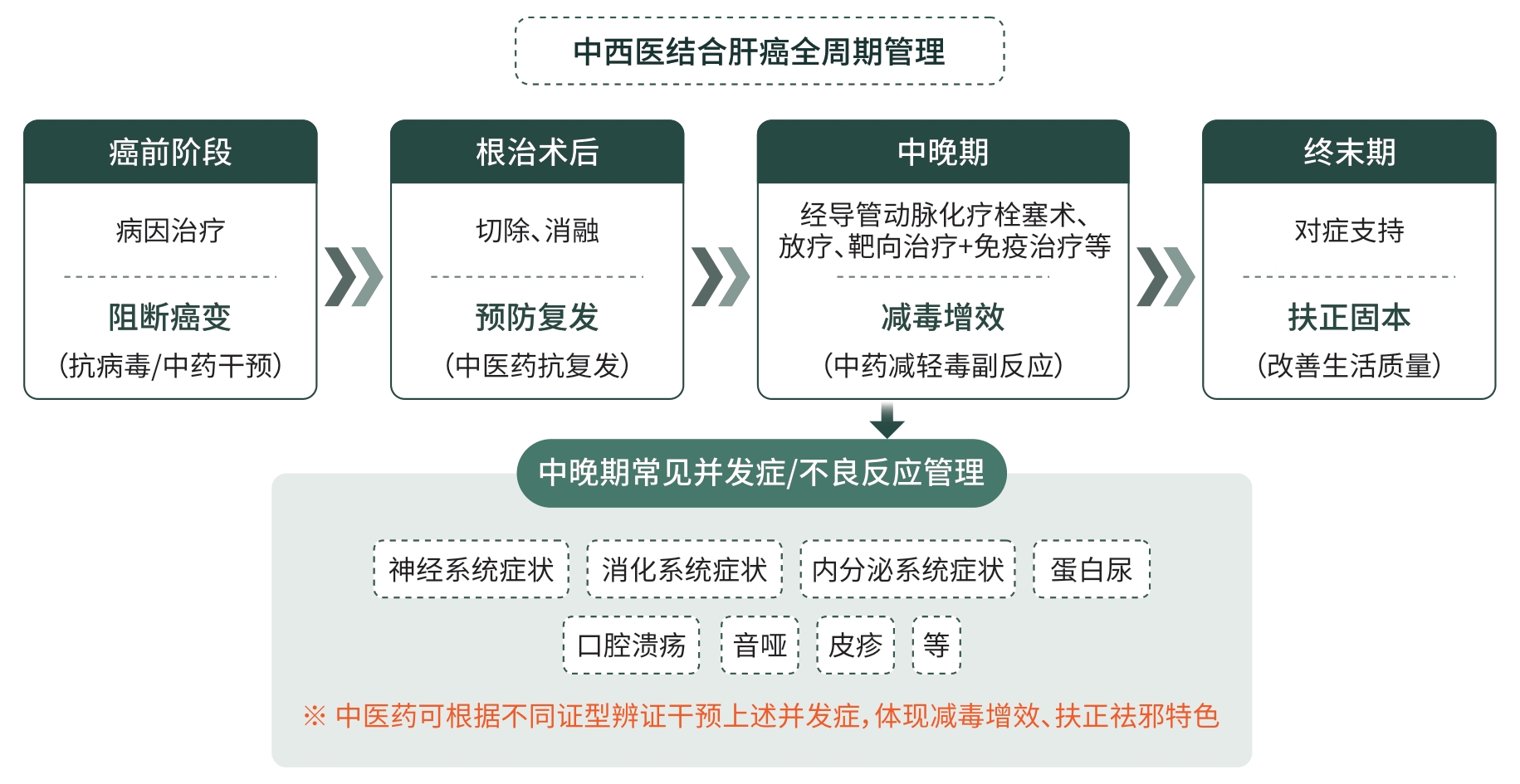
图 1 中西医结合肝癌全周期管理及不同阶段中西医结合的干预目标
Figure 1. Whole-cycle management of liver cancer with integrated traditional Chinese and Western medicine, and intervention goals of integrated Chinese and Western medicine at different stages
表 1 基于目标导向的肝癌中医药防治疗效评价指标选择与研究设计
Table 1. Goal-oriented selection of evaluation indicators and research design for traditional Chinese medicine intervention in liver cancer prevention and treatment
指标类别 具体指标 癌前阶段 根治术后 中晚期 终末期 终点事件指标 总生存期 √ √ √ 无复发生存期 √ 无进展生存期 √ √ 肝癌发生率 √ 肝癌复发率 √ 死亡率 √ √ 肿瘤缓解指标 客观缓解率 √ 疾病控制率 √ 过程性指标 并发症改善 √ √ 不良反应缓解率 √ 主方案停药率 √ 依从性 √ √ √ √ 无创评估模型 肝脏弹性检测 √ 肝纤维化4因子指数 √ 年龄-男性-白蛋白-胆红素-血小板肝癌风险评分 √ 生物标志物 免疫功能指标 √ √ √ √ 肿瘤标志物 √ √ √ 肝功能指标 √ √ √ √ 患者综合状态 疼痛评分 √ 营养评分 √ 心理评估 √ EORTC QLQ-C30 √ √ √ √ 健康调查简表等 √ √ √ √ ECOG体力状况评分 √ √ √ √ KPS评分 √ √ √ √ 中医特色评价 体质评分 √ √ √ 证候积分 √ √ √ 症状评分 √ √ 舌象改善 √ √ √ √ 研究设计推荐 随机对照试验 真实世界研究 评价周期 长 短 注:EORTC QLQ-C30,欧洲癌症研究与治疗组织生活质量问卷核心量表;ECOG体力状况评分,美国东部肿瘤协作组体力状况评分;KPS评分,卡尔诺夫斯基体力状况评分。
 下载: 导出CSV
-
[1] Chinese Society of Liver Cancer, Chinese Anti-Cancer Association. Chinese expert consensus on multidisciplinary treatment of liver cancer[J]. J Clin Hepatol, 2025, 41( 7): 1279- 1286. DOI: 10.12449/JCH250709.中国抗癌协会肝癌专业委员会. 中国肝癌多学科综合治疗专家共识(2025年版)[J]. 临床肝胆病杂志, 2025, 41( 7): 1279- 1286. DOI: 10.12449/JCH250709. [2] Branch of Hepatobiliary Diseases, China Association of Chinese Medicine. Guideline for traditional Chinese medicine diagnosis and treatment of primary liver cancer[J]. J Clin Hepatol, 2024, 40( 5): 919- 927. DOI: 10.12449/JCH240509.中华中医药学会肝胆病分会. 原发性肝癌中医诊疗指南[J]. 临 床肝胆病杂志, 2024, 40( 5): 919- 927. DOI: 10.12449/JCH240509. [3] JI D, CHEN Y, BI JF, et al. Entecavir plus Biejia-Ruangan compound reduces the risk of hepatocellular carcinoma in Chinese patients with chronic hepatitis B[J]. J Hepatol, 2022, 77( 6): 1515- 1524. DOI: 10.1016/j.jhep.2022.07.018. [4] CHEN Q, SHU C, LAURENCE AD, et al. Effect of Huaier granule on recurrence after curative resection of HCC: A multicentre, randomised clinical trial[J]. Gut, 2018, 67( 11): 2006- 2016. DOI: 10.1136/gutjnl-2018-315983. [5] FENG QT, HU JJ, YU S, et al. Efficacy of Jiedu formula(解毒方) as adjuvant therapy for early recurrence of hepatocellular carcinoma after radical surgery: A propensity score matching study[J]. J Tradit Chin Med, 2025, 45( 2): 443- 449. DOI: 10.19852/j.cnki.jtcm.2025.02.019. [6] YUAN HX, NIU QQ, SHANG XF, et al. Impact of traditional Chinese medicine on prognosis of patients with hepatocellular carcinoma: A retrospective cohort study[J]. Integr Cancer Ther, 2023, 22: 15347354231170536. DOI: 10.1177/15347354231170536. [7] YU Y, WU TT, WU MR, et al. Evidence map of traditional Chinese exercises[J]. Front Public Health, 2024, 12: 1347201. DOI: 10.3389/fpubh.2024.1347201. [8] MUZELLEC L, BOURIEN H, EDELINE J. Patients’ experience of systemic treatment of hepatocellular carcinoma: A review of the impact on quality of life[J]. Cancers(Basel), 2021, 14( 1): 179. DOI: 10.3390/cancers14010179. [9] CHUNG EZ, SFERRAZZA D, LEE SF, et al. Comparing FACT and EORTC QLQ modules for the assessment of quality of life in patients with hepatobiliary cancers[J]. Curr Opin Support Palliat Care, 2025, 19: 203- 213. DOI: 10.1097/SPC.0000000000000764. [10] YU GH, SONG CY, SONG X. Effect evaluation of Kushen Huangqi decoction combined with Aidi injection in the treatment of primary liver cancer[J]. Tianjin Med J, 2025, 53( 4): 429- 433. DOI: 10.11958/20242336.于光华, 宋春燕, 宋雪. 苦参黄芪汤联合艾迪注射液治疗原发性肝癌的效果评价[J]. 天津医药, 2025, 53( 4): 429- 433. DOI: 10.11958/20242336. [11] CHENG Y, WANG HY, WAN CY, et al. Efficacy and safety of Erzhu Jiedu Decoction Granules in treating mid-advanced hepatitis B virus-associated primary liver cancer patients with Pi(Spleen)-deficiency and dampness-heat syndrome[J]. Chin J Integr Med, 2025, 31: 394- 401. DOI: 10.1007/s11655-024-3818-1. [12] YAN HT, LI YJ, GUO B, et al. The effect of traditional Chinese medicine on patients undergoing targeted therapy for primary liver cancer: a systematic review and meta-analysis[J]. Front Oncol, 2025, 15: 1674965. DOI: 10.3389/fonc.2025.1674965. [13] CHEN XL, WANG P, YANG MD, et al. Therapeutic effect of Jianpi Liqi Fang combined with transcatheter arterial chemoembolization in patients with hepatocellular carcinoma and spleen deficiency syndrome[J]. J Tradit Chin Med, 2021, 41: 157- 166. DOI: 10.19852/j.cnki.jtcm.2021.01.018. [14] KONG Y, ZHU XN, ZHANG X, et al. Traditional Chinese medicine combined with radiofrequency ablation improves primary liver cancer outcomes: A systematic review with meta-analysis[J]. Heliyon, 2023, 9: e18591. DOI: 10.1016/j.heliyon.2023.e18591. [15] PU Q, YU LH, WANG XH, et al. Immunomodulatory effect of traditional Chinese medicine combined with systemic therapy on patients with liver cancer: A systemic review and network meta-analysis[J]. J Cancer, 2022, 13( 11): 3280- 3296. DOI: 10.7150/jca.74829. [16] ZHOU TH, ZHANG YY, LU YQ, et al. The efficacy of combined use of Huaier Granules in the treatment of primary liver cancer: An updated systematic review and meta-analysis[J]. Pharmaceuticals(Basel), 2025, 18( 6): 884. DOI: 10.3390/ph18060884. [17] CHAN T, YE CY, GUO H Y, et al. Liver elastography-based risk score for predicting hepatocellular carcinoma risk[J]. J Natl Cancer Inst, 2025, 117( 4): 761- 771. DOI: 10.1093/jnci/djae304. [18] CHOI J, NGUYEN VH, PRZYBYSZEWSKI E, et al. Statin use and risk of hepatocellular carcinoma and liver fibrosis in chronic liver disease[J]. JAMA Intern Med, 2025, 185( 5): 522- 530. DOI: 10.1001/jamainternmed.2025.0115. [19] FAN R, PAPATHEODORIDIS G, SUN J, et al. aMAP risk score predicts hepatocellular carcinoma development in patients with chronic hepatitis[J]. J Hepatol, 2020, 73( 6): 1368- 1378. DOI: 10.1016/j.jhep.2020.07.025. [20] WANG YY, LIN WF, HUANG GK, et al. The therapeutic principle of combined clearing heat and resolving toxin plus TACE on primary liver cancer: A systematic review and meta-analysis[J]. J Ethnopharmacol, 2024, 319( Pt 1): 117072. DOI: 10.1016/j.jep.2023.117072. [21] YANG Y, SUN MY, YAO WB, et al. Compound kushen injection relieves tumor-associated macrophage-mediated immunosuppression through TNFR1 and sensitizes hepatocellular carcinoma to sorafenib[J]. J Immunother Cancer, 2020, 8( 1): E000317. DOI: 10.1136/jitc-2019-000317. [22] CUI Z, WANG HJ, LI S, et al. Dihydroartemisinin enhances the inhibitory effect of sorafenib on HepG2 cells by inducing ferroptosis and inhibiting energy metabolism[J]. J Pharmacol Sci, 2022, 148: 73- 85. DOI: 10.1016/j.jphs.2021.09.008. [23] LUO Y, ZHAO X, WANG RL, et al. Integrated evidence chain-based effectiveness evaluation of traditional Chinese medicines(Eff-iEC): A demonstration study[J]. Acta Pharm Sin B, 2025, 15( 2): 909- 918. DOI: 10.1016/j.apsb.2024.12.024. [24] ZHANG P, ZHANG Q, LI S. Advancing cancer prevention through an AI-based integration of traditional and western medicine[J]. Cancer Discov, 2024, 14( 11): 2033- 2036. DOI: 10.1158/2159-8290.CD-24-0832. -

 本文二维码
本文二维码
图(1) / 表(1)
计量
- 文章访问数: 551
- HTML全文浏览量: 214
- PDF下载量: 123
- 被引次数: 0