PDF下载 ( 957 KB)

肝移植术后免疫抑制剂治疗与肠道微生态的相互作用及机制
DOI: 10.12449/JCH260430
利益冲突声明:本文不存在任何利益冲突。
作者贡献声明:王岩负责文章构思和撰写;刘玉凤负责查阅文献并修改文章;张海洋、张志伟对文章知识性内容进行补充;莱智勇负责文章审阅工作;徐钧指导撰写文章并最终定稿。
Mechanism of the interaction between immunosuppressive therapy and intestinal microflora after liver transplantation
-
摘要: 免疫抑制药物的应用显著降低了肝移植术后的排斥反应发生率,然而受患者个体差异影响,其临床疗效仍存在较大波动。本文系统综述了近年来免疫抑制剂与肠道微生态相互作用的研究进展,重点探讨了肠道微生物群落对免疫抑制剂疗效的调控作用及其机制。研究表明,肠道微生物组是维持肝移植术后免疫抑制治疗效果稳定的关键因素之一。本综述旨在为该领域的深入探索提供理论依据,并为开发基于肠道微生态调控的个体化免疫抑制治疗方案提供新思路。Abstract: The application of immunosuppressants has significantly reduced the incidence rate of rejection reaction after liver transplantation, but the clinical efficacy of immunosuppressants is greatly affected by individual differences between patients. This article systematically reviews the recent research advances in the interaction between immunosuppressants and gut microbiota, with a focus on the regulatory role and mechanism of intestinal microflora communities on the efficacy of immunosuppressants. Studies have shown that intestinal microbiome is one of the key factors influencing the efficacy of immunosuppressive therapy after liver transplantation. This review aims to provide a theoretical basis for in-depth research in this field and provide new insights for developing individualized immunosuppressive treatment regimens based on the regulation of intestinal microflora.
-
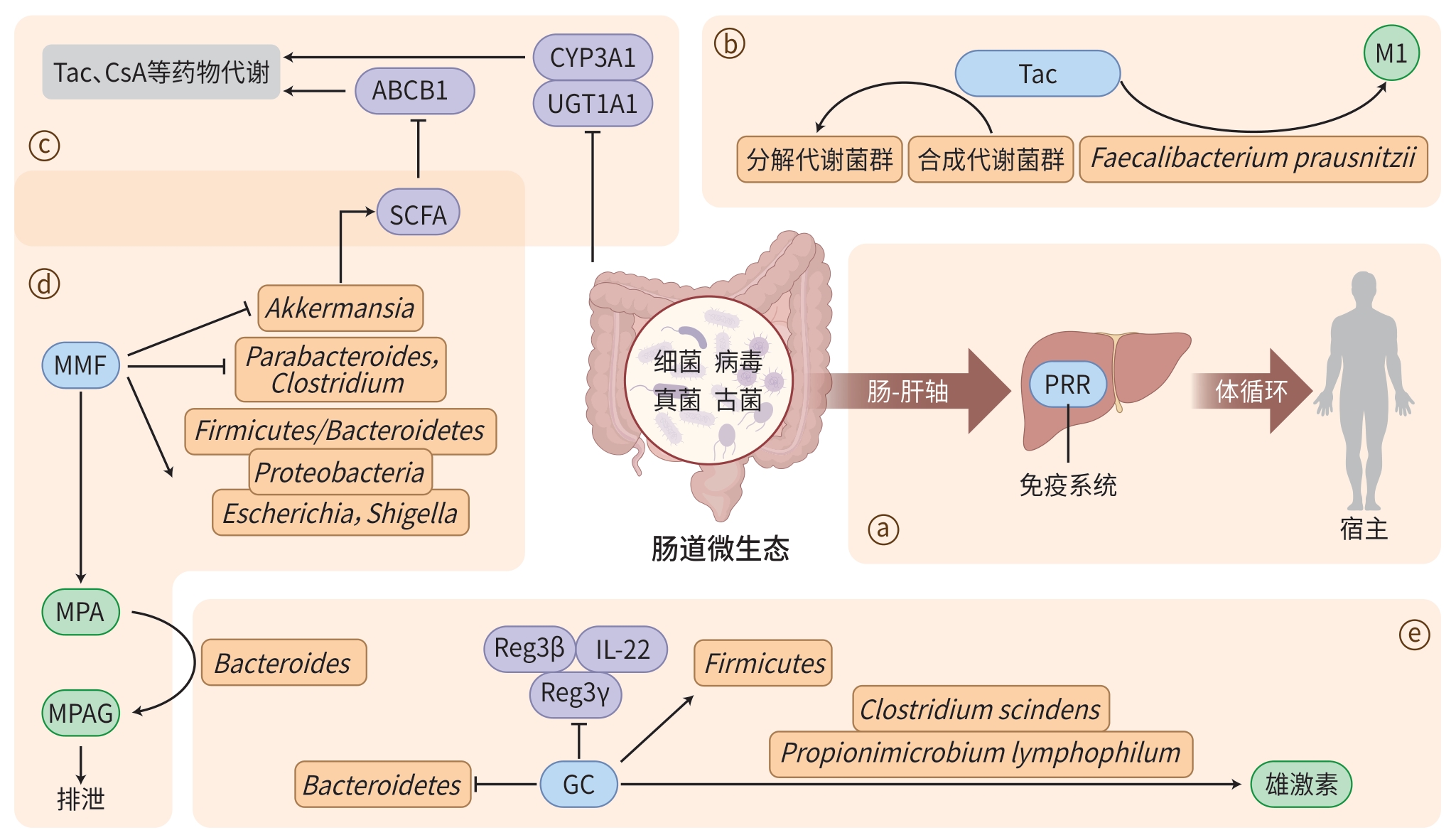
注: a,肠道微生物代谢物通过肠-肝轴进入肝脏与体循环;b,Tac与肠道微生物群之间的相互作用;c,肠道微生物群通过调节蛋白质功能影响免疫抑制剂的药物代谢动力学;d,MMF与肠道微生物群之间的相互作用;e,GC与肠道微生物群之间的相互作用及其对肠道免疫功能的调节作用。PRR,模式识别受体;Tac,他克莫司;M1,Tac代谢物;CsA,环孢素A;ABCB1,三磷酸腺苷结合盒亚家族B成员1;UGT1A1,UDP-葡萄糖醛酸转移酶1家族多肽A1;CYP3A1,细胞色素P450 3A1;SCFA,短链脂肪酸;MMF,吗替麦考酚酯;MPA,霉酚酸;MPAG,霉酚酸葡萄糖醛酸苷;GC,糖皮质激素;Reg3γ,再生胰岛衍生蛋白3γ;Reg3β,再生胰岛衍生蛋白3β;IL-22,白细胞介素22。
图 1 肠道微生物与免疫抑制剂之间的关系
Figure 1. The relationship between gut microbes and immunosuppressants
-
[1] LIU J, KONG JJ. Innovations and development in liver transplantation surgery techniques[J]. Ogran Transplant, 2025, 16( 6): 853- 858. DOI: 10.12464/j.issn.1674-7445.2025219.刘军, 孔俊杰. 肝移植手术技术的创新与发展[J]. 器官移植, 2025, 16( 6): 853- 858. DOI: 10.12464/j.issn.1674-7445.2025219. [2] KOSUTA I, KELAVA T, OSTOJIC A, et al. Immunology demystified: A guide for transplant hepatologists[J]. World J Transplant, 2024, 14( 1): 89772. DOI: 10.5500/wjt.v14.i1.89772. [3] CHOUDHARY NS, SAIGAL S, BANSAL RK, et al. Acute and chronic rejection after liver transplantation: What a clinician needs to know[J]. J Clin Exp Hepatol, 2017, 7( 4): 358- 366. DOI: 10.1016/j.jceh.2017.10.003. [4] SWARTE JC, LI YN, HU SX, et al. Gut microbiome dysbiosis is associated with increased mortality after solid organ transplantation[J]. Sci Transl Med, 2022, 14( 660): eabn7566. DOI: 10.1126/scitranslmed.abn7566. [5] WU LJ, YE ZJ, ZHANG XY, et al. Application progress on therapeutic drug monitoring of immunosuppressants in organ transplantation[J]. Drug Eval Res, 2022, 45( 3): 583- 589. DOI: 10.7501/j.issn.1674-6376.2022.03.026.吴灵洁, 叶珍洁, 张晓颖, 等. 免疫抑制剂治疗药物监测在器官移植领域的应用进展[J]. 药物评价研究, 2022, 45( 3): 583- 589. DOI: 10.7501/j.issn.1674-6376.2022.03.026. [6] CAMPAGNE O, MAGER DE, TORNATORE KM. Population pharmacokinetics of tacrolimus in transplant recipients: What did we learn about sources of interindividual variabilities[J]. J Clin Pharmacol, 2019, 59( 3): 309- 325. DOI: 10.1002/jcph.1325. [7] LEMAITRE F, VETHE NT, D'AVOLIO A, et al. Measuring intracellular concentrations of calcineurin inhibitors: Expert consensus from the international association of therapeutic drug monitoring and clinical toxicology expert panel[J]. Ther Drug Monit, 2020, 42( 5): 665- 670. DOI: 10.1097/FTD.0000000000000780. [8] SCHUMACHER L, LEINO AD, PARK JM. Tacrolimus intrapatient variability in solid organ transplantation: A multiorgan perspective[J]. Pharmacotherapy, 2021, 41( 1): 103- 118. DOI: 10.1002/phar.2480. [9] YAN ZH, HAO TY, YAN YF, et al. Quantitative and dynamic profiling of human gut core microbiota by real-time PCR[J]. Appl Microbiol Biotechnol, 2024, 108( 1): 396. DOI: 10.1007/s00253-024-13204-4. [10] ZHANG JY, ZHANG CC, ZHANG QS, et al. Meta-analysis of the effects of proton pump inhibitors on the human gut microbiota[J]. BMC Microbiol, 2023, 23( 1): 171. DOI: 10.1186/s12866-023-02895-w. [11] FISHBEIN SRS, MAHMUD B, DANTAS G. Antibiotic perturbations to the gut microbiome[J]. Nat Rev Microbiol, 2023, 21( 12): 772- 788. DOI: 10.1038/s41579-023-00933-y. [12] WU ZR, ZHOU HJ, LIU DL, et al. Alterations in the gut microbiota and the efficacy of adjuvant probiotic therapy in liver cirrhosis[J]. Front Cell Infect Microbiol, 2023, 13: 1218552. DOI: 10.3389/fcimb.2023.1218552. [13] LAI ZY, CHEN ZK, ZHANG AH, et al. The gut microbiota in liver transplantation recipients during the perioperative period[J]. Front Physiol, 2022, 13: 854017. DOI: 10.3389/fphys.2022.854017. [14] SADRI M, SHAFAGHAT Z, ROOZBEHANI M, et al. Effects of probiotics on liver diseases: Current in vitro and in vivo studies[J]. Probiotics Antimicrob Proteins, 2025, 17( 3): 1688- 1710. DOI: 10.1007/s12602-024-10431-z. [15] ALHOUEI B, ESLAMIAN G, MOHTADI M. A systematic review of the effects of probiotics and synbiotics on infection incidence after liver transplant surgery[J]. Prev Nutr Food Sci, 2025, 30( 2): 101- 109. DOI: 10.3746/pnf.2025.30.2.101. [16] WANG G, HUANG S, WANG YM, et al. Bridging intestinal immunity and gut microbiota by metabolites[J]. Cell Mol Life Sci, 2019, 76( 20): 3917- 3937. DOI: 10.1007/s00018-019-03190-6. [17] SCHROEDER BO, BÄCKHED F. Signals from the gut microbiota to distant organs in physiology and disease[J]. Nat Med, 2016, 22( 10): 1079- 1089. DOI: 10.1038/nm.4185. [18] HACKSTEIN CP, ASSMUS LM, WELZ M, et al. Gut microbial translocation corrupts myeloid cell function to control bacterial infection during liver cirrhosis[J]. Gut, 2017, 66( 3): 507- 518. DOI: 10.1136/gutjnl-2015-311224. [19] AL-RASHIDI HE. Gut microbiota and immunity relevance in eubiosis and dysbiosis[J]. Saudi J Biol Sci, 2022, 29( 3): 1628- 1643. DOI: 10.1016/j.sjbs.2021.10.068. [20] SALIMOV UR, OLEGOVICH SI, ALIAKSEEVICH KA, et al. Gut microbiota might influence the risk of rejection after liver transplantation[J]. J Liver Transplant, 2023, 9: 100140. DOI: 10.1016/j.liver.2023.100140. [21] KATO K, NAGAO M, MIYAMOTO K, et al. Longitudinal analysis of the intestinal microbiota in liver transplantation[J]. Transplant Direct, 2017, 3( 4): e144. DOI: 10.1097/TXD.0000000000000661. [22] GUO YZ, WANG Q, LI DG, et al. Vendor-specific microbiome controls both acute and chronic murine lung allograft rejection by altering CD4+ Foxp3+ regulatory T cell levels[J]. Am J Transplant, 2019, 19( 10): 2705- 2718. DOI: 10.1111/ajt.15523. [23] ZHANG Z, LIU L, TANG H, et al. Immunosuppressive effect of the gut microbiome altered by high-dose tacrolimus in mice[J]. Am J Transplant, 2018, 18( 7): 1646- 1656. DOI: 10.1111/ajt.14661. [24] WEERSMA RK, ZHERNAKOVA A, FU JY. Interaction between drugs and the gut microbiome[J]. Gut, 2020, 69( 8): 1510- 1519. DOI: 10.1136/gutjnl-2019-320204. [25] GUO YK, CRNKOVIC CM, WON KJ, et al. Commensal gut bacteria convert the immunosuppressant tacrolimus to less potent metabolites[J]. Drug Metab Dispos, 2019, 47( 3): 194- 202. DOI: 10.1124/dmd.118.084772. [26] JIANG JW, REN ZG, LU HF, et al. Optimal immunosuppressor induces stable gut microbiota after liver transplantation[J]. World J Gastroenterol, 2018, 24( 34): 3871- 3883. DOI: 10.3748/wjg.v24.i34.3871. [27] DERY KJ, KADONO K, HIRAO H, et al. Microbiota in organ transplantation: An immunological and therapeutic conundrum[J]. Cell Immunol, 2020, 351: 104080. DOI: 10.1016/j.cellimm.2020.104080. [28] ZIMMERMANN M, ZIMMERMANN-KOGADEEVA M, WEGMANN R, et al. Mapping human microbiome drug metabolism by gut bacteria and their genes[J]. Nature, 2019, 570( 7762): 462- 467. DOI: 10.1038/s41586-019-1291-3. [29] QIAN LY, OUYANG HR, GORDILS-VALENTIN L, et al. Identification of gut bacterial enzymes for keto-reductive metabolism of xenobiotics[J]. ACS Chem Biol, 2022, 17( 7): 1665- 1671. DOI: 10.1021/acschembio.2c00312. [30] LEE JR, MUTHUKUMAR T, DADHANIA D, et al. Gut microbiota and tacrolimus dosing in kidney transplantation[J]. PLoS One, 2015, 10( 3): e0122399. DOI: 10.1371/journal.pone.0122399. [31] MOHAMED ME, SCHLADT DP, GUAN WH, et al. Tacrolimus troughs and genetic determinants of metabolism in kidney transplant recipients: A comparison of four ancestry groups[J]. Am J Transplant, 2019, 19( 10): 2795- 2804. DOI: 10.1111/ajt.15385. [32] TILLMAN E, NIKIRK MG, CHEN J, et al. Implementation of clinical cytochrome P450 3A genotyping for tacrolimus dosing in a large kidney transplant program[J]. J Clin Pharmacol, 2023, 63( 8): 961- 967. DOI: 10.1002/jcph.2249. [33] EVERTON JBF, PATRÍCIO FJB, FARIA MS, et al. CYP3A5 and PPARA genetic variants are associated with low trough concentration to dose ratio of tacrolimus in kidney transplant recipients[J]. Eur J Clin Pharmacol, 2021, 77( 6): 879- 886. DOI: 10.1007/s00228-020-03076-8. [34] LIU F, OU YM, YU AR, et al. Long-term influence of CYP3A5, CYP3A4, ABCB1, and NR1I2 polymorphisms on tacrolimus concentration in Chinese renal transplant recipients[J]. Genet Test Mol Biomarkers, 2017, 21( 11): 663- 673. DOI: 10.1089/gtmb.2017.0088. [35] CSIKÁNY N, KISS Á, DÉRI M, et al. Clinical significance of personalized tacrolimus dosing by adjusting to donor CYP3A-status in liver transplant recipients[J]. Br J Clin Pharmacol, 2021, 87( 4): 1790- 1800. DOI: 10.1111/bcp.14566. [36] HU N, LIU X, MU QF, et al. The gut microbiota contributes to the modulation of intestinal CYP3A1 and P-gp in streptozotocin-induced type 1 diabetic rats[J]. Eur J Pharm Sci, 2021, 162: 105833. DOI: 10.1016/j.ejps.2021.105833. [37] HENKEL L, JEHN U, THÖLKING G, et al. Tacrolimus-why pharmacokinetics matter in the clinic[J]. Front Transplant, 2023, 2: 1160752. DOI: 10.3389/frtra.2023.1160752. [38] DEGRAEVE AL, HAUFROID V, LORIOT A, et al. Gut microbiome modulates tacrolimus pharmacokinetics through the transcriptional regulation of ABCB1[J]. Microbiome, 2023, 11( 1): 138. DOI: 10.1186/s40168-023-01578-y. [39] JIA JJ, TIAN XY, JIANG JW, et al. Structural shifts in the intestinal microbiota of rats treated with cyclosporine A after orthotropic liver transplantation[J]. Front Med, 2019, 13( 4): 451- 460. DOI: 10.1007/s11684-018-0675-3. [40] ZHOU JP, ZHANG R, GUO PP, et al. Effects of intestinal microbiota on pharmacokinetics of cyclosporine a in rats[J]. Front Microbiol, 2022, 13: 1032290. DOI: 10.3389/fmicb.2022.1032290. [41] ZHANG JX, XIE QS, KONG WM, et al. Short-chain fatty acids oppositely altered expressions and functions of intestinal cytochrome P4503A and P-glycoprotein and affected pharmacokinetics of verapamil following oral administration to rats[J]. J Pharm Pharmacol, 2020, 72( 3): 448- 460. DOI: 10.1111/jphp.13215. [42] BHAT M, PASINI E, COPELAND J, et al. Impact of immunosuppression on the metagenomic composition of the intestinal microbiome: A systems biology approach to post-transplant diabetes[J]. Sci Rep, 2017, 7( 1): 10277. DOI: 10.1038/s41598-017-10471-2. [43] TOURRET J, WILLING BP, DION S, et al. Immunosuppressive treatment alters secretion of ileal antimicrobial peptides and gut microbiota, and favors subsequent colonization by uropathogenic Escherichia coli[J]. Transplantation, 2017, 101( 1): 74- 82. DOI: 10.1097/TP.0000000000001492. [44] FLANNIGAN KL, TAYLOR MR, PEREIRA SK, et al. An intact microbiota is required for the gastrointestinal toxicity of the immunosuppressant mycophenolate mofetil[J]. J Heart Lung Transplant, 2018, 37( 9): 1047- 1059. DOI: 10.1016/j.healun.2018.05.002. [45] JARDOU M, PROVOST Q, BROSSIER C, et al. Alteration of the gut microbiome in mycophenolate-induced enteropathy: Impacts on the profile of short-chain fatty acids in a mouse model[J]. BMC Pharmacol Toxicol, 2021, 22( 1): 66. DOI: 10.1186/s40360-021-00536-4. [46] SAQR A, CARLSON B, STALEY C, et al. Reduced enterohepatic recirculation of mycophenolate and lower blood concentrations are associated with the stool bacterial microbiome after hematopoietic cell transplantation[J]. Transplant Cell Ther, 2022, 28( 7): 372. DOI: 10.1016/j.jtct.2022.04.018. [47] TAYLOR MR, FLANNIGAN KL, RAHIM H, et al. Vancomycin relieves mycophenolate mofetil-induced gastrointestinal toxicity by eliminating gut bacterial β-glucuronidase activity[J]. Sci Adv, 2019, 5( 8): eaax2358. DOI: 10.1126/sciadv.aax2358. [48] KHAN MH, ONYEAGHALA GC, RASHIDI A, et al. Fecal β-glucuronidase activity differs between hematopoietic cell and kidney transplantation and a possible mechanism for disparate dose requirements[J]. Gut Microbes, 2022, 14( 1): 2108279. DOI: 10.1080/19490976.2022.2108279. [49] WU T, YANG LN, JIANG JG, et al. Chronic glucocorticoid treatment induced circadian clock disorder leads to lipid metabolism and gut microbiota alterations in rats[J]. Life Sci, 2018, 192: 173- 182. DOI: 10.1016/j.lfs.2017.11.049. [50] RIDLON JM, IKEGAWA S, ALVES JMP, et al. Clostridium scindens: A human gut microbe with a high potential to convert glucocorticoids into androgens[J]. J Lipid Res, 2013, 54( 9): 2437- 2449. DOI: 10.1194/jlr.M038869. [51] WU XY, XIA YY, HE F, et al. Intestinal mycobiota in health and diseases: From a disrupted equilibrium to clinical opportunities[J]. Microbiome, 2021, 9( 1): 60. DOI: 10.1186/s40168-021-01024-x. [52] GABARRE P, LOENS C, TAMZALI Y, et al. Immunosuppressive therapy after solid organ transplantation and the gut microbiota: Bidirectional interactions with clinical consequences[J]. Am J Transplant, 2022, 22( 4): 1014- 1030. DOI: 10.1111/ajt.16836. [53] WEI XL, LI L, FAN M, et al. Analysis of fungal infection and risk factors in patients with liver failure after liver transplantation[J]. Trauma Crit Care Med, 2024, 12( 3): 164- 167. DOI: 10.16048/j.issn.2095-5561.2024.03.08.魏希乐, 李琳, 范明, 等. 肝衰竭患者肝移植术后真菌感染情况及危险因素分析[J]. 创伤与急危重病医学, 2024, 12( 3): 164- 167. DOI: 10.16048/j.issn.2095-5561.2024.03.08. [54] GARCIA-BONETE MJ, RAJAN A, SURIANO F, et al. The underrated gut microbiota helminths, bacteriophages, fungi, and Archaea[J]. Life, 2023, 13( 8): 1765. DOI: 10.3390/life13081765. [55] BANG C, WEIDENBACH K, GUTSMANN T, et al. The intestinal Archaea Methanosphaera stadtmanae and Methanobrevibacter smithii activate human dendritic cells[J]. PLoS One, 2014, 9( 6): e99411. DOI: 10.1371/journal.pone.0099411. [56] BLAIS LECOURS P, MARSOLAIS D, CORMIER Y, et al. Increased prevalence of Methanosphaera stadtmanae in inflammatory bowel diseases[J]. PLoS One, 2014, 9( 2): e87734. DOI: 10.1371/journal.pone.0087734. [57] VIERBUCHEN T, BANG C, ROSIGKEIT H, et al. The human-associated archaeon Methanosphaera stadtmanae is recognized through its RNA and induces TLR8-dependent NLRP3 inflammasome activation[J]. Front Immunol, 2017, 8: 1535. DOI: 10.3389/fimmu.2017.01535. [58] BANG C, VIERBUCHEN T, GUTSMANN T, et al. Immunogenic properties of the human gut-associated archaeon Methanomassiliicoccus luminyensis and its susceptibility to antimicrobial peptides[J]. PLoS One, 2017, 12( 10): e0185919. DOI: 10.1371/journal.pone.0185919. [59] HOUSHYAR Y, MASSIMINO L, LAMPARELLI LA, et al. Going beyond bacteria: Uncovering the role of archaeome and mycobiome in inflammatory bowel disease[J]. Front Physiol, 2021, 12: 783295. DOI: 10.3389/fphys.2021.783295. [60] CORNUAULT JK, PETIT MA, MARIADASSOU M, et al. Phages infecting Faecalibacterium prausnitzii belong to novel viral Genera that help to decipher intestinal viromes[J]. Microbiome, 2018, 6( 1): 65. DOI: 10.1186/s40168-018-0452-1. [61] GÓRSKI A, JOŃCZYK-MATYSIAK E, MIĘDZYBRODZKI R, et al." Phage transplantation in allotransplantation": Possible treatment in graft-versus-host disease[J]. Front Immunol, 2018, 9: 941. DOI: 10.3389/fimmu.2018.00941. [62] DERY KJ, GÓRSKI A, MIĘDZYBRODZKI R, et al. Therapeutic perspectives and mechanistic insights of phage therapy in allotransplantation[J]. Transplantation, 2021, 105( 7): 1449- 1458. DOI: 10.1097/TP.0000000000003565. -

 下载:
下载:
 本文二维码
本文二维码
图(1)
计量
- 文章访问数: 466
- HTML全文浏览量: 165
- PDF下载量: 89
- 被引次数: 0