PDF下载 ( 716 KB)

微RNA在代谢相关脂肪性肝病向肝细胞癌进展中的调控作用
DOI: 10.12449/JCH260425
The regulatory role of microRNA in the progression from metabolic dysfunction-associated fatty liver disease to hepatocellular carcinoma
-
摘要: 代谢相关脂肪性肝病(MAFLD)是全球慢性肝病的主要病因,最终可导致肝细胞癌的发生。本文概述了MAFLD的定义演变与流行病学负担,以及微RNA(miRNA)的生物合成与功能;详细综述了不同种类的miRNA通过调节脂质代谢、炎症与肝纤维化、氧化应激、内质网应激以及糖酵解等过程,在MAFLD进展中发挥重要调控作用,同时评估了miRNA作为诊断生物标志物与治疗靶点的应用前景。最后指出,尽管现有研究已揭示miRNA在MAFLD进展中的重要作用,但其临床转化仍面临诸多挑战,未来需开展更大规模研究以明确miRNA在MAFLD诊断与治疗中的实际价值,从而为精准医疗开辟新的路径。Abstract: Metabolic dysfunction-associated fatty liver disease (MAFLD) is the main cause of chronic liver disease around the world and can eventually lead to hepatocellular carcinoma. This article describes the evolution of the definition of MAFLD, the epidemiological burden of MAFLD, and the biosynthesis and biological functions of microRNA (miRNA), as well as the important role of various types of miRNA in the progression of MAFLD by regulating the processes such as lipid metabolism, inflammation and liver fibrosis, oxidative stress, endoplasmic reticulum stress, and glycolysis. This article also evaluates the application prospect of miRNA as diagnostic biomarkers and therapeutic targets. It is pointed out that although existing studies have shown that miRNA plays an important role in the progression of MAFLD, there are still challenges in clinical translation, and large-scale studies should be conducted in the future to clarify the practical value of miRNA in MAFLD diagnosis and treatment, thereby providing new ways for precision medicine.
-
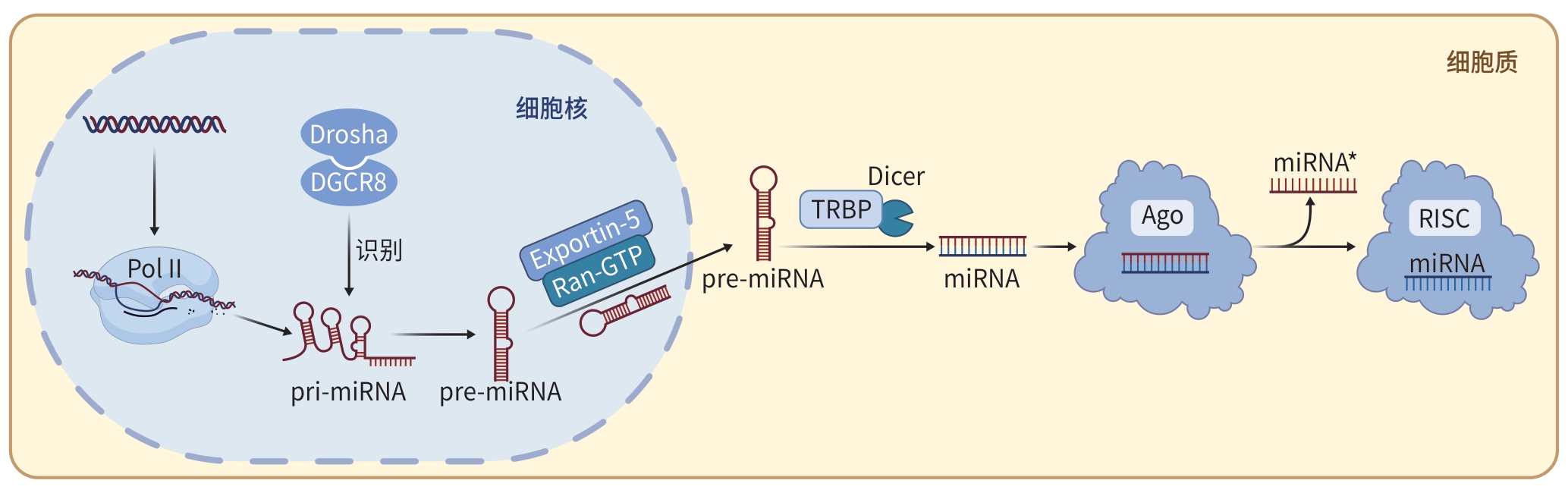
注: Pol Ⅱ,RNA聚合酶Ⅱ;Drosha-DGCR8,微处理器复合物;pri-miRNA,初级miRNA;pre-miRNA,前体miRNA;Ran-GTP,鸟苷三磷酸Ran蛋白;Exportin-5,输出蛋白-5;TRBP,反式激活应答RNA结合蛋白;Dicer,Dicer酶;Ago,Argonaute蛋白;RISC,RNA诱导的沉默复合物。
图 1 miRNA的生物合成过程
Figure 1. Schematic diagram of miRNA biosynthesis
表 1 MAFLD/MASH中与脂代谢相关的miRNA的表达变化、分子机制及治疗潜力
Table 1. Summary of studies on expression changes,molecular mechanisms and therapeutic potential of miRNA related to lipid metabolism in MAFLD/MASH
miRNA 表达变化 核心靶点/通路 功能机制 治疗潜力 文献 miRNA-34a 上调 SIRT1、 PPARα 抑制脂肪酸氧化,促进炎症
反应拮抗剂则改善脂肪
变性[25] miRNA-33b 上调 SREBP-1 促进胆固醇合成 抗miRNA-33b延缓
MASH进展[27] miRNA-30b-5p 下调 SREBP-1 抑制脂质合成基因表达 模拟物减少肝细胞脂
滴积累[28] miRNA-103-3p 上调 ACOX1 抑制过氧化物酶体β氧化 拮抗剂改善氧化应激 [30] miRNA-124-3p 上调(高脂饮食小鼠) Pref-1 负调控Pref-1,促进脂质
积累靶向miRNA-124-3p/Pref-1轴或可改善肝
脂肪变性[32] miRNA-130b-5p 上调 IGFBP2 抑制AKT通路,促进胰岛素
抵抗拮抗剂改善胰岛素敏
感性[34] miRNA-379/miRNA-544簇 上调(高脂饮食小鼠) IGF1R/DLK1信号 簇缺失改善代谢紊乱;
miRNA-379直接抑制IGF1R
和DLK1,促进脂质沉积抑制该簇或可增强胰
岛素样生长因子1信
号,减轻MAFLD[35] 注:SIRT1,去乙酰化酶1;PPARα,过氧化物酶体增殖物激活受体α;SREBP-1,固醇调节元件结合蛋白1;MASH,代谢相关脂肪性肝炎;ACOX1,酰基辅酶A氧化酶1;Pref-1,前脂肪细胞因子1;IGFBP2,胰岛素样生长因子结合蛋白2;AKT,蛋白激酶B;IGF1R胰岛素样生长因子1受体;DLK1,δ样同源物1;MAFLD,代谢相关脂肪性肝病。
 下载: 导出CSV
表 2 MAFLD/MASH中与应激和代谢相关的miRNA的表达变化、分子机制及治疗潜力
Table 2. Summary of studies on expression changes, molecular mechanisms and therapeutic potential of stress and metabolism-related miRNA in MAFLD/MASH
miRNA 表达变化 核心靶点/通路 功能机制 治疗潜力 文献 miRNA-26a 下调(MAFLD) 内质网应激/eIF2α
通路内质网应激诱导miRNA-26a上调,
反馈性缓解内质网应激和脂质积
累;缺失加重肝损伤恢复miRNA-26a水平或可
减轻内质网应激和脂肪
变性[36] miRNA-137-3p 下调(MAFLD) PDE4D/AMPKα
通路激活AMPKα减轻氧化应激和炎症
反应;而拮抗剂则加重高脂肪饮食
诱发的肝损伤miRNA-137-3p类似物或为
抗氧化应激治疗策略[37] miRNA-122-5p 下调(MASH) PKM2/糖酵解途径 下调导致Kupffer细胞Warburg效应
增强,促进炎症反应和癌前病变补充miRNA-122-5p或抑制
PKM2可改善MASH进程[38] miRNA-22 下调(HCC/MASH) TSP1/代谢相关基因 缺失促进肿瘤发生,影响线粒体功
能和代谢重编程;多重调控致癌因
子和分化相关基因miRNA-22替代疗法或可延
缓MASH相关HCC进展[39] 注:MAFLD,代谢相关脂肪性肝病;MASH,代谢相关脂肪性肝炎;eIF2α,真核翻译起始因子2α亚基;PDE4D,磷酸二酯酶4D;AMPKα,腺苷-磷酸活化蛋白激酶α亚基;PKM2,丙酮酸激酶肌肉同工酶2;HCC,肝细胞癌;TSP1,血小板反应蛋白1。
下载: 导出CSV
-
[1] TENG ML, NG CH, HUANG DQ, et al. Global incidence and prevalence of nonalcoholic fatty liver disease[J]. Clin Mol Hepatol, 2023, 29( Suppl): S32- S42. DOI: 10.3350/cmh.2022.0365. [2] RINELLA ME, LAZARUS JV, RATZIU V, et al. A multisociety Delphi consensus statement on new fatty liver disease nomenclature[J]. J Hepatol, 2023, 79( 6): 1542- 1556. DOI: 10.1016/j.jhep.2023.06.003. [3] HUANG DQ, WONG VWS, RINELLA ME, et al. Metabolic dysfunction-associated steatotic liver disease in adults[J]. Nat Rev Dis Primers, 2025, 11( 1): 14. DOI: 10.1038/s41572-025-00599-1. [4] GUO ZW, WU DJ, MAO RH, et al. Global burden of MAFLD, MAFLD related cirrhosis and MASH related liver cancer from 1990 to 2021[J]. Sci Rep, 2025, 15( 1): 7083. DOI: 10.1038/s41598-025-91312-5. [5] WU YK, ZHENG Q, ZOU BY, et al. The epidemiology of NAFLD in Mainland China with analysis by adjusted gross regional domestic product: A meta-analysis[J]. Hepatol Int, 2020, 14( 2): 259- 269. DOI: 10.1007/s12072-020-10023-3. [6] FANG J, CELTON-MORIZUR S, DESDOUETS C. NAFLD-related HCC: Focus on the latest relevant preclinical models[J]. Cancers, 2023, 15( 14): 3723. DOI: 10.3390/cancers15143723. [7] BARTEL DP. Metazoan microRNAs[J]. Cell, 2018, 173( 1): 20- 51. DOI: 10.1016/j.cell.2018.03.006. [8] SHANG RF, LEE S, SENAVIRATHNE G, et al. MicroRNAs in action: Biogenesis, function and regulation[J]. Nat Rev Genet, 2023, 24( 12): 816- 833. DOI: 10.1038/s41576-023-00611-y. [9] BARTEL DP. MicroRNAs: Genomics, biogenesis, mechanism, and function[J]. Cell, 2004, 116( 2): 281- 297. DOI: 10.1016/s0092-8674(04)00045-5. [10] GEBERT LFR, MACRAE IJ. Regulation of microRNA function in animals[J]. Nat Rev Mol Cell Biol, 2019, 20( 1): 21- 37. DOI: 10.1038/s41580-018-0045-7. [11] LEE YS, DUTTA A. MicroRNAs in cancer[J]. Annu Rev Pathol Mech Dis, 2009, 4: 199- 227. DOI: 10.1146/annurev.pathol.4.110807.092222. [12] AHMAD S, KHAN H, MUTHONI NI, et al. Riding the wave of progress: Examining the current landscape and future potential of microRNAs in cancer gene therapy[J]. Curr Gene Ther, 2025. DOI: 10.2174/0115665232353538250318075057.[ Epub ahead of print] [13] VENKATESH S, MANAZ PM, PRIYA MH, et al. Shedding light on the molecular diversities of miRNA in cancer- an exquisite mini review[J]. Mol Biotechnol, 2025, 67( 11): 4025- 4037. DOI: 10.1007/s12033-024-01312-5. [14] MORISHITA A, OURA K, TADOKORO T, et al. MicroRNAs and nonalcoholic steatohepatitis: A review[J]. Int J Mol Sci, 2023, 24( 19): 14482. DOI: 10.3390/ijms241914482. [15] MICHELOTTI GA, MACHADO MV, DIEHL AM. NAFLD, NASH and liver cancer[J]. Nat Rev Gastroenterol Hepatol, 2013, 10( 11): 656- 665. DOI: 10.1038/nrgastro.2013.183. [16] HOCHREUTER MY, DALL M, TREEBAK JT, et al. MicroRNAs in non-alcoholic fatty liver disease: Progress and perspectives[J]. Mol Metab, 2022, 65: 101581. DOI: 10.1016/j.molmet.2022.101581. [17] JOPLING C. Liver-specific microRNA-122: Biogenesis and function[J]. RNA Biol, 2012, 9( 2): 137- 142. DOI: 10.4161/rna.18827. [18] HOSSAIN MM, MISHRA AK, YADAV AK, et al. MicroRNA-122 regulates inflammatory and autophagic proteins by downregulating pyruvate kinase M2 in non-alcoholic fatty liver disease[J]. Mol Cell Biochem, 2025, 480( 5): 3067- 3078. DOI: 10.1007/s11010-024-05174-y. [19] CHAI C, COX B, YAISH D, et al. Agonist of RORA attenuates nonalcoholic fatty liver progression in mice via up-regulation of microRNA 122[J]. Gastroenterology, 2020, 159( 3): 999- 1014.e9. DOI: 10.1053/j.gastro.2020.05.056. [20] CHUN KH. Molecular targets and signaling pathways of microRNA-122 in hepatocellular carcinoma[J]. Pharmaceutics, 2022, 14( 7): 1380. DOI: 10.3390/pharmaceutics14071380. [21] YAMADA H, SUZUKI K, ICHINO N, et al. Associations between circulating microRNAs(miR-21, miR-34a, miR-122 and miR-451) and non-alcoholic fatty liver[J]. Clin Chim Acta, 2013, 424: 99- 103. DOI: 10.1016/j.cca.2013.05.021. [22] XU YY, ZHU YD, HU SW, et al. Hepatocyte miR-34a is a key regulator in the development and progression of non-alcoholic fatty liver disease[J]. Mol Metab, 2021, 51: 101244. DOI: 10.1016/j.molmet.2021.101244. [23] JIAO Y, LU Y, LI XY. Farnesoid X receptor: A master regulator of hepatic triglyceride and glucose homeostasis[J]. Acta Pharmacol Sin, 2015, 36( 1): 44- 50. DOI: 10.1038/aps.2014.116. [24] LEE J, PADHYE A, SHARMA A, et al. A pathway involving farnesoid X receptor and small heterodimer partner positively regulates hepatic sirtuin 1 levels via microRNA-34a inhibition[J]. J Biol Chem, 2010, 285( 17): 12604- 12611. DOI: 10.1074/jbc.M109.094524. [25] DING JX, LI M, WAN XY, et al. Effect of miR-34a in regulating steatosis by targeting PPARα expression in nonalcoholic fatty liver disease[J]. Sci Rep, 2015, 5: 13729. DOI: 10.1038/srep13729. [26] LIU CH, AMPUERO J, GIL-GÓMEZ A, et al. miRNAs in patients with non-alcoholic fatty liver disease: A systematic review and meta-analysis[J]. J Hepatol, 2018, 69( 6): 1335- 1348. DOI: 10.1016/j.jhep.2018.08.008. [27] MIYAGAWA S, HORIE T, NISHINO T, et al. Inhibition of microRNA-33b in humanized mice ameliorates nonalcoholic steatohepatitis[J]. Life Sci Alliance, 2023, 6( 8): e202301902. DOI: 10.26508/lsa.202301902. [28] ZHANG Q, MA XF, DONG MZ, et al. MiR-30b-5p regulates the lipid metabolism by targeting PPARGC1A in Huh-7 cell line[J]. Lipids Health Dis, 2020, 19( 1): 76. DOI: 10.1186/s12944-020-01261-3. [29] HUANG DQ, WONG VWS, RINELLA ME, et al. Metabolic dysfunction-associated steatotic liver disease in adults[J]. Nat Rev Dis Primers, 2025, 11( 1): 14. DOI: 10.1038/s41572-025-00599-1. [30] DING JX, XIA CX, CEN PP, et al. miR-103-3p promotes hepatic steatosis to aggravate nonalcoholic fatty liver disease by targeting of ACOX1[J]. Mol Biol Rep, 2022, 49( 8): 7297- 7305. DOI: 10.1007/s11033-022-07515-w. [31] GIMADIEV PP, NIIAZOV AR, MUKHIN VE, et al. The diagnostic importance of circulating microrna for non-alcoholic fatty liver disease: Literature review[J]. Russ Clin Lab Diagn, 2019, 64( 12): 723- 729. DOI: 10.18821/0869-2084-2019-64-12-723-729. [32] WANG G, ZOU HB, LAI CY, et al. Repression of microRNA-124-3p alleviates high-fat diet-induced hepatosteatosis by targeting Pref-1[J]. Front Endocrinol, 2020, 11: 589994. DOI: 10.3389/fendo.2020.589994. [33] SHAW TA, SINGARAVELU R, POWDRILL MH, et al. MicroRNA-124 regulates fatty acid and triglyceride homeostasis[J]. iScience, 2018, 10: 149- 157. DOI: 10.1016/j.isci.2018.11.028. [34] LIU XN, CHEN SH, ZHANG LJ. Downregulated microRNA-130b-5p prevents lipid accumulation and insulin resistance in a murine model of nonalcoholic fatty liver disease[J]. Am J Physiol Endocrinol Metab, 2020, 319( 1): E34- E42. DOI: 10.1152/ajpendo.00528.2019. [35] CAO CC, DUAN P, LI WC, et al. Lack of miR-379/miR-544 cluster resists high-fat diet-induced obesity and prevents hepatic triglyceride accumulation in mice[J]. Front Cell Dev Biol, 2021, 9: 720900. DOI: 10.3389/fcell.2021.720900. [36] XU HX, TIAN Y, TANG DM, et al. An endoplasmic reticulum stress–MicroRNA-26a feedback circuit in NAFLD[J]. Hepatology, 2021, 73( 4): 1327- 1345. DOI: 10.1002/hep.31428. [37] YU YJ, HE CP, TAN SY, et al. MicroRNA-137-3p improves nonalcoholic fatty liver disease through activating AMPKα[J]. Anal Cell Pathol, 2021, 2021: 4853355. DOI: 10.1155/2021/4853355. [38] INOMATA Y, OH JW, TANIGUCHI K, et al. Downregulation of miR-122-5p activates glycolysis via PKM2 in Kupffer cells of rat and mouse models of non-alcoholic steatohepatitis[J]. Int J Mol Sci, 2022, 23( 9): 5230. DOI: 10.3390/ijms23095230. [39] GJORGJIEVA M, AY AS, CORREIA DE SOUSA M, et al. MiR-22 deficiency fosters hepatocellular carcinoma development in fatty liver[J]. Cells, 2022, 11( 18): 2860. DOI: 10.3390/cells11182860. [40] RODRIGUES PM, AFONSO MB, SIMÃO AL, et al. MiR-21-5p promotes NASH-related hepatocarcinogenesis[J]. Liver Int, 2023, 43( 10): 2256- 2274. DOI: 10.1111/liv.15682. [41] WANG Y, ZENG ZS, GUAN L, et al. GRHL2 induces liver fibrosis and intestinal mucosal barrier dysfunction in non-alcoholic fatty liver disease via microRNA-200 and the MAPK pathway[J]. J Cell Mol Med, 2020, 24( 11): 6107- 6119. DOI: 10.1111/jcmm.15212. [42] CHEN X, CHEN S, PANG J, et al. Hepatic steatosis aggravates atherosclerosis via small extracellular vesicle-mediated inhibition of cellular cholesterol efflux[J]. J Hepatol, 2023, 79( 6): 1491- 1501. DOI: 10.1016/j.jhep.2023.08.023. [43] CHEN QH, YE LF, HUANG LT, et al. Exosomal novel-miRNA-126 mediates vascular endothelial dysfunction by targeting AhR-NLRP3 pathway in nonalcoholic steatohepatitis[J]. Sci Rep, 2025, 15( 1): 10291. DOI: 10.1038/s41598-025-94917-y. [44] MEAD B, TOMAREV S. Bone marrow-derived mesenchymal stem cells-derived exosomes promote survival of retinal ganglion cells through miRNA-dependent mechanisms[J]. Stem Cells Transl Med, 2017, 6( 4): 1273- 1285. DOI: 10.1002/sctm.16-0428. [45] SU T, XIAO YZ, XIAO Y, et al. Bone marrow mesenchymal stem cells-derived exosomal miR-29b-3p regulates aging-associated insulin resistance[J]. ACS Nano, 2019, 13( 2): 2450- 2462. DOI: 10.1021/acsnano.8b09375. [46] JIANG W, ZENG QM, LIU CH, et al. Huc-MSCs-derived exosomes alleviate non-alcoholic steatohepatitis by regulating macrophages polarization through miR-24-3p/STING axis[J]. Stem Cell Res Ther, 2025, 16( 1): 74. DOI: 10.1186/s13287-025-04197-6. [47] CAI CZ, LIN YM, YU CH. Circulating miRNAs as novel diagnostic biomarkers in nonalcoholic fatty liver disease: A systematic review and meta-analysis[J]. Can J Gastroenterol Hepatol, 2019, 2019: 2096161. DOI: 10.1155/2019/2096161. [48] GJORGJIEVA M, SOBOLEWSKI C, DOLICKA D, et al. miRNAs and NAFLD: From pathophysiology to therapy[J]. Gut, 2019, 68( 11): 2065- 2079. DOI: 10.1136/gutjnl-2018-318146. [49] MULLOKANDOV G, BACCARINI A, RUZO A, et al. High-throughput assessment of microRNA activity and function using microRNA sensor and decoy libraries[J]. Nat Methods, 2012, 9( 8): 840- 846. DOI: 10.1038/nmeth.2078. [50] DRESCHER HK, WEISKIRCHEN S, WEISKIRCHEN R. Current status in testing for nonalcoholic fatty liver disease(NAFLD) and nonalcoholic steatohepatitis(NASH)[J]. Cells, 2019, 8( 8): 845. DOI: 10.3390/cells8080845. [51] WANG XW, HEEGAARD NHH, ØRUM H. MicroRNAs in liver disease[J]. Gastroenterology, 2012, 142( 7): 1431- 1443. DOI: 10.1053/j.gastro.2012.04.007. -

 本文二维码
本文二维码
计量
- 文章访问数: 382
- HTML全文浏览量: 90
- PDF下载量: 95
- 被引次数: 0